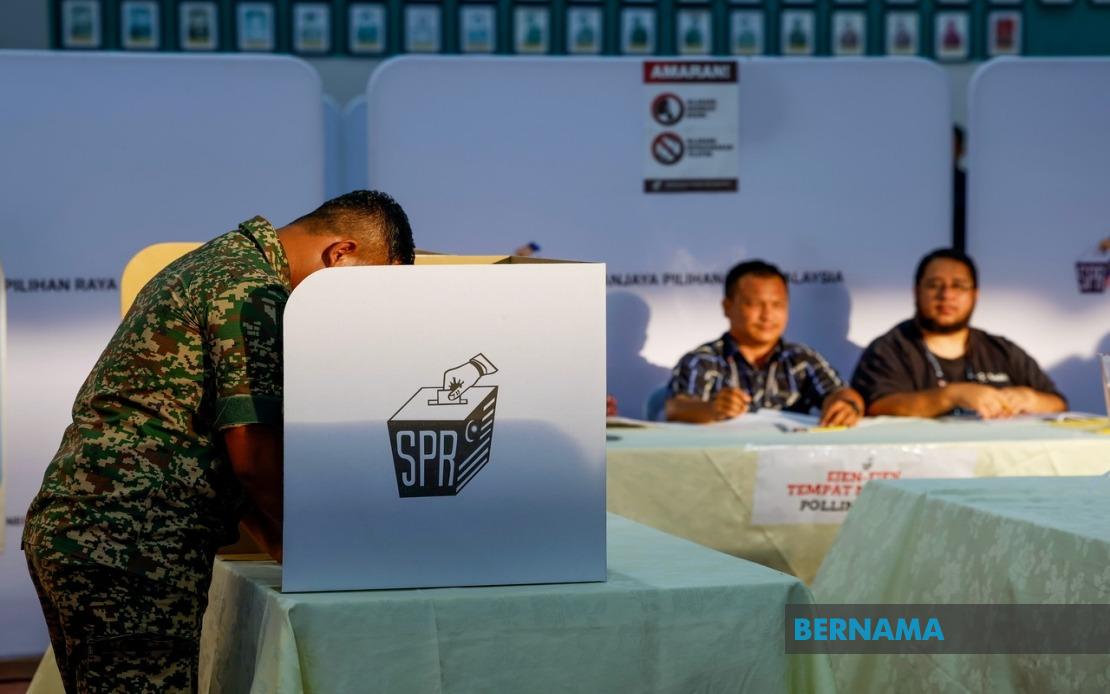
The 16th Negeri Sembilan state election witnessed a healthy early voting response on July 28, with the Election Commission reporting that 14.31 per cent of designated early voters had already cast their ballots by 9 am. The figure underscores strong civic participation among military and police personnel who were afforded the opportunity to vote ahead of the main polling day, a provision that recognises the operational constraints faced by security forces.
The early voters casting ballots comprised 1,431 military personnel and 925 police officers, along with their eligible spouses, according to data released through the Election Commission's official Facebook page. This breakdown reveals a combined turnout of 2,356 individuals out of the 22,389 registered early voters across the state, representing a participation rate that suggests considerable interest in the electoral process among these groups.
Facilities for early voting were made available across 38 polling centres that opened simultaneously at 8 am throughout Negeri Sembilan. The staggered closure schedule, with centres shutting down between noon and 5 pm depending on their location and voter registration numbers, was designed to accommodate the geographic distribution of voters and manage operational workflows efficiently. This logistical arrangement reflects the commission's efforts to balance accessibility with administrative practicality.
The broader context of the Negeri Sembilan election involves a substantial competitive field, with 103 candidates competing for 36 available state assembly seats. The number of candidates relative to seats available indicates a vigorous democratic contest, with multiple parties and independent contenders vying for representation. This level of competition typically generates greater public engagement and encourages higher voter participation rates across all polling phases.
The main general election is scheduled for July 28, with approximately 889,490 registered voters expected to participate across all polling stations throughout the state. This voter register represents a significant portion of Negeri Sembilan's population eligible to influence the state's political direction. The scale of the general election dwarfs the early voting component, though early voting serves a critical function in ensuring that security personnel can fulfil their democratic rights without compromising their operational duties.
For Malaysian readers, the Negeri Sembilan election carries broader implications for the country's political landscape. As one of the smaller states by population, elections in Negeri Sembilan often serve as indicators of voter sentiment and can influence national political momentum. The willingness of military and police personnel to participate early suggests confidence in the electoral process and their commitment to democratic participation despite their service obligations.
The Election Commission's transparent reporting of voting figures through its social media channels demonstrates an institutional commitment to providing real-time updates and maintaining public confidence in the integrity of the electoral process. Such transparency, particularly in the digital age, allows voters to monitor participation rates and follow the progression of elections as they unfold across the state.
The structure of early voting specifically accommodates uniformed services personnel, whose operational requirements might otherwise prevent them from voting during standard polling hours. This provision reflects democratic principles that seek to ensure no eligible citizen is disenfranchised due to their professional duties. The participation of spouses alongside military and police personnel further broadens the scope of early voting access.
As the state election progresses toward the main polling day, the early voting figures provide a foundation for understanding overall participation patterns. If the 14.31 per cent early voting rate is representative of broader voter engagement, the general election on July 28 could potentially draw substantial numbers to the polls. Higher turnout figures often correlate with electoral legitimacy and mandate strength for the eventual winners.
The competition involving 103 candidates for 36 seats means that many electoral contests will be closely fought, potentially with narrow margins determining outcomes in several constituencies. In such scenarios, overall voter turnout becomes even more consequential, as increased participation can shift results by introducing different demographic voting patterns. The early performance in Negeri Sembilan's early voting phase may therefore prove strategically significant for understanding which electoral segments are most engaged in this particular contest.

