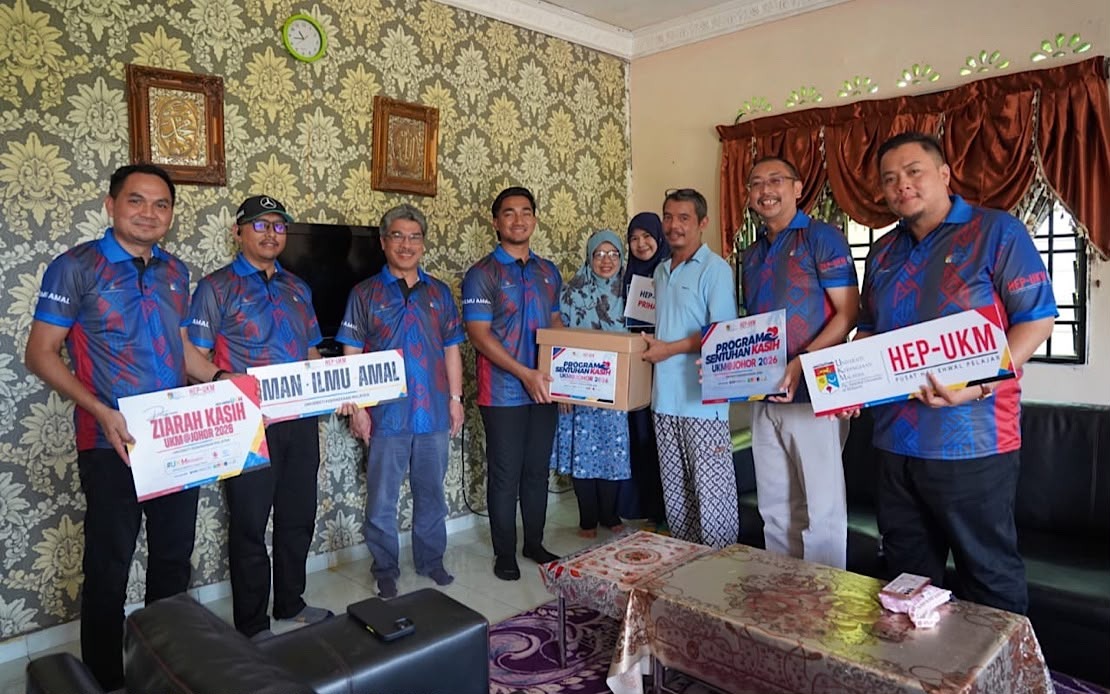
Universiti Kebangsaan Malaysia (UKM) has deepened its community engagement footprint in Johor through an ambitious outreach initiative that brought together nearly 1,000 residents across multiple districts. The Sentuhan Kasih UKM@Johor programme, executed last weekend in four separate locations throughout the state, represents part of a broader institutional strategy to bridge the gap between academic institutions and the neighbourhoods they serve. The exercise involved 78 members of the UKM community, including students and staff, working alongside residents in Kota Masai, Pasir Gudang, Kampung Baru Sri Aman and Taman Jaringan in Skudai to deliver a range of practical support services and social activities.
The programme operated under the banner "Dari Kampus ke Komuniti, Menyebar Kasih dan Bakti"—a framing that reflects UKM's philosophy of extending university resources and expertise beyond institutional boundaries. Rather than functioning as a one-off charitable gesture, the initiative encompassed diverse activities tailored to community needs, including environmental clean-up drives organised on a gotong-royong basis, compassionate home visitation programmes, mental health assessments conducted by university medical and counselling staff, and recreational sporting activities that encouraged neighbourhood participation across age groups. The breadth of the intervention signals an understanding that university outreach must address multiple dimensions of community wellbeing simultaneously.
Associate Professor Dr Darfizzi Derawi, director of UKM's Student Affairs Centre and programme chairman, articulated a pedagogical rationale underlying these activities. Beyond merely serving communities, student participation in structured outreach cultivates capabilities that classroom instruction struggles to develop—particularly adaptability, interpersonal communication and the practical soft skills increasingly demanded by employers across sectors. His statement that universities risk institutional irrelevance if they remain confined to campus grounds reflects a growing consensus within Malaysian higher education that meaningful social contribution strengthens institutional legitimacy and graduate employability simultaneously. This perspective aligns with sector-wide pressure to demonstrate social impact as a key performance indicator.
The geographical distribution of activities across four distinct Johor locations—industrial zones, established residential areas and newer suburban developments—reveals deliberate targeting of neighbourhoods where university presence might otherwise prove minimal. Kota Masai and Pasir Gudang function as working-class residential areas serving the industrial clusters that dominate eastern Johor's economy, while Skudai hosts growing middle-class settlements. This geographic strategy ensures that diverse socioeconomic cohorts benefit from UKM's capacities, rather than concentrating effort in already-privileged areas where institutional engagement proves easier to mobilise.
Community reception proved notably receptive despite practical obstacles. Herman Ismadi Ismail, identified as community leader for Kota Delima Zone, acknowledged that approximately eighty percent of local residents work in industrial employment and maintain demanding weekend schedules, yet reported strong turnout and collaborative spirit. His observation that residents valued exposure to UKM's institutional offerings and scholarship opportunities highlights how targeted outreach can simultaneously serve communities materially while enhancing university visibility among populations that might otherwise lack familiarity with higher education pathways. For economically constrained households, such direct contact with universities can prove transformative in raising awareness of educational mobility possibilities.
Beyond the main outreach events, UKM extended welfare support to student families residing in Johor's Tiram and Puteri Wangsa areas through dedicated home visitation programmes. This dimension reveals that the institution's community engagement extends to supporting its own enrolled students who maintain family connections within the state—an acknowledgment that student welfare encompasses not just campus-based provisions but recognition of broader familial contexts. Such holistic support architecture acknowledges that many Malaysian undergraduates juggle academic demands while contributing to household economies or managing family responsibilities, particularly in states outside Kuala Lumpur.
UKM Vice-Chancellor Professor Datuk Dr Sufian Jusoh positioned the programme within the institution's broader mission around graduate formation. His framing emphasises that university education encompasses development of character and civic consciousness alongside academic excellence—a formulation that counters the instrumental reduction of universities to credentialing machines. Specifically, he identified compassion, collective responsibility and social consciousness as essential dimensions of the graduate development agenda, arguing that investments in student welfare represent long-term human capital cultivation rather than merely discretionary charitable activity. This philosophical articulation carries particular weight in Malaysian contexts where tertiary education increasingly faces scrutiny regarding its relevance to national development objectives.
The initiative's expansion trajectory warrants attention for regional implications. UKM's commitment to systematically extending Sentuhan Kasih activities to additional states signals institutional intent to establish outreach as a permanent rather than episodic institutional function. For a research-intensive national university, such systematic community engagement requires structural commitments—dedicated funding, staff coordination, student training and evaluation mechanisms—that transform outreach from goodwill gestures into institutionalised practice. This approach contrasts with universities that treat community service as peripheral to core teaching and research missions, instead positioning engagement as constitutive of institutional identity.
Higher Education Minister Datuk Seri Dr Zambry Abd Kadir's attendance at the programme affirms ministerial recognition that university-community engagement aligns with policy priorities around graduate relevance and institutional accountability. Government visibility at such events signals ministerial endorsement of the outreach model while providing opportunity to reinforce expectations that publicly-funded institutions discharge social responsibilities. The participation also facilitates knowledge transfer between university leadership and government about implementation models that might be adapted across the sector, contributing to gradual standardisation of community engagement expectations across Malaysia's tertiary education landscape.
For Malaysian readers, the significance extends beyond immediate community benefits in four Johor locations. The Sentuhan Kasih programme exemplifies how universities might activate their human and material resources to address localised needs while simultaneously enhancing student preparation for roles as engaged citizens and socially-conscious professionals. As Malaysia navigates economic transitions and social fragmentation, institutions that cultivate graduate cohorts experienced in direct community interaction and equipped with practical problem-solving capabilities serve broader national resilience objectives. UKM's model invites examination by peer institutions regarding how outreach might become institutionalised rather than sporadic, and how student development objectives might integrate service learning with academic curricula.

