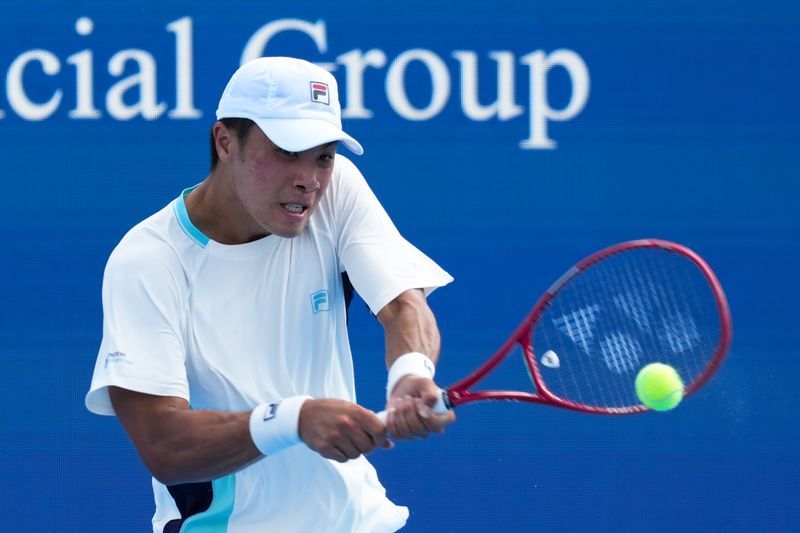
Brandon Nakashima continues his breakthrough campaign on North American hard courts, advancing to the Cincinnati Open semifinals on Friday after a dramatic comeback victory over sixth-seeded American Taylor Fritz. The 25-year-old mounted a decisive third-set charge to claim a 7-6(9) 4-6 6-3 win, with Fritz's mounting errors proving costly in the closing stages. The result marks another significant milestone for Nakashima, who arrived in Cincinnati with considerable momentum following his recent appearance in the Montreal Masters final four.
The Cincinnati triumph now gives Nakashima consecutive Masters 1000 semifinals, a feat that underscores his emerging status among the sport's rising American talents. Coming into this week, he held a disadvantageous 1-4 record against Fritz, making this comeback victory particularly meaningful in their head-to-head rivalry. As the 27th seed, Nakashima has gradually climbed the ATP rankings through consistent performances at the tour's highest tier of events, and his capacity to overcome stronger opponents demonstrates his growing mental resilience under pressure.
The opening set epitomized the tight margins that characterize modern men's tennis at this level. Both Nakashima and Fritz showcased superior serving ability, with neither player conceding a break of serve across the standard games. The intense competition carried into the tiebreak, where neither player yielded easily. After a back-and-forth struggle featuring multiple lead changes and mini-breaks, Nakashima finally capitalized on his fifth set point opportunity when Fritz sent a return long, securing the opener and establishing early psychological advantage.
Fritz responded with conviction in the second set, demonstrating the aggressive returning patterns that have defined his recent rise in ranking. The American broke Nakashima's serve early in the set and subsequently held his own serve with an ace to force the match into a decisive third set. This resurgence suggested Fritz, despite his seeding disadvantage against Nakashima, remained a formidable opponent capable of executing the specific tactical adjustments needed to combat his opponent's game.
The decider proved pivotal, with momentum swinging dramatically several times. Fritz initially gained ascendancy by converting an early break opportunity, moving to 3-2 and positioning himself to potentially close out the match. However, Nakashima's response was immediate and impressive. Facing 30-0 down, he recovered composure to engineer his second break point conversion of the afternoon, leveling the set at 3-3 and demonstrating the kind of clutch resilience that separates players capable of reaching the sport's higher echelons from those who plateau at mid-ranking levels.
Once that critical juncture passed, the momentum decisively shifted toward Nakashima. The 25-year-old seized the initiative and claimed the final three games of the match, exploiting an increasing number of unforced errors from Fritz as the American's confidence eroded. Nakashima's ability to maintain composure while capitalizing on his opponent's mistakes illustrated the maturation evident in his recent performances. The victory extended his career-best run and contributed to an impressive statistic: four top-10 victories achieved during the current season, a remarkable achievement for a player still establishing himself among the sport's elite.
Nakashima's performance carries particular significance given the proximity of the U.S. Open, scheduled to commence later this month. Hard-court tennis represents his preferred surface, and the successful consecutive Masters 1000 runs through Montreal and Cincinnati provide substantial confidence heading into the year's final Grand Slam tournament. For American tennis followers, his emergence as a consistent performer at prestigious events offers encouraging signs of domestic depth in the men's game, particularly at a time when American representation at elite levels has become increasingly vital to the sport's commercial and competitive landscape.
The semifinals matchup awaits clarification pending the outcome of Fritz's next opponent. Nakashima will face either tenth-seeded Italian Lorenzo Musetti or fellow American Frances Tiafoe in the next round. Both represent intriguing challenges—Musetti brings European clay-court credentials that sometimes translate effectively to hard courts, while Tiafoe would represent a battle between two American players seeking distinction in the same era. Regardless of opponent, Nakashima enters the semifinal as the clear favorite given his current trajectory and the decisive manner in which he disposed of Fritz.
The broader narrative surrounding Nakashima's ascent reflects the evolving American tennis landscape, where younger players increasingly combine physical prowess with strategic sophistication previously associated with European opponents. His consistent performances at Masters 1000 level suggest the United States maintains a substantial pipeline of talent capable of competing with the world's elite. For Southeast Asian tennis enthusiasts monitoring the sport's global development, Nakashima's emergence adds another dimension to the increasingly competitive and unpredictable nature of professional tennis in the current era.

