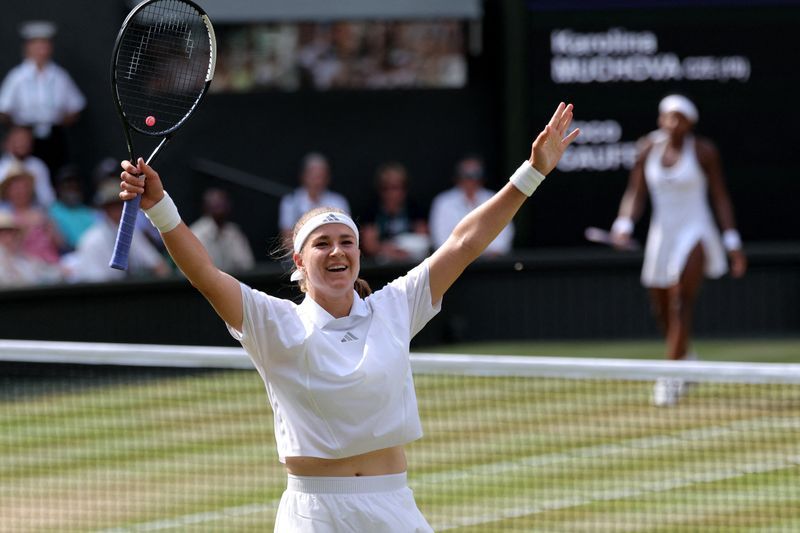
Karolina Muchova has pulled off one of the tournament's most dramatic upsets, surviving a match point to defeat American seventh seed Coco Gauff 6-2 1-6 7-6 (12-10) and advance to her first Wimbledon final. The Czech player's victory on Centre Court on Saturday came after a tension-filled tiebreak in the decider, clinching her berth in the championship match with a nerve-wracking finish that saw Gauff's forehand disappear into the net.
Muchova's triumph opens the tantalising possibility of tennis history being made on Saturday when the final trophy is awarded. Should her compatriot Linda Noskova overcome Ukrainian Marta Kostyuk in Thursday's second semi-final, the sport would witness its first all-Czech final at Wimbledon. This achievement would mark the third successive year that a Czech player has claimed the Venus Rosewater Dish, following Marketa Vondrousova's 2023 victory and Barbora Krejcikova's triumph in 2024, an extraordinary run of dominance by the Eastern European nation on grass's most hallowed stage.
What makes Muchova's performance particularly remarkable is the adversity she must overcome simply to compete at the All England Club. The 10th-seeded player suffers from a grass allergy that requires intensive pharmaceutical management—she depends on a cocktail of pills, sprays, and eyedrops merely to step onto the turf without severe discomfort. Despite this physical handicap, Muchova displayed masterful court craft throughout the encounter, showcasing the tactical intelligence that has defined her grass-court evolution.
The opening set unfolded in Muchova's favour as she dictated play with clinical efficiency. Breaking Gauff's service in the third and fifth games, the Czech player imposed her game through a mixture of precision and aggressive baseline striking. Muchova sealed the 6-2 first set in convincing fashion with an ace clocked at 111 mph, sending a clear message that she had come to compete at the highest intensity despite the sweltering conditions that made Centre Court feel like an oven.
Gauff, however, demonstrated the competitive fire that has characterised her career throughout this tournament. The American has made a habit of embracing danger during this Wimbledon fortnight, surviving four consecutive three-set matches to reach the semi-final stage. True to form, she refused to surrender meekly when facing elimination and instead mounted a remarkable comeback. After struggling to capitalise on her first eight break-point opportunities, Gauff finally converted on her ninth to seize a 3-1 advantage in the second set, a breakthrough her mother celebrated enthusiastically from the player's box.
Gauff's resurgence accelerated dramatically as she broke Muchova again for a commanding 5-1 lead, levelling the match with a dominant 6-1 second set. The American's ball-striking during this phase was virtually flawless, featuring the kind of thunderous forehands and textured backhands that have made her one of tennis's rising superstars. The momentum appeared decisively in her favour entering the decider, raising expectations that she would extend this encounter to its natural conclusion.
The third set evolved into a chess match between two players determined to impose their will. Both competitors unleashed their most devastating weapons, trading blows with ferocious intensity that kept the crowd on edge. The set reached a critical juncture when Gauff secured two break opportunities that would have delivered a 5-4 lead, but Muchova's composure under pressure proved decisive. The Czech player successfully defended against both threats, demonstrating the mental resilience necessary to survive in high-stakes competition.
With momentum swinging back in her favour, Muchova seized control of the match tiebreak with a display of shot-making brilliance. She produced an audacious diving volley that left spectators gasping, followed by a perfectly executed lob that caught Gauff stranded at the baseline. These exceptional shots yielded her first match point opportunity, though Gauff managed to recover that critical juncture. However, Muchova would not be denied a second time. When Gauff's forehand landed in the net at 12-10 in the tiebreak, the 2 hour 35 minute thriller concluded with Muchova's arms raised in celebration, her first Wimbledon final secured.
Muchova's achievement represents a significant milestone in her career, marking her breakthrough moment at the sport's most prestigious grass-court championship. For Malaysian and Southeast Asian tennis enthusiasts, her victory underscores the global nature of elite competition and how players from unexpected quarters can emerge as serious contenders at major tournaments. The narrative of a player competing through physical constraints to achieve their career-defining success resonates deeply in a region where perseverance is culturally valued.
The potential Czech final would provide Asian audiences with an intriguing matchup between two players who have demonstrated exceptional skill and determination. Should Noskova advance, Malaysian viewers would witness a rare Grand Slam final featuring two players from the same nation competing for the most prestigious prize in women's tennis. This outcome would further cement the Czech Republic's status as a tennis powerhouse, a relatively small nation that continues to produce world-class competitors with remarkable consistency across multiple generations.

