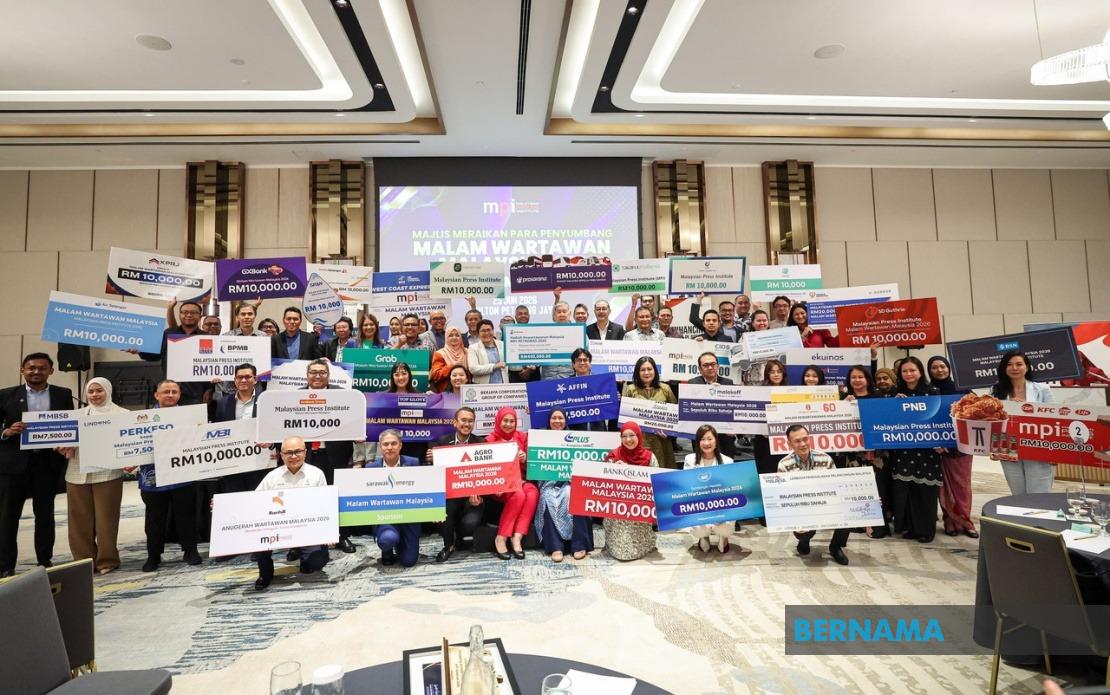
The Malaysian Press Institute has successfully mobilised RM1.037 million in financial backing for Malaysia Press Night 2026, an event designed to celebrate and honour the contributions of media professionals across the country. The funding will support the gathering, which marks another milestone in MPI's long-standing tradition of recognising journalism excellence and advancing the media industry's professional standards.
The contributions take two distinct forms, reflecting broad-based support from multiple quarters. A total of RM587,000 has come from 60 different organisations, demonstrating widespread commitment to the initiative among Malaysia's business and institutional community. Complementing this is RM450,000 in sponsorship from PETRONAS, the national oil corporation that has maintained a consistent partnership with MPI for three decades. This longstanding relationship between PETRONAS and the journalism awards programme stretches back to 1994, underscoring the private sector's role in sustaining media development initiatives.
Dr Ainol Amriz Ismail, who serves as chief executive officer of MPI, highlighted the deeper significance of this financial commitment during his remarks at the Contributors' Appreciation Ceremony held in Kuala Lumpur. Rather than viewing the sponsorships and contributions as mere logistical support, he positioned them as manifestations of a shared vision among Malaysia's corporate and institutional leaders. The funding, he explained, reflects a collective determination to bolster journalism that adheres to professional standards, maintains ethical conduct, and earns public trust—qualities increasingly vital in today's information environment where misinformation and disinformation pose significant challenges to democratic discourse.
The event itself has acquired heightened prominence this year through the confirmed attendance of Prime Minister Datuk Seri Anwar Ibrahim on July 17. The Prime Minister's participation signals government recognition of journalism's role in national development and represents an official endorsement of the media profession's contribution to Malaysia's broader social and economic objectives. This level of political attention typically amplifies the significance of industry awards and recognition programmes, offering participating journalists and news organisations visibility at the highest levels of government.
MPI's leadership team has actively championed the event and solicited support. The institute's president Datuk Yong Soo Heong and deputy president Farrah Naz Abd Karim were present at the appreciation ceremony, alongside Datin Paduka Nur-ul Afida Kamaludin, who holds dual roles as an MPI governing council member and chief executive officer of Bernama, Malaysia's national news agency. This intersection of institutional leadership reflects how journalism development in Malaysia operates through interconnected networks of professional bodies, government agencies, and commercial entities. PETRONAS's involvement further emphasises private sector participation in supporting media infrastructure.
MPI's framing of Malaysia Press Night as recognition for practitioners who undertake the demanding work of information gathering and verification carries particular relevance in contemporary Malaysia. The institute describes the event as honouring journalists who devote themselves to fact-checking, cross-referencing sources, and delivering accurate reports—fundamentals sometimes challenged in rapid-news cycles and social media environments. By explicitly celebrating these methodological commitments, MPI reinforces the distinction between professional journalism and other forms of information dissemination, reinforcing professional identity during periods when trust in media institutions faces pressure globally and regionally.
The appreciation ceremony also functioned as a platform for broader industry dialogue through a discussion panel featuring prominent figures from Malaysia's media landscape. Datuk A. Kadir Jasin, a Malaysian Journalism Icon, participated alongside representatives from major media organisations including Karangkraf Group chief executive officer Firdaus Hussamuddin, TV AlHijrah chief executive officer Namanzee Harris, and Vanakkam Malaysia editor-in-chief Thiaga Rajan Muthusamy. These panellists represent different segments of Malaysia's diverse media ecosystem—print, broadcast, and community-focused publications—suggesting that MPI's initiatives seek to encompass the full range of journalism practice across language groups and audience communities. The inclusion of varied media perspectives underscores how press development requires engagement across traditionally segmented sectors.
MPI's broader mission extends beyond the annual awards ceremony itself. The institute has framed its work around implementing professional development programmes, industry training, and other capacity-building initiatives that benefit Malaysia's media community. This operational focus indicates that journalism development is understood as a long-term undertaking requiring sustained investment in human capital and institutional practices rather than periodic recognition events alone. For Malaysian readers and media professionals, this suggests a committed institutional actor working to elevate standards across the industry.
The successful fundraising for Malaysia Press Night 2026 carries implications for Malaysia's media landscape as it navigates significant challenges and transitions. Regional developments, including digital transformation, evolving audience consumption patterns, and competition from social media platforms, have reshaped journalism business models across Southeast Asia. Within this context, institutional support for journalism through awards and recognition programmes serves multiple functions: it maintains professional morale, sets quality benchmarks, and demonstrates that sectors beyond media themselves value accurate reporting and ethical practice. For Malaysia specifically, the private and public sector participation reflected in the fundraising totals suggests acknowledgment that media stability constitutes a public good worthy of deliberate investment.

