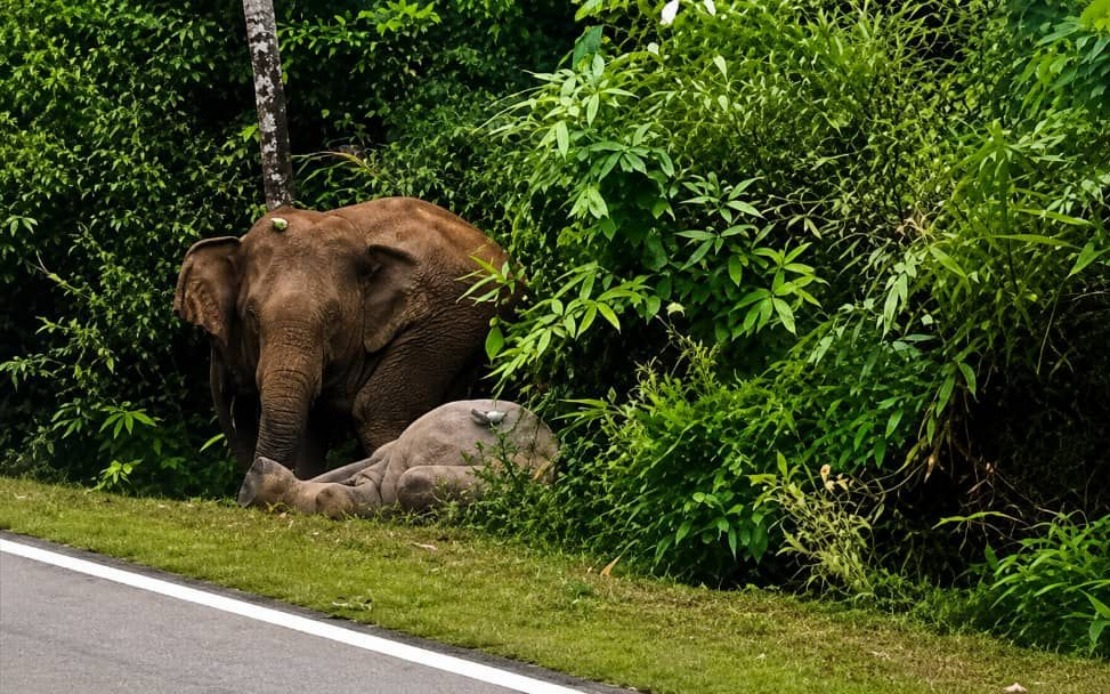
The morning of July 1 brought tragic reminders of Malaysia's ongoing human-elephant conflict when a young elephant calf was fatally struck by a vehicle along Jalan Felda Nitar in Mersing, Johor. What made the incident particularly haunting was the mother elephant's steadfast refusal to abandon her dead offspring, remaining at the roadside for seven hours in a scene that many observers found deeply distressing. The incident, captured in viral social media videos, drew immediate comparisons to the Gerik tragedy that unfolded on Mother's Day the previous year, which similarly captured the nation's heart and reignited debate over the escalating tension between wildlife conservation and human encroachment into elephant habitats.
The fatal collision occurred at approximately 2.28 am when a Perodua Bezza struck the five-year-old female calf, killing the animal instantly. According to the Johor Department of Wildlife and National Parks (Perhilitan), the young elephant measured roughly 150 centimetres in body length, with a front footprint width of 11 inches and rear footprint width of 14 centimetres. The animal bore no tusks, identifying it definitively as a young female. Despite the early morning hour and darkness that typically characterises the road, the mother elephant remained steadfastly beside her dead calf, unwilling or perhaps unable to comprehend the loss or leave her offspring unattended.
Perhilitan received formal notification of the incident at approximately 8.30 am, some six hours after the initial collision. Four department personnel were promptly dispatched to the scene to assess the situation and conduct preliminary investigations. Upon arrival, officers confirmed that the deceased elephant belonged to the Jamaluang-Mersing identification group, one of several herds in the region. The presence of an adult elephant at the scene was quickly established as the mother, whose protective instincts kept her vigil despite the dangerous roadside location and ongoing human activity around her dead calf.
The human cost of the collision cannot be overlooked. The driver of the Perodua Bezza, a 31-year-old man, experienced a more immediate and severe consequence when his vehicle plunged into a five-metre-deep ravine following the impact with the elephant. The Fire and Rescue Department reported that he became trapped inside the wreckage and sustained significant leg injuries requiring rescue operations. This aspect underscores the reality that human-elephant conflicts exact tolls on both species, creating casualties that extend beyond wildlife conservation statistics into the lived experience of ordinary Malaysians.
The response from local authorities demonstrated established protocols for such incidents. Beyond Perhilitan's personnel, the Elephant Capture Unit from the Johor Elephant Sanctuary was mobilised to assist in the critical task of coaxing the grieving mother elephant back into the forest. After approximately seven hours of standoff, officers successfully drove the mother away from the roadside location. The calf's carcass was subsequently buried at a site near the accident location, an approach intended to minimise the risk of the mother attempting to return to the location or entering the road again searching for her offspring.
Following the operation, Perhilitan announced plans for enhanced patrols throughout the evening and the following day, recognising the heightened risk that an emotionally distressed mother elephant might attempt to return to the accident site or pose unexpected dangers to motorists. The area is characterised by low visibility at night and serves as an established elephant crossing zone, creating inherently hazardous conditions where human traffic intersects with wildlife movement. Warning signage alerting drivers to the possibility of elephants crossing the roadway had previously been installed, though such measures have proven inadequate to prevent collisions or reduce their severity.
The incident inevitably invoked memories of the Gerik tragedy that unfolded on Mother's Day in Perak the previous year. In that incident, a younger elephant became trapped beneath a container lorry after impact, prompting the mother elephant to visibly attempt pushing the vehicle in what appeared to be an effort to rescue her trapped calf. Captured on video and widely circulated across social media platforms, the Gerik incident transcended typical wildlife news to become a visceral national moment, sparking unprecedented public discourse about human-elephant coexistence and the rights of wild animals. The recurring nature of such tragedies suggests systemic failures in wildlife management and road safety protocols.
The broader context of human-elephant conflict in Malaysia reflects a region grappling with fundamental questions about development, conservation, and species survival. As human populations expand and road networks proliferate through traditional elephant habitats, such incidents become increasingly predictable. The elephants traversing routes like Jalan Felda Nitar are not unusual wanderers but residents displaced by agricultural expansion, plantation development, and rural infrastructure projects. The herd designation as Jamaluang-Mersing ID group indicates these animals maintain established territorial ranges that now intersect catastrophically with human transportation corridors.
For Malaysian readers and policymakers, these recurring tragedies represent more than sympathetic wildlife stories. They signify underlying failures in regional planning that pit economic development against ecological sustainability. The installation of warning signs, while symbolically important, addresses only the symptom rather than the disease. Genuine solutions would require more comprehensive measures including wildlife crossing infrastructure, speed restrictions in identified crossing zones during peak animal movement periods, and habitat preservation efforts that reduce pressure on elephant populations to venture into dangerous areas searching for food and resources.
The mother elephant's seven-hour vigil, captured in viral videos and discussed across Malaysian social media, reveals something profound about animal cognition and emotion that resonates with human experience. Unlike abstract conservation statistics, the image of a grieving mother refusing to abandon her dead offspring creates emotional bridges between species, generating public empathy that raw data cannot match. This emotional connection represents the most powerful potential driver for genuine policy change, transforming wildlife incidents from isolated tragedies into catalysts for systemic reform.
As Perhilitan continues monitoring the bereaved mother elephant's movements and psychological recovery, the incident serves as yet another warning that Malaysia's current approach to managing human-elephant coexistence remains fundamentally inadequate. The next such tragedy seems not a question of if but when, unless significant institutional and infrastructural changes materialise. The mother elephant's loss becomes a mirror reflecting Malaysian society's broader failure to create sustainable pathways forward where both economic progress and wildlife survival can flourish.

