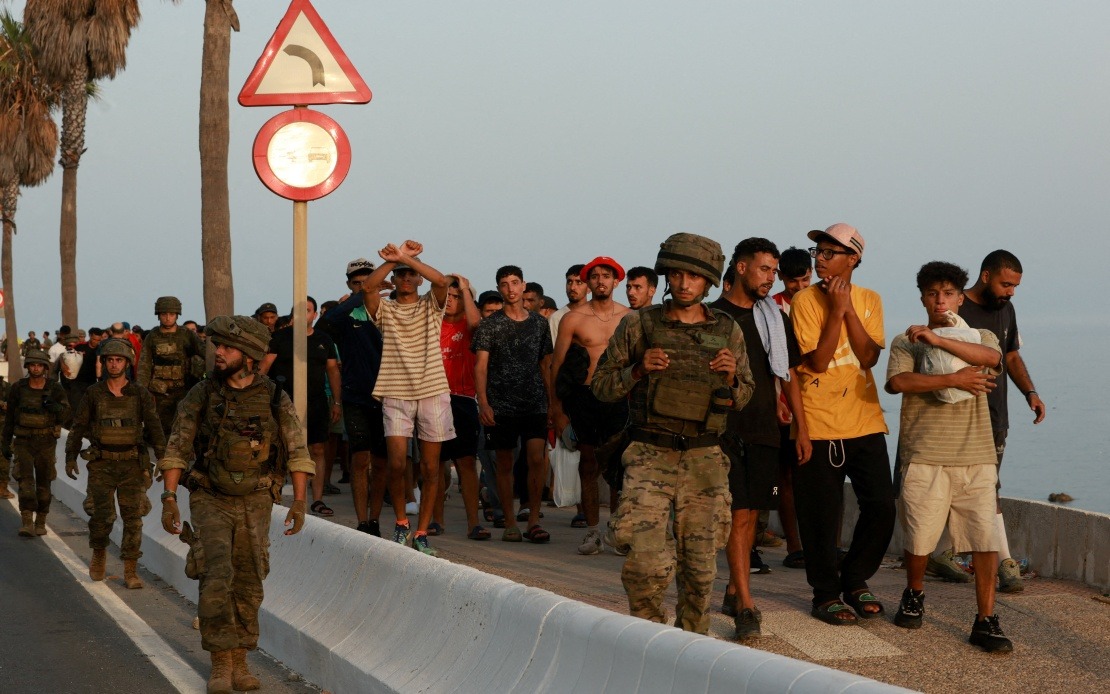
Morocco's Interior Ministry has pointed to social media misinformation and criminal trafficking operations as the primary drivers behind the unprecedented surge of migrants attempting to reach the Spanish enclave of Ceuta, a territorial dispute that has exposed the region's fragile security dynamics and exposed deep rifts in how both countries assess the humanitarian emergency unfolding at their shared border.
According to Moroccan officials, false claims circulating across social media platforms convinced migrants that a recent Spanish court ruling would allow them to enter European territory without facing immediate deportation. This narrative, amplified across WhatsApp groups, Facebook pages, and other messaging applications popular in West African communities, created a false sense of opportunity that emboldened thousands to attempt the dangerous sea crossing. The ministry's assessment suggests that trafficking syndicates deliberately exploited these misconceptions to fill boats and lorries, regardless of migrants' actual chances of remaining in Spain or Europe.
The scale of the migration event itself remains contested between the two governments. Spanish officials estimate that between 50,000 and 60,000 migrants entered Ceuta within a remarkably short timeframe of only several days, overwhelming the territory's capacity to process and accommodate newcomers. For context, Ceuta has a pre-existing population of approximately 85,000 residents, meaning the incoming migration flow temporarily increased the territory's population by more than half its normal size. Morocco's government offers a lower figure, claiming approximately 40,000 people successfully crossed into Ceuta, with an additional 1,135 attempting to reach the nearby enclave of Melilla.
The divergence in casualty figures between the two nations underscores the broader diplomatic tensions surrounding the crisis. Moroccan authorities reported that 11 people died during crossing attempts, yet Spanish sources documented at least 72 deaths, a stark difference that reflects either vastly different access to information or fundamentally different methodologies for counting fatalities. Such discrepancies complicate international humanitarian responses and prevent a clear understanding of the actual human cost of migration attempts across the Strait of Gibraltar, one of the world's most dangerous maritime crossings.
Morocco's claim regarding Melilla, where it asserted that all migrants were immediately returned, contrasts sharply with the situation in Ceuta, suggesting that coordinated border responses differ markedly across Spanish territories. This inconsistency raises questions about whether Spain's capacity to manage mass migration events varies significantly by location, or whether Morocco itself exercises differential enforcement depending on which Spanish enclave migrants target. The strategic implications matter considerably for Southeast Asian observers, as similar border management challenges emerge across ASEAN nations where irregular migration, human trafficking, and maritime crossings create recurring humanitarian emergencies.
The reference to a Spanish court ruling introduces a crucial legal dimension often overlooked in migration coverage. Spanish judicial decisions regarding asylum rights, refugee status, and the treatment of undocumented migrants carry substantial weight, yet their interpretation by ordinary migrants—particularly those in remote areas with limited access to authoritative legal information—frequently diverges from official intent. When migrants misunderstand or are deliberately misled about their legal standing, they become susceptible to exploitation by trafficking networks seeking to monetise their desperation.
Human traffickers' role in orchestrating the mass crossing cannot be separated from deeper economic realities affecting West Africa. Networks operating across Senegal, Mali, Mauritania, and Guinea profit handsomely from transporting migrants, charging substantial fees that can exceed monthly earnings in origin countries. These criminal organisations possess sophisticated understanding of border security gaps, seasonal weather patterns, coastal conditions, and law enforcement routines. Their investment in spreading misinformation through social media represents a relatively low-cost method to generate demand for their services, since each migrant transported generates revenue regardless of eventual outcomes.
For Malaysian readers, the Ceuta situation carries instructive parallels to Southeast Asia's own migration challenges. The region hosts millions of migrant workers and irregular migrants seeking economic opportunity in Thailand, Malaysia, Singapore, and Brunei. Similar dynamics of misinformation, trafficking networks, and disputed casualty figures characterise maritime migration across the Andaman Sea and Bay of Bengal. The mechanisms by which false information spreads—particularly through encrypted messaging platforms and social media groups—replicate patterns observed in North Africa, suggesting that digital literacy and targeted counter-misinformation campaigns should feature more prominently in regional migration management strategies.
Moroccan authorities indicated they would continue coordinating with Spanish counterparts to verify additional deaths and establish identities and nationalities of those involved in the crossing attempt. This commitment to posthumous documentation, while administratively important, cannot address the underlying governance failures that permitted the crisis to escalate so dramatically. Both nations face pressure to examine their border management systems, intelligence gathering capabilities, and capacity to counter human trafficking networks operating within their territories.
The dispute over casualty figures and migrant numbers reflects broader patterns in international migration crises, where different actors operating from different vantage points collect incompatible data. Spanish authorities documenting deaths may have access to hospital records, coroner reports, and rescue operation accounts. Moroccan officials, operating from a territory migrants are leaving, encounter different subsets of evidence. Neither government may be deliberately falsifying figures; rather, their different positions in the migration process yield legitimately different information. Yet the ambiguity serves neither humanitarian purposes nor rational policy-making.
Looking forward, the misinformation angle offers governments a potentially productive focus for preventive action. If false information about legal entry prospects genuinely motivates dangerous crossing attempts, then accurate public messaging in origin communities could theoretically reduce both migration pressure and trafficking demand. However, such messaging campaigns require substantial resources, cultural competence, and coordination between origin and destination countries—coordination that remains elusive in North Africa and equally challenging across Southeast Asia.
The Ceuta crisis ultimately exposes how migration pressures, information ecosystems, human trafficking networks, and legal frameworks interact in ways that traditional border security approaches struggle to address. Morocco's emphasis on misinformation and trafficking, while partially deflecting responsibility for border management failures, identifies genuine factors that policy-makers across the Mediterranean and Southeast Asia cannot ignore when designing comprehensive migration strategies that balance humanitarian concerns with national security imperatives.

