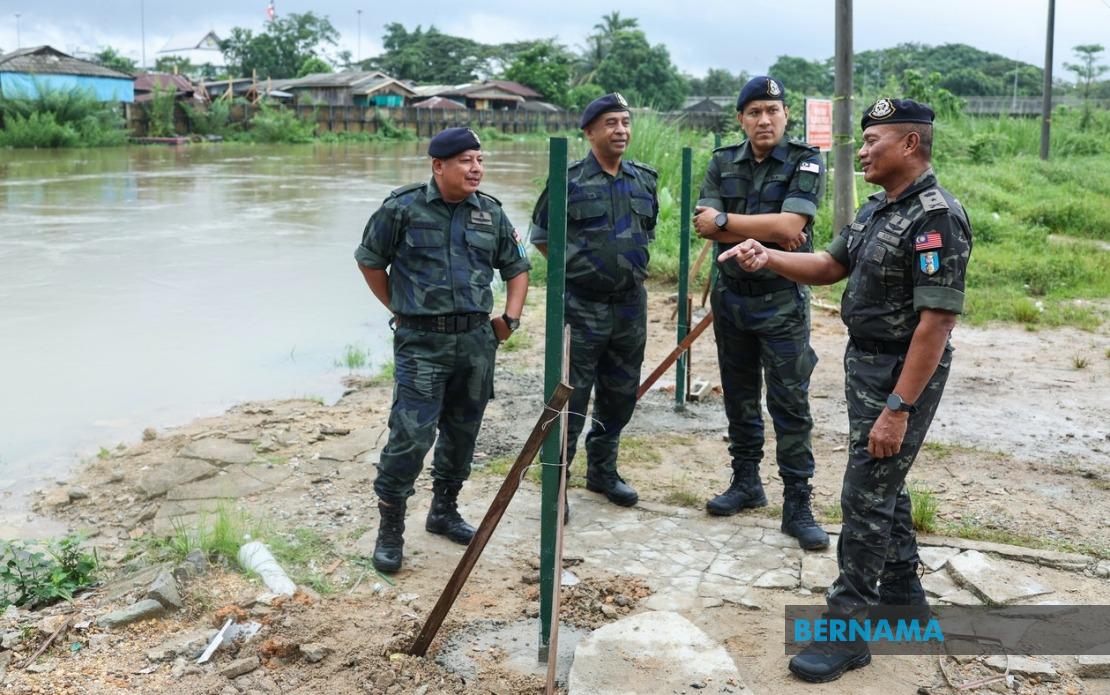
Authorities in Kelantan have uncovered a troubling evolution in migrant trafficking operations, revealing that smuggling syndicates are deliberately fragmenting their movements to reduce the likelihood of apprehension by security forces. The Southeast Brigade of the General Operations Force conducted a series of raids in Pasir Mas district that disrupted what appears to be a coordinated effort to transport undocumented Myanmar nationals through northern Malaysia en route to employment opportunities in the Kuala Lumpur region. This operational shift represents a significant challenge for law enforcement agencies already stretched thin across Malaysia's porous borders, as smaller, dispersed groups are inherently more difficult to detect and interdict than the large convoys that characterised earlier trafficking patterns.
The discovery emerged during Operasi Taring Wawasan Kelantan, when GOF personnel detected suspicious activity in Kampung Banggol Kemian early on the morning of June 27. Acting on intelligence tips, officers spotted a Proton Exora vehicle displaying unusual behaviour in the area. The driver, recognising the presence of uniformed personnel, abandoned the vehicle and fled into nearby forest, ultimately evading capture. The tactical decision to abandon the car and run suggests the driver possessed advance warning systems or spotters positioned along the route—a hallmark of well-organised trafficking networks that maintain communication channels with handlers.
The initial vehicle inspection yielded four Myanmar nationals from the rear seats who could not produce valid travel documentation. Their arrest prompted an expanded search operation into the surrounding forest that resulted in nine additional apprehensions approximately one hour later. These nine individuals were positioned strategically throughout the forest perimeter, suggesting they had been deliberately dispersed upon arrival to create multiple collection points and reduce concentration. All 13 detainees, ranging from 20 to 37 years of age and including five women, were nationals of Myanmar seeking irregular entry into Malaysia.
According to GOF Southeast Brigade commander SAC Ahmad Radzi Hussain, the arrested migrants revealed crucial details about their trafficking journey. They had crossed the Golok River from Thailand under the guidance of two unidentified smugglers who coordinated the entire transport and distribution operation. Rather than crowding migrants into vehicles for single trips, the syndicate operated a staged transport system, dropping off groups sequentially throughout the forest and surrounding areas to minimise exposure to patrols. This methodical approach demonstrates tactical sophistication and reflects lessons learned from previous enforcement operations that successfully disrupted larger convoys.
The migrant cohort indicated they were destined for the Kuala Lumpur region with employment as their stated objective. This destination pattern aligns with Malaysia's established migrant labour economy, where undocumented workers seek positions in construction, manufacturing, domestic service, and informal sectors. The willingness to risk perilous river crossings and forest journeys reflects the significant wage differential between Myanmar and Malaysia, a gap that continues to fuel irregular migration flows throughout Southeast Asia despite intensified border enforcement.
Beyond the human trafficking dimension, authorities seized a Proton Exora valued at approximately RM30,000 that functioned as the primary transport mechanism. Vehicle seizures represent a critical enforcement tool, as replacement costs and insurance implications create financial pressure on trafficking networks. However, the relative affordability of domestic vehicles compared to potential profits from human trafficking suggests the loss of a single vehicle creates minimal disruption to organised syndicates operating multiple routes and backup transportation assets.
The investigation now falls under the purview of the Criminal Investigation Division at Pasir Mas district police headquarters, with all detainees facing charges under Section 6(1)(c) of the Immigration Act 1959/63. This legal framework criminalises the harbouring and transport of undocumented aliens, though prosecutorial challenges persist in establishing complex organisational connections and identifying smuggling masterminds who remain several steps removed from field operations. The two unidentified smugglers who coordinated the actual crossing represent the tier of operators most difficult for law enforcement to apprehend, operating from Thai territory where Malaysian jurisdiction cannot extend.
The evolution toward smaller group movements reflects adaptive behaviour within transnational smuggling networks that continuously reassess enforcement capabilities and adjust tactics accordingly. Malaysian security agencies have achieved notable successes in disrupting large-scale operations, which creates perverse incentives for syndicates to fragment their operations into smaller, lower-profile movements that consume more operational resources to intercept comprehensively. A single large convoy requires one enforcement operation; the same volume distributed across multiple small groups requires proportionally greater surveillance, intelligence gathering, and coordinated raids.
Kelantan and Terengganu's positioning along maritime and overland routes from Thailand creates persistent vulnerability to migrant trafficking operations. The Golok River, forming the international boundary, provides multiple crossing points with limited electronic surveillance and sparse ground presence during night hours when most crossings occur. The porous nature of Malaysia's northern border reflects both geographic realities—dense forested terrain with limited road infrastructure—and resource constraints facing GOF and police units managing vast areas with insufficient personnel and equipment.
The implications of this tactical shift extend beyond Kelantan's security environment to national policy considerations regarding border management and labour regulation. Malaysia's demand for migrant workers, combined with regulatory barriers to formalised recruitment, creates structural conditions encouraging irregular migration. Enforcement operations address the symptom but not the underlying drivers that make irregular entry appear attractive to Myanmar nationals facing economic desperation. Without parallel initiatives addressing root causes through formalised labour channels or economic development in source regions, enforcement operations will remain reactive treatments of a systemic issue.
The syndicate's apparent competence in coordinating cross-border movements, maintaining secure communication, and adapting operational procedures suggests involvement of experienced trafficking operators rather than opportunistic smugglers. This level of sophistication indicates the involvement of transnational criminal networks with operations spanning multiple countries and diversified revenue streams. Disrupting such organisations requires intelligence sharing between Malaysian, Thai, and Myanmar authorities—cooperation that remains inconsistent and fragmented despite bilateral agreements.
Moving forward, enforcement agencies face the challenge of scaling detection capabilities to address dispersed migrant movements while maintaining effectiveness against traditional large-scale operations. Intelligence gathering must become more granular, focusing on identifying the command structure coordinating multiple small groups rather than only disrupting the visible transportation assets. The capture of 13 migrants and one vehicle represents a tactical success but leaves the underlying syndicate intact and likely capable of reconstituting operations within days using alternative routes and personnel.

