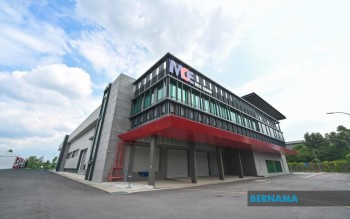
MCE Holdings Bhd has launched an ambitious RM50 million manufacturing facility in Serendah that signals renewed commitment to positioning Malaysia as a centre of excellence for automotive electronics. The MCE Auto Hub, inaugurated by Investment, Trade and Industry Minister Datuk Seri Johari Abdul Ghani at the UMW High Value Manufacturing Park, represents a watershed moment for the country's automotive sector at a critical juncture when regional competition for advanced manufacturing investment has intensified significantly.
The sprawling 5.52-hectare facility anchors the first phase of MCE's broader RM200 million investment roadmap, a scale of commitment that underscores confidence in Malaysia's manufacturing ecosystem despite regional headwinds. This development arrives as Southeast Asian economies vie aggressively for automotive supply chain diversification away from traditional hubs. MCE's expansion will more than double the group's existing production capacity, a tangible indicator of manufacturing momentum at a time when observers debate whether Malaysia can retain competitiveness in high-value automotive segments.
MCE's trajectory from its 1990 origins as a supplier of remote alarms and central locking systems to today's position as a tier-1 automotive electronics manufacturer reflects three decades of incremental capability building. The company now operates across multiple Malaysian locations—Johor Bahru, Port Klang, and the new Serendah hub—while serving customers throughout Malaysia, broader ASEAN markets, and the United States. This geographic and customer diversification reduces exposure to single-market volatility and positions MCE to capitalise on supply chain fragmentation trends reshaping global automotive production.
The Serendah hub exemplifies Industry 4.0 manufacturing philosophy, incorporating clean room production areas and precisely controlled manufacturing environments essential for contemporary automotive electronics. These specifications address dual imperatives: maintaining quality standards for internal combustion engine components while simultaneously developing capabilities for increasingly complex electric vehicle systems. This dual-track technical preparedness matters enormously for Malaysia, which risks obsolescence if tied exclusively to conventional engine technology as global vehicle electrification accelerates.
Workforce expansion accompanying the facility demonstrates faith in Malaysia's engineering talent pool. MCE now employs 680 people across operations, including 90 engineers distributed among its three major locations. This skilled workforce concentration strengthens MCE's capacity to manage sophisticated development programmes simultaneously across both conventional and electric vehicle segments. For Malaysian policymakers, such employment patterns validate investments in technical education and engineering training programmes—tangible evidence that domestic talent can sustain advanced manufacturing operations.
The facility's strategic positioning within Malaysia's broader automotive transformation deserves closer examination. Minister Johari's statement emphasised that the investment reflects confidence in both MCE and Malaysia's future, particularly as local suppliers pursue manufacturing excellence through engineering expertise and innovation. This framing suggests government recognition that sustainable automotive competitiveness depends increasingly on capabilities rather than cost advantages. Malaysia's manufacturing wage profile no longer offers decisive advantage against Southeast Asian competitors, making technological sophistication the differentiator.
MCE managing director Dr Goh Kar Chun articulated an important strategic vision: future automotive leadership in Malaysia will emerge through stronger collaboration among carmakers, tier-1 suppliers, and ecosystem players spanning semiconductors, electrical components, and electronics manufacturers. This ecosystem thinking acknowledges that individual company success depends upon strengthened value chains rather than isolated capability building. For Malaysia, this implies that the Serendah hub's success hinges not merely on MCE's performance but on whether supporting suppliers, research institutions, and technology partners can match the facility's advanced standards.
The emphasis on localisation carries particular significance given regional competition. By strengthening MCE's position as a domestic technology developer and manufacturer, Malaysia potentially captures greater value from its automotive supply chain. Historical patterns show that countries allowing suppliers to concentrate on contract manufacturing—rather than encouraging design and engineering capabilities—eventually lose these industries to lower-cost jurisdictions. MCE's investment in design and engineering capacity suggests recognition that sustainable manufacturing requires moving up value chains.
Electric vehicle readiness represents perhaps the most consequential dimension of this investment. As global automakers transition toward electrified powertrains, opportunities for conventional parts suppliers contracted sharply. Suppliers who successfully adapted to EV requirements—developing expertise in battery management systems, electric motor controls, and high-voltage electrical architecture—maintained growth trajectories. MCE's simultaneous investment in ICE and EV capabilities positions it to serve customers during the automotive industry's historical transition, a capability not all suppliers achieve successfully.
The facility's location within UMW High Value Manufacturing Park reflects broader clustering strategies in Malaysia's automotive sector. Such parks concentrate complementary manufacturers, research institutions, and service providers, creating knowledge spillovers and facilitating supplier networking. This geographic concentration supports the ecosystem collaboration Goh emphasised, enabling rapid information exchange and collaborative problem-solving that isolated facilities cannot achieve. For Malaysian automotive policy, such clustering reinforces value chain density.
Global context matters substantially here. Established automotive electronics manufacturers across Europe, Japan, and increasingly China and South Korea have consolidated market share through continuous capability upgrades and strategic acquisitions. MCE's RM200 million commitment, while significant for a Malaysian company, remains modest compared to multinational electronics suppliers' R&D budgets. This reality suggests MCE must focus intensively on specialised niches—particular vehicle architectures, regional market requirements, or emerging technologies—where smaller suppliers can achieve disproportionate influence.
The investment's alignment with government aspirations toward advanced manufacturing and higher-value activities indicates policy support through complementary incentives and infrastructure development. However, sustained success requires stability beyond government promotion cycles. MCE's long-term visibility into customer demand from Malaysian and regional vehicle manufacturers depends partly on government policies supporting local content requirements and automotive industry strategic planning. Without clear, durable policy frameworks, supplier confidence can fluctuate.
Looking forward, MCE Auto Hub's success will signal whether Malaysian manufacturing can anchor the regional automotive electronics supply chain in an electrified future. The facility addresses critical timing: the window for suppliers to establish EV capabilities before larger competitors consolidate the market remains open but narrowing. MCE's decision to invest now, rather than delay until competitive positions solidified, reflects commercial judgment that Malaysia retains sufficient advantages—engineering talent, established customer relationships, geographic positioning—to succeed in advanced automotive electronics. Whether subsequent phases of the RM200 million investment materialise will reveal whether initial optimism translates into sustained market success.

