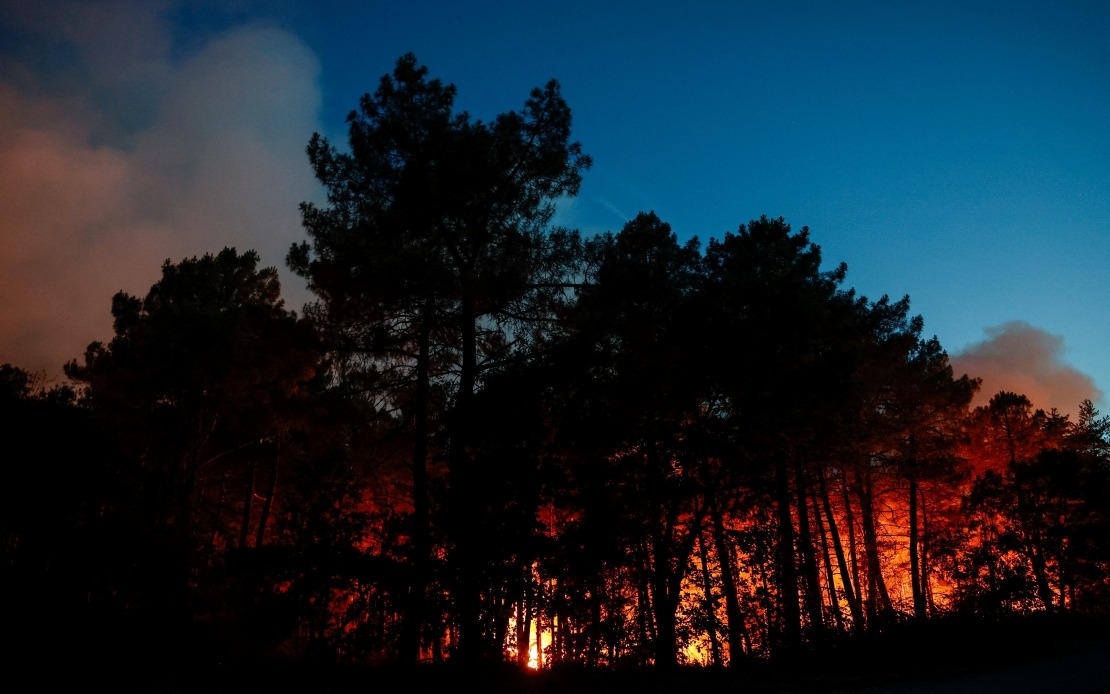
A devastating wildfire tearing through the renowned Fontainebleau forest south of Paris has mobilized one of France's largest firefighting operations in recent memory, with authorities now investigating whether the blaze was deliberately set. The inferno, which ignited late on Sunday near a major motorway, had consumed approximately 800 hectares of woodland by Monday as emergency crews fought to contain the advancing flames that threatened nearby communities.
The scale of the firefighting response underscores the severity of the situation in what is normally a temperate region of northern France. Approximately 400 firefighters have been deployed to battle the blaze, supported by two water-bombing aircraft that continuously ferry supplies from the Seine river to drop on the advancing fire. This aerial support represents a significant commitment of resources, as such aircraft operations are typically reserved for the most critical fire situations across Western Europe's largest continuous forested areas.
Among those investigating the fire's origins is French Interior Minister Laurent Nuñez, who traveled to the scene and suggested that deliberate human action may have triggered the catastrophe. The minister's assessment rested on a crucial piece of evidence: multiple separate fire outbreaks detected within a remarkably confined radius of just 1,000 metres, a pattern that strongly suggests coordinated arson rather than a single accidental ignition. The gendarmerie has formally opened an investigation into the potential criminal act, though details about suspects or motives remained undisclosed as emergency operations continued.
The Fontainebleau forest carries immense historical and ecological significance across Europe. Home to the celebrated Château de Fontainebleau, a former royal residence and architectural masterpiece, the forest represents one of the last great uninterrupted woodland expanses in Western Europe. The loss of 800 hectares represents a substantial blow to this irreplaceable natural heritage, raising concerns about the forest's long-term recovery and the displacement of wildlife inhabiting the region.
Civilian impact has been profound and immediate. Local authorities reported that more than 1,000 residents and visiting tourists have been evacuated from the surrounding area, with some evacuees describing harrowing scenes as flames advanced with terrifying speed. The mayor of Le Vaudoué, a village adjacent to the forest, conveyed the chaos to media outlets, describing what witnesses characterized as a solid wall of flames moving relentlessly toward residential areas. The evacuation operation itself underscores how rapidly the fire's progression threatened inhabited zones, a stark reminder of how destructive uncontrolled wildfires can be even in regions not typically associated with such disasters.
French government officials have characterized the situation as unprecedented in its intensity for northern France. Maud Bregeon, the government's official spokeswoman, described the circumstances as exceptional and confirmed that authorities were mobilizing every available resource to suppress the blaze. Her remarks highlighted a significant historical point: wildfires of this magnitude have been exceptionally rare in the northern regions of France, meaning emergency services and local authorities lacked the routine experience typical of Mediterranean-prone areas in managing such large-scale conflagrations.
The timing of this disaster coincides with France's third major heatwave of the current year, which has created dangerously dry conditions across the nation. High temperatures and depleted moisture levels in vegetation and soil create ideal conditions for rapid fire spread and intensification, transforming what might otherwise be a manageable incident into a cascading emergency. The weather service Météo-France responded to these dangerous conditions by placing 37 departments under its highest-level red heat alert at the beginning of the week, signaling that large portions of the country were experiencing exceptional fire risk.
The broader context reveals a troubling pattern across France. Firefighting crews have simultaneously engaged with multiple blazes erupting in various regions throughout the country, placing enormous strain on the nation's firefighting infrastructure and personnel. This simultaneous outbreak of fires across different locations reflects how effectively the heatwave conditions create widespread vulnerability to ignition and spread, whether from natural causes or deliberate acts.
For Southeast Asian observers, the Fontainebleau incident carries lessons relevant to forest management and disaster preparedness. Although France's climate and vegetation differ substantially from Malaysia and the region, the incident demonstrates how rapidly wildfires can overwhelm even the most well-resourced nations. The coordination required between aerial units, ground crews, and local administration mirrors challenges faced in transboundary haze situations affecting Malaysia, Indonesia, and Singapore. Furthermore, the suspected arson component raises questions about the adequacy of forest access control and surveillance systems—issues equally pertinent to protecting Southeast Asian forest reserves from similar threats.
The investigation into potential arson will likely proceed alongside the immediate firefighting operations, with prosecutors examining evidence of the multiple fire starting points. If deliberate ignition is confirmed, authorities will face questions about how such coordinated criminal activity could occur during a period of heightened alert and expanded emergency presence. The political implications extend to French debates about climate change, land management, and internal security—topics with parallels across Europe and globally as nations grapple with intensifying natural hazards and evolving security threats.

