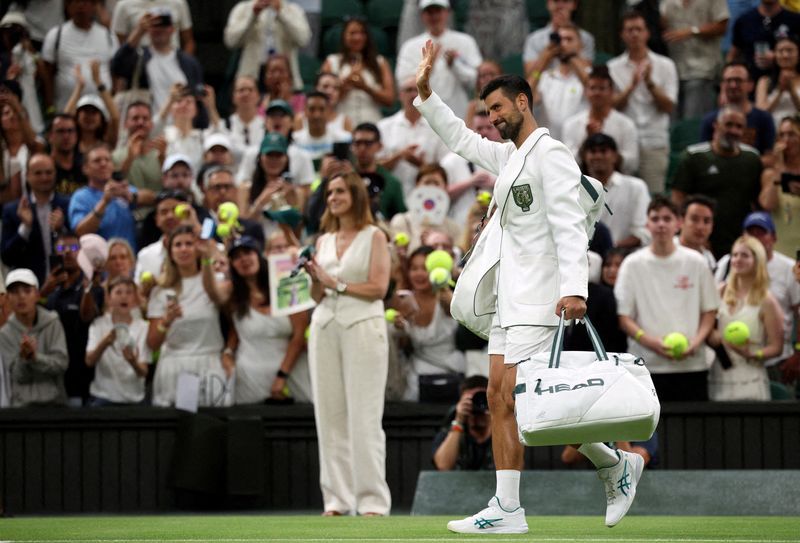
Naomi Osaka's striking kimono-inspired entrance may have captured headlines at this year's Wimbledon, but she is far from the only player turning the walk-on into a fashion spectacle. The trend has clearly rubbed off on the men's draw, where top-seeded players are collaborating with major sponsors to craft memorable arrivals that blur the line between competitive sport and high-fashion runway. Novak Djokovic has commanded attention in a personalised Lacoste blazer and coordinating shorts, while sixth seed Taylor Fritz has opted for a sophisticated white Hugo Boss jacket paired with tailored trousers and a silk scarf, demonstrating that male players are now seizing the opportunity to express their style at sport's most traditional venue.
This shift represents something genuinely novel in professional tennis. Wilson's chief creative officer Joelle Michaeloff, who works with players including Australian fifth seed Alex de Minaur and Ukrainian 12th seed Marta Kostyuk, suggests that male players are finally matching the creativity their female counterparts have long displayed. The timing appears deliberate—athletes and their teams are acutely aware of the marketing potential and the global audience watching these pre-match moments. Michaeloff notes that this constitutes the first Grand Slam tournament where the men are truly elevating their sartorial game, creating a ripple effect throughout the draw as players reconsider their own entrances.
The constraint of Wimbledon's all-white dress code, while limiting compared to the vibrant colours on display at the French Open or US Open, has paradoxically become an asset. It forces designers and athletes to think more creatively about silhouette, fabric texture, layering, and accessories—the hallmarks of sophisticated tailoring. The venue itself carries immense historical weight; it has been the backdrop for genuinely iconic moments, from Ted Tinling's groundbreaking white bodysuit in 1985 to Roger Federer's memorable jacket in 2007. By invoking these precedents, contemporary players are positioning themselves within a continuum of tennis tradition while simultaneously pushing boundaries.
Yet the stakes for these fashion-forward entrances are real and unforgiving. Fritz has been candid about the risk calculation involved: a player cannot afford to arrive in a designer outfit and then lose in the first round without inviting ridicule. The outfit must be backed by performance. Fortunately for Fritz, he has reached the third round without dropping a set, which means his calculated bet on style has paid off. His Hugo Boss suit, complete with trousers that can be rapidly removed along perforated seams, represents the marriage of fashion and practicality—a suit designed not just to impress visually but to function within the demands of professional tennis.
Sponsorship has become the crucial enabler of this trend. Major brands including Nike, Hugo Boss, and Lacoste view Wimbledon entrances as premium marketing real estate, particularly given the intensity of social media coverage. Nike and Osaka's team pre-promoted her kimono-inspired arrival across platforms before her opening match, while Hugo Boss similarly leveraged Fritz's tailored entrance. This convergence of athlete, designer, and brand is what Michaeloff identifies as genuinely new territory. The relationship between athlete and sponsor is no longer confined to equipment and apparel worn during play; it now encompasses the theatrical moment of arrival, transforming tennis into a more holistic fashion experience.
The design process itself has become more collaborative, with some male players now seeking meaningful input on everything from fabric selection and colour palettes to neckline design and fit. Russian player Karen Khachanov, who has also reached the third round, exemplifies this engaged approach, discussing every aspect of his outfit with his team to ensure it looks fashionable while maintaining the performance characteristics he requires. This represents a maturation of the athlete's role from passive wearer to active creative participant, reflecting broader cultural shifts in how athletes view personal branding and self-expression.
Not all attempts at sartorial innovation have succeeded. Italian player Matteo Berrettini, formerly ranked as high as sixth in the world, experienced the restrictive enforcement of Wimbledon's dress code when his proposed outfit was rejected as insufficiently white. This incident underscores that while the All England Lawn Tennis Club has loosened its traditionally rigid approach to fashion, boundaries remain firmly in place. The club clearly distinguishes between creative expression within the all-white framework and outright violations of its foundational aesthetic rules.
Historically, the foundations for this moment were laid decades ago. Michaeloff draws parallels to earlier fashion innovators, particularly citing legendary American player Arthur Ashe, who understood that how one dressed and presented oneself was integral to one's identity and impact. The lineage extends through the 1960s and 70s, when tennis clothing began reflecting broader cultural conversations about style and individuality. What has changed is momentum and reach—whereas fashion statements in earlier eras might have been noticed by those present at the venue, today's social media amplification means a single walk-on can generate millions of impressions within minutes.
Naomi Osaka herself has fundamentally elevated the stakes this season across all four Grand Slams. At the Australian Open, she wore a jellyfish-inspired outfit; at the French Open, she donned a black Kevin Germanier skirt followed by a glittering yellow-brown and gold Nike dress inspired by the illuminated Eiffel Tower. Her Wimbledon iteration, a fresh variation on the kimono theme, reinforces her position as the sport's fashion vanguard. Eleanor Thomas, the All England Lawn Tennis Club's collections lead and custodian of the sport's historical items displayed in the on-site museum, has explicitly positioned Osaka's 2023 fashion choices as iconic moments worthy of historical record.
For players considering whether to embrace this trend, Fritz has suggested that the women have already proven the viability and appeal of walk-on production value. By elevating the entrance into genuine theatre, female players have essentially given permission to the men's draw to do likewise. Fritz predicts we will see further evolution as more male players understand that fashion need not detract from competitive credibility. The narrative is shifting: arriving in a striking outfit backed by strong performance becomes not distraction but narrative enhancement, adding another dimension to a player's public persona.
The implications extend beyond individual players to the sport's broader commercial ecosystem. Tennis authorities and venues now recognise that these pre-match moments represent valuable content generation opportunities. The All England Lawn Tennis Club's tacit encouragement of creative within-the-rules expression suggests that tennis' most conservative venue has calculated that controlled fashion innovation drives engagement and viewership rather than detracting from competitive focus. For Southeast Asian players and fans observing this shift, it signals that tennis is evolving into a more visually compelling, personality-driven sport where individual expression is increasingly celebrated alongside athletic achievement.

