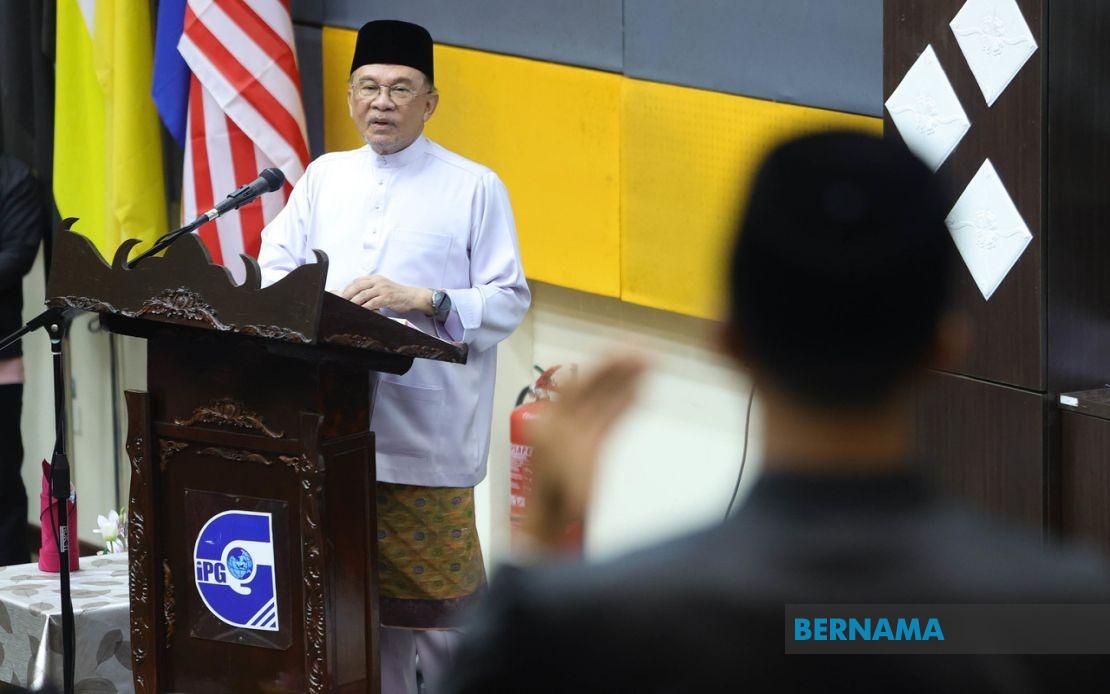
Prime Minister Datuk Seri Anwar Ibrahim has called for a fundamental reimagining of how Malaysia develops its teaching workforce, arguing that educators must simultaneously embrace cutting-edge technological expertise while maintaining unwavering commitment to moral and ethical principles. Speaking at an event in Nilai on July 17, Anwar emphasised that the nation faces a critical juncture where education policy cannot afford to remain static, nor can it pursue technological advancement at the expense of character formation and spiritual grounding.
The challenge facing Malaysia's schools, as Anwar articulated it, reflects a broader global tension between the imperatives of digital transformation and the preservation of humanistic values. Countries worldwide are grappling with similar questions about how to prepare students for jobs that may not yet exist while ensuring they develop the critical thinking and ethical frameworks necessary to navigate technological power responsibly. For Malaysia specifically, this tension carries additional weight given the nation's multicultural composition and the specific vulnerabilities that arise when educational institutions fail to cultivate mutual respect across communities.
Anwar's formulation—"reach for the skies while keeping our roots on the ground"—captures the dual mandate he believes educators must fulfil. Teachers will need demonstrable competence across Science, Technology, Engineering and Mathematics disciplines, particularly in emerging fields such as artificial intelligence, which is reshaping economies and labour markets across the Asia-Pacific region. Yet this technical proficiency, Anwar warned, becomes dangerous if untethered from robust ethical grounding. The concern is not merely theoretical; it reflects real anxieties about how AI systems trained without diverse perspectives or ethical constraints can perpetuate bias and cause social harm.
The Prime Minister further cautioned that education systems risk fundamental failure if they allow sentiments of racial or religious intolerance to take root within schools. This warning resonates deeply within Malaysia's context, where historical communal tensions remain within living memory and where educational institutions serve not merely as knowledge transmission centres but as crucial spaces where young Malaysians from different backgrounds learn to coexist and cooperate. When schools become vectors for divisiveness rather than bridges for understanding, Anwar suggested, they undermine the entire social compact that holds multiethnic democracies together.
Crucially, Anwar positioned education as the foundational prerequisite for national advancement, placing it ahead of other policy priorities. This ordering reflects a sophisticated understanding that Malaysia's competitiveness in global technology markets depends not just on isolated pockets of technical expertise but on a broad educational base where millions of young people develop both capability and character. The implication is that shortcuts—focusing on STEM to the exclusion of humanities and ethics, or privileging technological training while neglecting the development of judgment and values—will ultimately produce graduates ill-equipped to navigate complex professional and civic challenges.
The remarks came alongside Education Minister Fadhlina Sidek and IPGKPT (Institut Pendidikan Guru Kampus Pendidikan Teknik) director Dr Kartini Abdul Mutalib, suggesting these themes enjoy support across Malaysia's education establishment. Teacher training institutions will be central to any implementation of this vision, requiring them to redesign curricula and assessment frameworks to cultivate both technical mastery and ethical reasoning among trainee educators. This is not merely an additive exercise of grafting ethics modules onto existing STEM programmes; it demands integrated pedagogical approaches where moral and technical reasoning reinforce one another.
Anwar's emphasis on tolerance and mutual respect as prerequisites for national security takes on particular significance given contemporary global trends. Authoritarian movements globally have often mobilised religious and ethnic grievance; Malaysia's relative stability as a multicommunal state with democratic institutions depends partly on educational institutions actively cultivating intercommunal understanding rather than remaining neutral on questions of social cohesion. By framing these values not as optional extras but as essential to education's mission, Anwar is asserting a particular vision of what education is fundamentally for.
The practical implications for Malaysia's education system are substantial. Teacher training programmes will need to recruit candidates with strong STEM backgrounds while also assessing their ethical maturity and commitment to inclusive pedagogy. Professional development for existing teachers must address not just new technological tools but also how to integrate technology responsibly within diverse classrooms. Curriculum development must create space for students to engage deeply with ethical questions raised by emerging technologies—questions about data privacy, algorithmic bias, and the social impact of automation—rather than treating technology as a morally neutral domain.
Regionally, Malaysia's positioning on these questions carries significance. As Southeast Asian nations compete to develop digital economies and attract technology investment, the temptation exists to view education primarily through an economic lens, maximising STEM outputs without equal attention to broader social outcomes. Anwar's articulation of a balancing principle suggests an alternative model where technological sophistication and social stability are understood as interdependent rather than competing objectives. This framing may resonate across the region, where rapid development often creates anxieties about cultural preservation and social cohesion.
The Prime Minister's statement also implicitly critiques approaches to education that treat different subjects and values as compartmentalised. In reality, a chemistry teacher influences students' ethical development through how they conduct research and treat collaborators; a mathematics instructor shapes character through insisting on intellectual honesty and rigorous thinking; a technology teacher conveys values through decisions about what problems are worth solving and for whose benefit. Integration of technical and ethical education requires recognising these connections rather than maintaining artificial boundaries between subjects.
Looking forward, implementation will be crucial. Developing teachers who authentically integrate technological capability with ethical grounding is more demanding than simply raising technical standards or mandating ethics instruction. It requires patience in teacher selection and training, investment in professional development that allows educators to develop their own ethical frameworks, and school cultures where discussing difficult questions about technology, identity, and values is normalised rather than avoided. Malaysia's education system will be tested by how seriously it takes this dual mandate in the years ahead.

