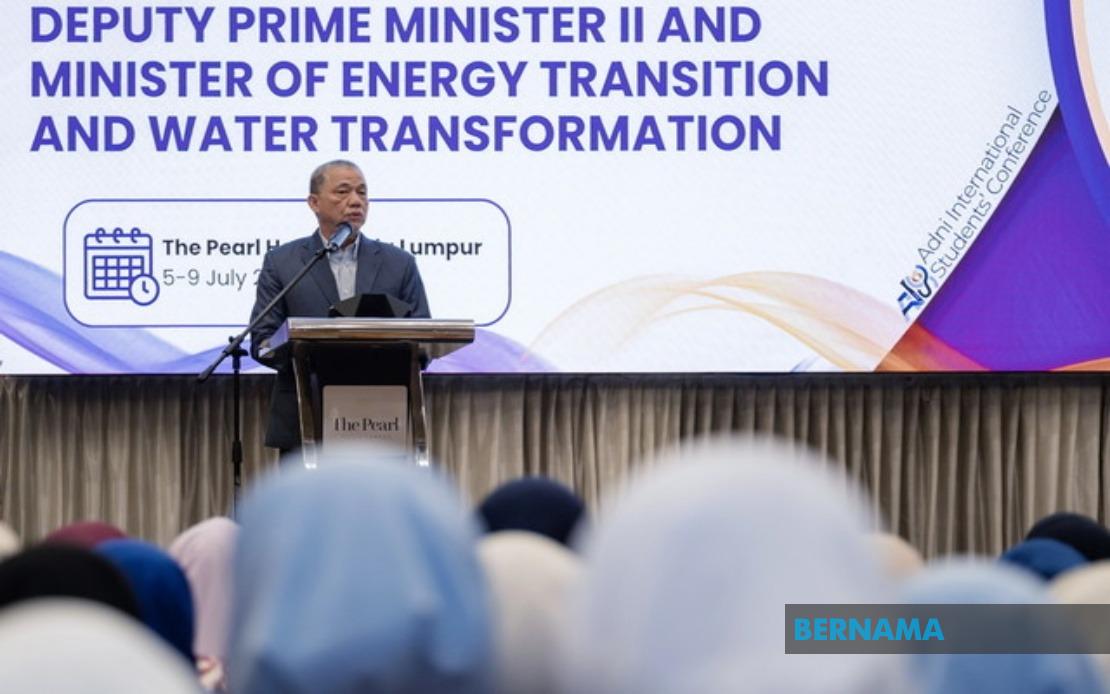
Deputy Prime Minister Datuk Seri Fadillah Yusof has underscored a fundamental truth about national development that extends beyond conventional measures of economic growth and technological prowess. Speaking at the ADNI International Students' Conference (AISC) 2026 in Kuala Lumpur, Fadillah articulated a vision for Malaysia centred on the calibre of its people rather than material indicators alone. This emphasis signals a strategic pivot within the MADANI Government's policy framework, recognising that sustainable competitive advantage in the modern world emerges from investing in and nurturing the intellectual and moral capabilities of citizens across all sectors of society.
The Deputy Prime Minister outlined the specific attributes that Malaysian citizens must develop to navigate an increasingly complex and interconnected global landscape. Critical thinking, effective communication, and adaptive capacity have become essential competencies as economies face disruption from technological innovation and shifting geopolitical dynamics. These skills transcend traditional academic subjects and reflect the human qualities required to solve problems that no single technology or nation can address in isolation. The emphasis on such capabilities reflects international trends in education policy, where soft skills and cognitive flexibility have gained equal prominence to technical expertise in workforce development frameworks.
Fadillah identified a constellation of interconnected challenges that will define the next generation's test of leadership and problem-solving ability. Climate change, pandemic preparedness, digital transformation, and widening social disparities represent issues that demand coordinated responses across institutional boundaries. The Malaysian government recognises that compartmentalised approaches—where individual sectors work independently—cannot produce the holistic solutions these challenges require. Instead, addressing contemporary crises necessitates genuine collaboration between government bodies, universities, business entities, civil society organisations, and youth movements. This multi-stakeholder approach acknowledges that modern governance requires convening diverse perspectives and mobilising collective intelligence rather than relying on top-down directives alone.
The MADANI Government's positioning of human capital development as a core pillar of national strategy echoes historical precedent. Fadillah referenced Tun Hussein Onn, Malaysia's third Prime Minister, who emphasised that a nation's true strength derives from the unity and character of its people rather than material wealth or military might. This philosophical anchoring provides continuity with Malaysian governance traditions while demonstrating that contemporary policy innovation need not abandon foundational principles. The invocation of this legacy suggests that the government views current human capital investments as an extension of long-established national values rather than a departure from them.
The Deputy Prime Minister articulated a compelling distinction between technological connectivity and genuine social cohesion. While digital networks and communication platforms can link devices and transmit information with unprecedented speed and scale, such infrastructure cannot generate the shared values, mutual understanding, and trust that sustain functioning societies. Technology serves as a facilitator of human connection but cannot substitute for the interpersonal bonds forged through face-to-face interaction, cultural exchange, and collaborative problem-solving. This insight carries particular relevance for Malaysia as a multicultural nation where social harmony depends on citizens from diverse ethnic, religious, and socioeconomic backgrounds developing genuine understanding of one another.
Fadillah's conception of development encompasses dimensions that traditional economic metrics fail to capture. Education clearly forms the foundation, but his framework extends to encompass physical and mental well-being, ethical development, creative expression, environmental sustainability, and social integration. This expansive understanding aligns with international development indices such as the Human Development Index, which have increasingly recognised that quality of life encompasses far more than per capita income. For Malaysian policymakers, this framing implies that investment in healthcare, cultural infrastructure, environmental protection, and civic spaces should receive equal priority alongside traditional economic development initiatives.
The AISC 2026 gathering itself exemplifies the principles Fadillah articulated. Bringing together approximately 150 students from Malaysia and neighbouring Southeast Asian nations—including Thailand, the Philippines, and Indonesia—the conference created structured space for intellectual exchange and cross-cultural learning. These regional connections carry particular significance for Malaysia, which can position itself as a convening centre for Southeast Asian youth dialogue. Such conferences build informal networks and foster mutual understanding among future leaders and professionals who will shape regional cooperation in coming decades. The thematic focus on diversity, education, and wellness in a digital context directly addresses contemporary challenges that no single nation can resolve unilaterally.
Fadillah drew an important distinction between artificial intelligence and wisdom, cautioning against the assumption that technological sophistication can replace or supersede human judgment and understanding. As Malaysian businesses and government agencies increasingly adopt AI systems for decision-making, this reminder assumes urgent relevance. While machine learning algorithms can identify patterns in data and optimise specific metrics, wisdom—the ability to discern underlying principles, consider long-term consequences, and act with moral consideration—remains uniquely human. Similarly, he noted that technology cannot replicate compassion, the foundation of ethical leadership and social responsibility. These observations suggest that Malaysia's human capital development must emphasise moral and philosophical education alongside technical and professional training.
The conference's alignment with United Nations Sustainable Development Goals reflects Malaysia's commitment to international development frameworks while maintaining domestic focus on education quality, social inclusion, institutional strength, and cross-sector partnerships. The SDGs provide a shared global language for development, enabling Malaysia to benchmark its progress against international standards while contributing to regional stability and prosperity. Young people who internalise these principles become agents for sustainable development within their own communities and countries. For Malaysian educators and policymakers, supporting this youth engagement with the SDGs represents an investment in both global citizenship and local impact.
The MADANI Government's emphasis on human capital quality also carries implications for education policy and resource allocation. If national development depends fundamentally on the intellectual and ethical capacities of citizens, then education financing, curriculum design, and pedagogical approaches warrant re-examination. This could necessitate increased investment in teacher training, school infrastructure in underserved regions, vocational education pathways, and continuous learning opportunities for adults navigating career transitions. The message also carries relevance for the private sector, which bears responsibility for developing employees' capabilities and contributing to workforce development in broader society beyond narrow commercial interests.
Fadillah's articulation of development priorities positions Malaysia within a global conversation about how nations can build sustainable prosperity in an age of technological disruption and climate crisis. The emphasis on human qualities—critical thinking, communication, adaptability, ethical grounding—reflects recognition that future competitiveness depends on cultivating citizens who can navigate ambiguity, collaborate across difference, and contribute creatively to solving problems that existing frameworks have failed to address. For Malaysia specifically, a multicultural, middle-income nation positioned between developed and developing economies in Southeast Asia, this framework offers a pathway to sustained development that builds on the country's existing strengths while addressing persistent governance and social challenges that constrain fuller realisation of national potential.

