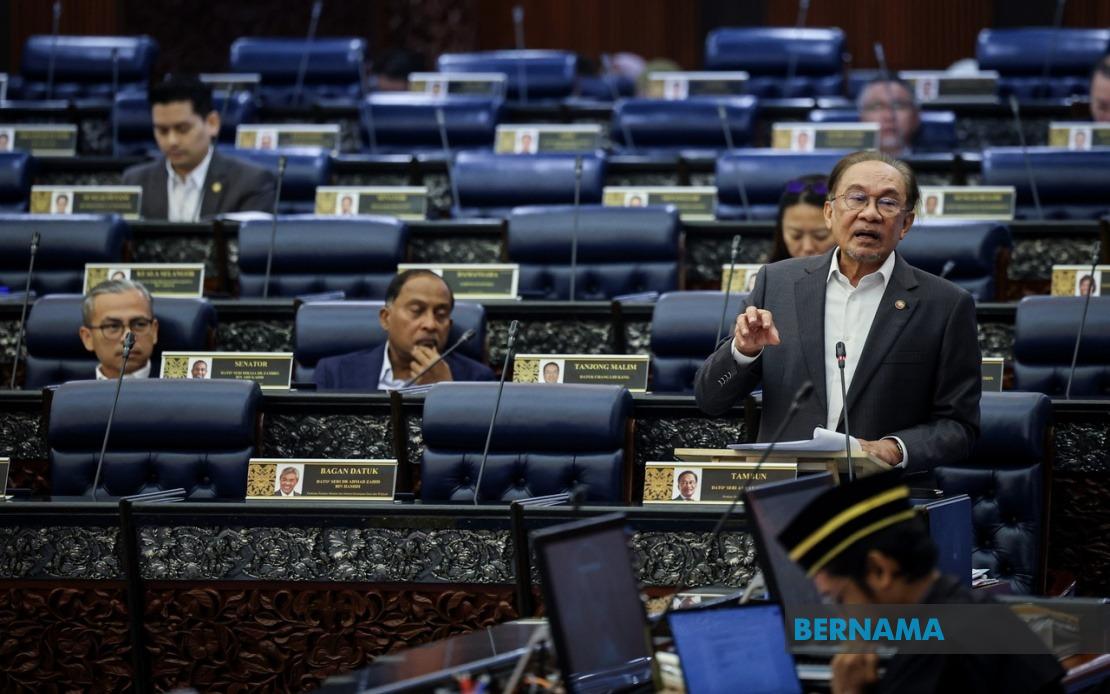
Prime Minister Datuk Seri Anwar Ibrahim has attributed Malaysia's slide in this year's World Press Freedom Index rankings to a combination of international assessment factors, including regulatory actions taken against several media organisations for breaching content guidelines on sensitive national issues.
Malaysia dropped to 95th place in the 2026 World Press Freedom Index from its previous 88th position, a shift that drew questions from opposition lawmakers in Parliament about the government's commitment to safeguarding media freedom. Rather than viewing these enforcement measures as suppression tactics, Anwar framed them as necessary protections for Malaysia's distinct constitutional and cultural framework—specifically targeting material that violates the three Rs: religion, race, and the royal institution.
The Prime Minister cited two specific cases that international observers had scrutinised closely. Sin Chew Daily faced action over publishing an inaccurate illustration of the Jalur Gemilang, while Sinar Harian drew regulatory attention following its coverage of the Inspector-General of Police's biography. Anwar acknowledged that the international media community had viewed the Sin Chew Daily incident particularly seriously, interpreting it as a curtailment of press freedom. However, he stressed that Malaysia's approach to issues involving national symbols reflects constitutional obligations that differ fundamentally from how other democracies prioritise such matters.
Critically, Anwar distinguished between enforcement action and editorial suppression. The government, he insisted, does not penalise journalists or publications for factual inaccuracies or political criticism standing alone. Instead, the administration emphasises public clarification and parliamentary explanation as preferred mechanisms for addressing disputed claims or challenging viewpoints. This distinction is significant for understanding Malaysia's regulatory philosophy: the concern centres on content that combines factual errors with potential damage to constitutionally protected institutions or that risks inciting communal tensions.
The Prime Minister referenced a decision by the Conference of Rulers, which maintains continuous vigilance over reports containing insults to the monarchy and material capable of inflaming religious or racial divisions. This institutional framework positions enforcement not as a political weapon but as a safeguard rooted in Malaysia's federal compact and the social contract underpinning the 1957 Merdeka agreement. Understanding this context is essential for international observers evaluating Malaysia's media environment; the 3R boundaries occupy a constitutionally distinct space that shapes how government and palace institutions respond to journalism.
Anwar also highlighted recent legislative reforms intended to broaden press latitude. Amendments to Section 233 of the Communications and Multimedia Act 1998 decriminalised satirical remarks directed at the Prime Minister and other political leaders, removing them from the scope of criminal prosecution. This change signals government willingness to recalibrate the balance between protecting sensitive institutions and permitting robust political discourse. For Malaysian newsrooms, the reform clarifies that satirical commentary on political leadership no longer triggers criminal liability, even if it remains subject to other regulatory frameworks.
The Prime Minister's analysis of the index methodology revealed a more complex picture than simple enforcement action. Reporters Without Borders (RSF), which compiles the World Press Freedom Index, evaluates multiple dimensions: the political environment, the legal framework's structure, economic conditions, socio-cultural context, and security circumstances. Malaysia's ranking reflects performance across all these dimensions, not merely government regulatory decisions. This nuance matters because it demonstrates that factors beyond government control—including economic pressures on news organisations and wider regional security concerns—contribute to Malaysia's declining score.
Addressing the role of social media platforms, Anwar noted that significant content removal occurs through private platform decisions rather than government directive. He cited the removal of his own posts related to Hamas by major social media companies despite government disagreement with those decisions. The Malaysian Communications and Multimedia Commission (MCMC) submits requests for content removal to platforms, but final authority rests with platform operators themselves. This decentralisation of content moderation means that Malaysia's press freedom ranking reflects not only government action but also the enforcement decisions of Silicon Valley-based companies operating under their own community standards.
For Southeast Asian observers, Anwar's position reflects a broader regional tension: balancing constitutional commitments to protecting specific institutions and communal harmony against international press freedom standards increasingly shaped by Western media organisations and indices. Malaysia's 3R framework derives from its foundational constitutional settlement, yet global assessment methodologies often apply uniform standards without accounting for the institutional and historical particularities of individual countries. This gap between domestic constitutional requirements and international press freedom metrics will likely persist as long as Malaysia maintains its current legal architecture.
The Prime Minister's explanation also underscores growing friction between government-directed moderation and platform-driven content governance. As social media companies exercise greater influence over information flows, traditional regulatory frameworks become less determinative of the overall media environment. MCMC requests may be rejected by platforms, rendering formal government compliance largely symbolic. For Malaysian media practitioners, this shift means that platform policies—often opaque to users and subject to algorithmic inconsistency—increasingly shape what circulates within the information ecosystem, sometimes independently of domestic regulatory action.
Anwar's defence of Malaysia's approach ultimately rests on distinguishing between targeting political opponents through media regulation and enforcing boundaries around constitutionally protected categories. Whether international observers accept this distinction depends partly on their assessment of how consistently and proportionately Malaysia applies these standards. The forthcoming years will test whether legislative reforms such as the Section 233 amendments generate measurable changes in press freedom indices, signalling genuine commitment to expanding journalistic latitude while maintaining constitutional guardrails.
For Malaysian newsrooms and regional media organisations, the policy framework remains calibrated toward protecting the 3R domains while expanding space for political satire and factual critique. The disconnect between Malaysia's ranking and government self-assessment suggests that international press freedom indices may not fully capture the government's declared intentions or structural reforms. How Malaysia performs in future World Press Freedom Index assessments will depend partly on whether enforcement becomes more consistently targeted at the defined 3R categories and whether platform moderation decisions align with rather than undermine government messaging.

