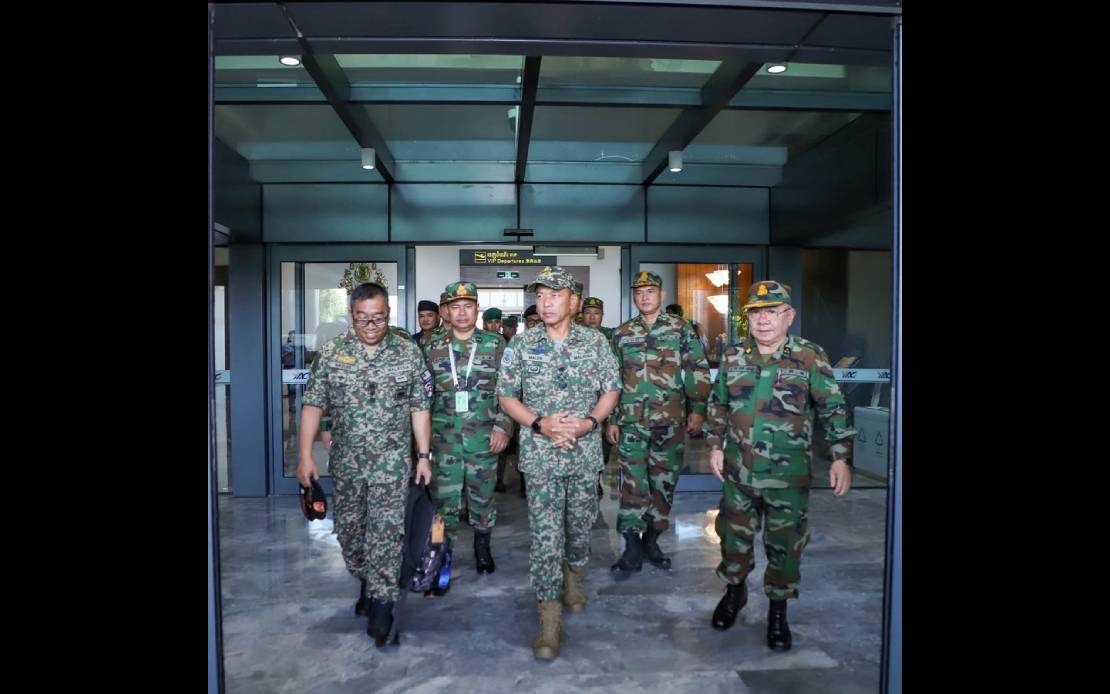
Malaysia's Chief of Defence Force Gen Tan Sri Malek Razak Sulaiman travelled to Cambodia's northwestern border region this week to conduct an on-the-ground review of security conditions in one of Southeast Asia's most sensitive frontier zones. The visit to Banteay Meanchey province, which forms part of the disputed Cambodia-Thailand boundary, reflects Malaysia's deepening engagement with ongoing peacekeeping efforts in the region and its broader diplomatic role within ASEAN's security architecture.
The defence chief's inspection was facilitated by detailed briefings from the ASEAN Observer Team stationed along the contested border area. This multinational contingent, established to oversee the implementation of a ceasefire agreement between Cambodia and Thailand, provided Malek Razak with comprehensive updates on the current security environment. The visit underscores Malaysia's determination to maintain close oversight of developments affecting the stability of ASEAN member states, particularly where territorial disputes risk destabilizing the broader region.
Malek Razak's three-day official visit, which began on July 8 and concludes on July 11, came at the formal invitation of General Vong Pisen, Commander-in-Chief of the Royal Cambodian Armed Forces. This bilateral military engagement represents an important opportunity for direct dialogue between Malaysia and Cambodia at the highest defence establishment level, strengthening institutional ties and fostering mutual understanding of each nation's security priorities and regional concerns.
The ASEAN Observer Team that briefed the Malaysian defence chief was established following a significant military confrontation between Cambodian and Thai forces that erupted on the border in July 2025, with territorial disputes lying at the heart of the clash. The team was tasked with monitoring compliance with the subsequent ceasefire agreement and preventing a recurrence of armed hostilities between the two neighbouring nations. This peacekeeping mechanism represents a critical test of ASEAN's capacity to manage intra-regional conflicts through collective diplomatic and operational mechanisms.
Currently, the Observer Team operates under the leadership of the Philippines, which holds the rotating chairmanship of ASEAN for the current term. This administrative arrangement places the responsibility for coordinating the multinational monitoring effort on Manila's shoulders, though Malaysia's participation through this high-level visit demonstrates that burden-sharing extends across multiple ASEAN capitals. The involvement of key regional powers in such peacekeeping missions reflects the organization's commitment to resolving disputes through consensus-based approaches rather than allowing them to fester or escalate.
Malaysia's prominent engagement with the Cambodia-Thailand border situation carries particular significance given Kuala Lumpur's own experience managing complex maritime and terrestrial boundary issues with neighbouring states. The country's participation in the Observer Team framework provides valuable institutional expertise and demonstrates ASEAN solidarity in upholding principles of peaceful dispute resolution. For Malaysian policymakers, monitoring the effectiveness of such mechanisms offers practical lessons that could inform approaches to managing its own bilateral boundary challenges.
The timing of this defence chief's visit also reflects Malaysia's broader strategic posture in Southeast Asia during a period of heightened geopolitical tension. By maintaining active engagement in regional security matters and demonstrating visible commitment to ASEAN-led peacekeeping initiatives, Malaysia reinforces its position as a stabilizing force within the organization. This diplomatic presence helps counterbalance potentially destabilizing external influences and reinforces the principle that ASEAN members bear primary responsibility for managing regional security challenges.
For Cambodia specifically, Malaysia's support through such high-level visits and participation in observer missions provides diplomatic comfort during a period of elevated tensions with Thailand. The presence of neighbouring ASEAN members through formal peacekeeping structures demonstrates that the region as a whole has a vested interest in preventing the escalation of this particular dispute. This collective engagement helps discourage either party from pursuing aggressive strategies and encourages both sides to seek negotiated settlements.
The border situation between Cambodia and Thailand remains fragile despite the ceasefire agreement. The underlying territorial disputes reflect historical grievances and competing interpretations of colonial-era boundary demarcations that continue to complicate the relationship between Phnom Penh and Bangkok. The presence of international observers, including Malaysian military personnel and other ASEAN contingents, serves as a deterrent to renewed hostilities while providing a neutral mechanism for monitoring compliance with agreements. However, the persistence of these tensions underscores the limitations of observer missions alone in resolving deep-rooted territorial disputes.
For Malaysia and other ASEAN members, the effectiveness of the Observer Team will have implications for how the organization approaches future conflicts. If the mechanism succeeds in maintaining the ceasefire and eventually facilitates a resolution of the underlying territorial dispute, it could establish a useful precedent for ASEAN conflict management. Conversely, if tensions reignite or negotiations stall indefinitely, it may prompt regional powers to reassess the utility of such multilateral approaches and consider alternative strategies.
Malaysia's defence establishment has long emphasized the importance of regional stability as a prerequisite for economic development and national prosperity. By actively participating in ASEAN peacekeeping missions and maintaining high-level military-to-military engagement with neighbouring capitals, Malaysia seeks to create a strategic environment conducive to shared growth and reduced security risks. This philosophy guides the country's participation in initiatives like the Observer Team and explains why the Chief of Defence Force prioritized a border zone inspection during his Cambodia visit.
Looking forward, Malaysia's continued involvement in monitoring the Cambodia-Thailand border situation will likely expand as circumstances evolve. Whether the two countries move toward negotiated settlement or face renewed confrontation, ASEAN's collective role through mechanisms like the Observer Team will remain vital. For Malaysia specifically, such engagement reinforces its credentials as a responsible ASEAN member committed to upholding regional norms and institutions, while simultaneously gathering intelligence and insights that inform its own approach to security challenges and diplomatic positioning within the association.

