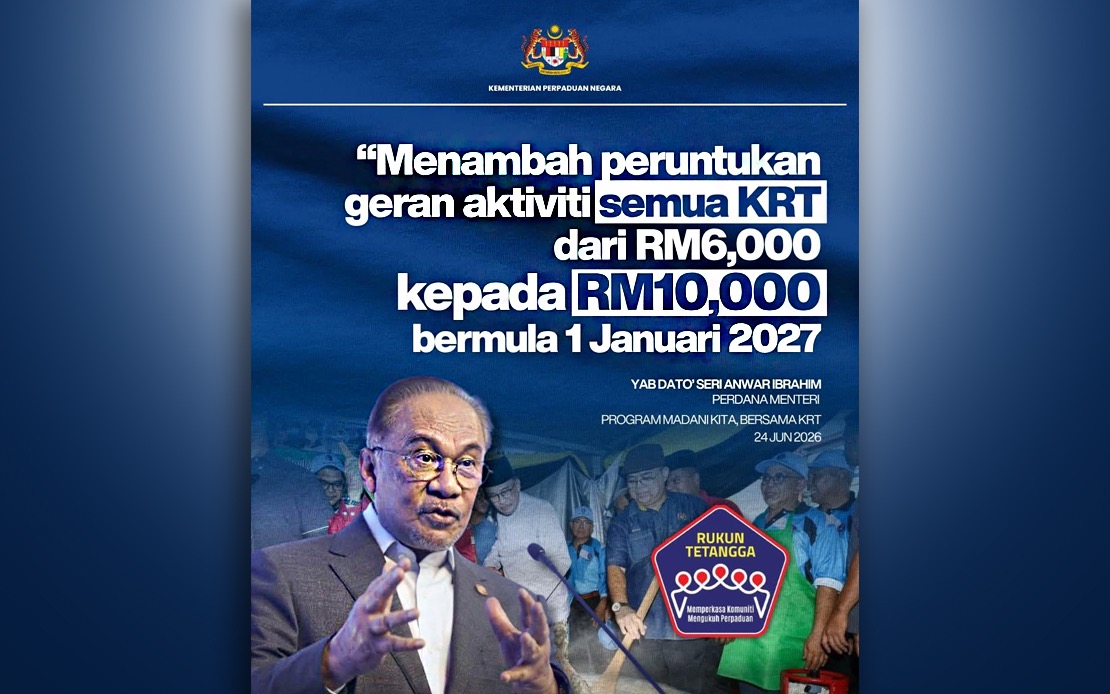
Prime Minister Datuk Seri Anwar Ibrahim has announced a substantial increase in government funding for Malaysia's neighbourhood watch system, lifting annual grants from RM6,000 to RM10,000 per group. The enhancement, which benefits all 8,615 registered KRT (Kawasan Ronda Tetangga) units across the nation, represents a significant 67 per cent boost to grassroots operational budgets and takes effect from January 1, 2027. The announcement came during an engagement session at Dataran Segamat in Johor, where the Prime Minister met directly with community leaders to underscore the government's commitment to neighbourhood-level initiatives.
National Unity Minister Datuk Aaron Ago Dagang framed the funding increase as recognition of the KRT system's half-century track record as a community institution driving social cohesion and public welfare. Beyond the financial component, the decision reflects broader MADANI Government strategy to invest in grassroots movements as the foundation for building a united and progressive society. The ministry views neighbourhood watch organisations as integral to translating national unity policies into tangible community benefits, particularly in an ethnically and religiously diverse country where inter-community relationships directly influence social stability.
The scale of KRT's reach demonstrates why policymakers consider the system worthy of expanded investment. Approximately 250,000 volunteer members operate within the KRT framework, collectively touching the lives of over 12 million Malaysians through roughly 100,000 community activities conducted annually. These figures suggest that KRT functions as Malaysia's most extensive volunteer-based social institution, often serving as the primary mechanism through which government initiatives filter down to neighbourhood level. For many rural and semi-urban communities, KRT remains the most accessible platform for organising collective action on local concerns.
The ministry has articulated a comprehensive vision for how the enhanced funding should be deployed. Beyond traditional neighbourhood security functions, the grants are intended to facilitate programmes spanning community unity activities, local economic empowerment, welfare support, educational initiatives, and volunteerism development. This multifunctional approach reflects recognition that contemporary neighbourhood challenges extend well beyond crime prevention to encompass social isolation, economic inequality, and community fragmentation—issues that became more acute during pandemic-related lockdowns. By framing the grant increase in terms of enabling higher-impact programmes, the government signals that neighbourhood organisations should position themselves as comprehensive development agents rather than single-purpose security bodies.
For Malaysian neighbourhood associations, the funding increase carries significant operational implications. The jump from RM6,000 to RM10,000 annually provides breathing room for activities that previously required subsidisation through member contributions or external donations. Groups can now sustain regular community meetings, support vulnerable residents, organise festive celebrations that bring mixed communities together, and invest in basic infrastructure improvements—from street lighting to community centres. In contexts where volunteer burnout has been a persistent challenge, the enhanced budget may enable KRT units to hire administrative support or event coordinators, freeing up leaders for strategic work.
The timing of the announcement deserves scrutiny from a political economy perspective. With Malaysia navigating persistent challenges around social cohesion, electoral polarisation, and inter-community tensions, investing in neighbourhood-level unity mechanisms serves both instrumental and symbolic purposes. The MADANI Government has consistently emphasised inclusive development and harmonious pluralism as policy anchors, making the KRT funding increase a concrete manifestation of this rhetoric. For Prime Minister Anwar Ibrahim, visiting KRT groups and announcing funding boosts provides opportunities to strengthen grassroots political networks while legitimising his government's commitment to community-oriented governance rather than top-down administration.
Regional context enriches understanding of Malaysia's neighbourhood watch investment. Unlike some Southeast Asian neighbours where community policing remains primarily a security function, KRT has evolved into a broader social institution. The government's willingness to expand its mandate and budget reflects confidence in volunteer organisations as vehicles for inclusive governance. This contrasts with centralised approaches in some regional contexts and aligns Malaysia with international best practice emphasising community participation in development and governance. The funding increase may also signal to other ASEAN nations the value of sustained investment in grassroots institutions as social stability mechanisms.
Minister Aaron Ago Dagang emphasised that neighbourliness itself—the quality of daily relations between residents regardless of ethnic or religious background—constitutes Malaysia's foundational source of national strength. This philosophical framing positions the KRT system not merely as an administrative convenience but as essential infrastructure for maintaining plural democracy. In a country where national identity remains contested and where neighbourhood composition often reflects broader demographic patterns, the functioning of KRT serves as a practical test of whether diverse Malaysians can organise collective action around shared local interests. By funding these organisations more generously, the government invests in demonstrating that functional diversity is achievable at community level.
Accountability and monitoring will shape the programme's ultimate success. While the ministry has stated its commitment to ensuring optimal utilisation of additional funds, practical mechanisms for tracking outcomes remain under-specified. KRT organisers will benefit from clarity regarding performance expectations, reporting requirements, and consequences for misuse. Successful grassroots funding programmes internationally typically combine autonomy in activity design with transparent accountability frameworks. The government should consider establishing simple impact metrics—participation rates, programme diversity, inter-community interaction indicators—that allow both KRT units and ministry officials to assess whether the funding increase translates into strengthened community capacity and social cohesion.
The neighbourhood watch system's future trajectory will depend partly on whether the funding increase reaches groups equitably and whether all communities experience it as beneficial. Rural and smaller urban units may face particular challenges in deploying grants effectively, suggesting the ministry might develop technical support mechanisms to accompany the financial boost. Moreover, ensuring that KRT programmes genuinely integrate minority communities and address equity concerns will determine whether the investment genuinely advances national unity or merely sustains parallel grassroots structures. The government's claim that KRT unites Malaysians across difference will ultimately rest on observable outcomes in actual neighbourhoods rather than policy announcements.
Looking forward, the RM10,000 grant level may face pressure for further adjustment as operational costs rise and community expectations expand. However, the current increase represents substantial recognition of grassroots institutions and positions KRT favourably within Malaysia's broader governance architecture. For neighbourhood organisers, the enhanced funding opens space for creativity and ambition in local programming. For the government, the investment represents faith in voluntary organisations as durable agents of social stability and inclusive development. Success will hinge on translating this financial commitment into genuine community empowerment and demonstrable improvements in how Malaysians experience life at neighbourhood level.