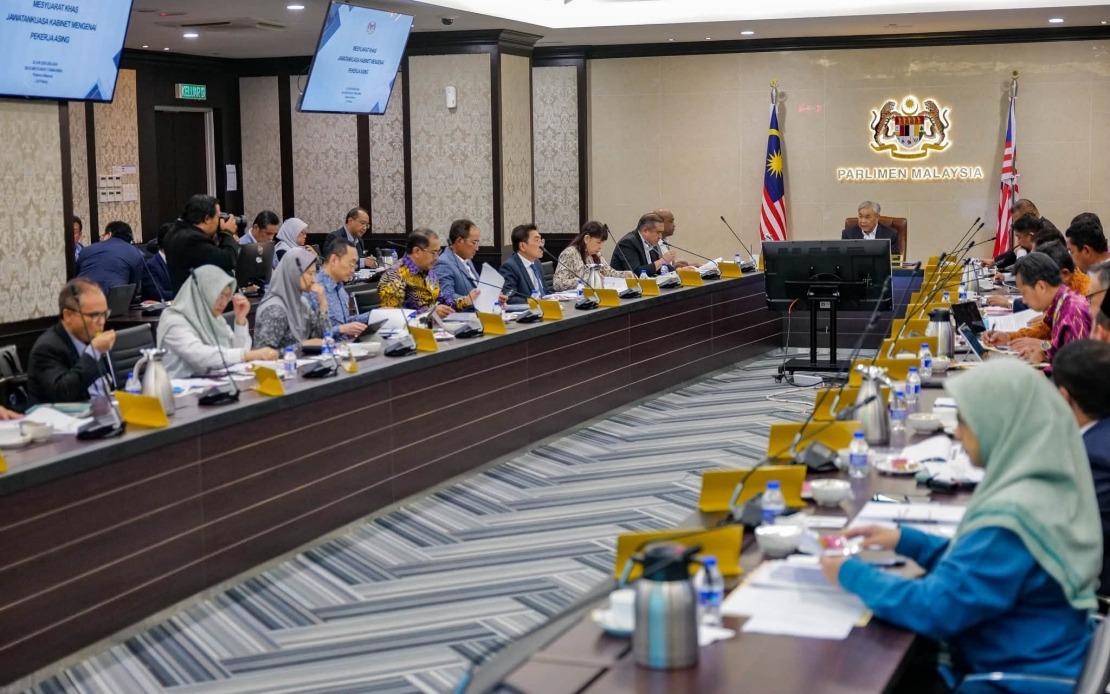
Deputy Prime Minister Datuk Seri Dr Ahmad Zahid Hamidi has unveiled plans to fundamentally reshape how Malaysia manages its foreign workforce, signalling a shift towards greater systemic efficiency and strategic alignment with actual labour market demands. The announcement follows a specially convened meeting of the Cabinet Committee on Foreign Workers held at Parliament, where senior government figures deliberated on structural changes designed to streamline a system that has long struggled with coordination challenges across multiple agencies.
Central to the proposed overhaul is the consolidation of foreign worker oversight mechanisms under a clearer administrative framework. The government has decided to relocate the One Stop Centre for Foreign Worker Management under the purview of the Ministry of Human Resources, a move that seeks to eliminate bureaucratic fragmentation that has historically complicated permit processing and worker verification. By concentrating authority within a single ministry, policymakers aim to reduce the coordination failures that have created bottlenecks in both recruitment and enforcement activities.
The restructuring reflects mounting pressure to balance competing priorities that have increasingly come into tension. Ahmad Zahid articulated this equilibrium explicitly, emphasising that reforms must simultaneously enhance operational efficiency, maintain system integrity, respond to genuine sector labour shortages, protect national security interests, and safeguard employment opportunities for Malaysian citizens. This multi-faceted mandate reveals the complexity of foreign worker policy in Malaysia, where economic pragmatism must coexist with nationalist labour market protection and security concerns.
A critical element of the reform agenda involves reimagining how foreign labour requirements are assessed and approved. Rather than continuing with historical patterns or industry projections that may inflate actual needs, the government intends to implement more rigorous, evidence-based evaluation of sectoral labour demand. This strategic approach suggests recognition that Malaysia has previously accommodated foreign workers beyond genuine economic necessity, potentially suppressing wages and employment prospects for domestic workers while creating dependency that complicates labour market adjustment.
Paralleling these structural changes is a sustained commitment to reducing Malaysia's underlying reliance on migrant labour through three interconnected strategies. First, the government emphasises expanding domestic workforce participation, particularly among demographic groups historically outside formal employment markets. Second, it prioritises skills development and training initiatives to upgrade the qualifications of Malaysian workers in sectors where foreign workers currently predominate. Third, it targets accelerated industrial transition towards automation and mechanisation, particularly in labour-intensive manufacturing and agricultural operations.
These complementary policies reflect a strategic pivot from treating foreign worker importation as a structural solution to labour shortages towards treating it as a transitional measure while domestic labour market transformation occurs. This represents meaningful policy evolution compared to earlier approaches that treated foreign worker quotas as semi-permanent features of sectoral operations. The emphasis on automation, in particular, acknowledges that some positions may ultimately prove unsuitable for permanent human employment regardless of worker nationality, requiring technological substitution.
For Malaysian employers, the restructuring introduces both opportunities and constraints. Clarified procedures and consolidated administration through the Ministry of Human Resources should reduce the bureaucratic friction that currently complicates foreign worker recruitment, potentially accelerating approval timelines. Simultaneously, however, more stringent verification of actual labour requirements means that employers cannot rely on loosely justified applications receiving automatic approval. This disciplined approach, while administratively burdensome initially, should prevent the labour market flooding that undermines wage stability and worker conditions across sectors.
The implications for Southeast Asian labour dynamics warrant attention as well. Malaysia's approach influences regional migration patterns and competitor countries' policies. If Malaysia successfully implements more strategic, demand-driven foreign worker management, it could reduce downward wage pressure across manufacturing and service sectors throughout the region, benefiting workers across multiple countries. Conversely, other nations might attempt to absorb workers no longer finding positions in Malaysia, creating secondary migration pressures in Thailand, Cambodia, and Laos.
National security considerations feature prominently in Ahmad Zahid's framing, suggesting that enhanced coordination will strengthen vetting procedures and ongoing monitoring capabilities. A consolidated management structure should improve the government's ability to verify worker backgrounds, detect undocumented presence, and coordinate with enforcement agencies on worker rights violations and criminal activities. These security dimensions have grown increasingly important as Malaysian authorities address human trafficking networks and organised migration crimes that exploit confused regulatory environments.
The cabinet's decision to modify the Cabinet Committee on Foreign Workers' membership and terms of reference indicates that governance structures themselves require recalibration. This suggests either that the previous composition failed to include essential stakeholders or that existing terms of reference insufficiently addressed contemporary labour market challenges. Without access to specific changes, observers should anticipate that restructured committee arrangements may incorporate stronger representation from the Ministry of Human Resources, security agencies, and industry chambers, ensuring that reform implementation reflects diverse institutional perspectives.
Looking forward, successful implementation will require sustained political commitment and adequate resource allocation to the Ministry of Human Resources. Agencies accustomed to autonomous foreign worker processing may resist consolidated administration, requiring careful change management and clear communication of reform rationales. The government's framing of these changes as driven by national interest and public welfare protection should facilitate stakeholder acceptance, though resistance from employers seeking unimpeded recruitment access remains probable.
The timing of this restructuring coincides with broader Malaysian efforts to rebalance economic priorities following the pandemic's labour market disruptions. With unemployment concerns moderating yet wage stagnation persisting in certain sectors, policymakers recognise that managing foreign worker inflows more carefully represents a constructive response to domestic labour challenges without resorting to protectionist extremes that would damage competitiveness. This calibrated approach positions Malaysia as a regional leader in thoughtful labour migration governance.

