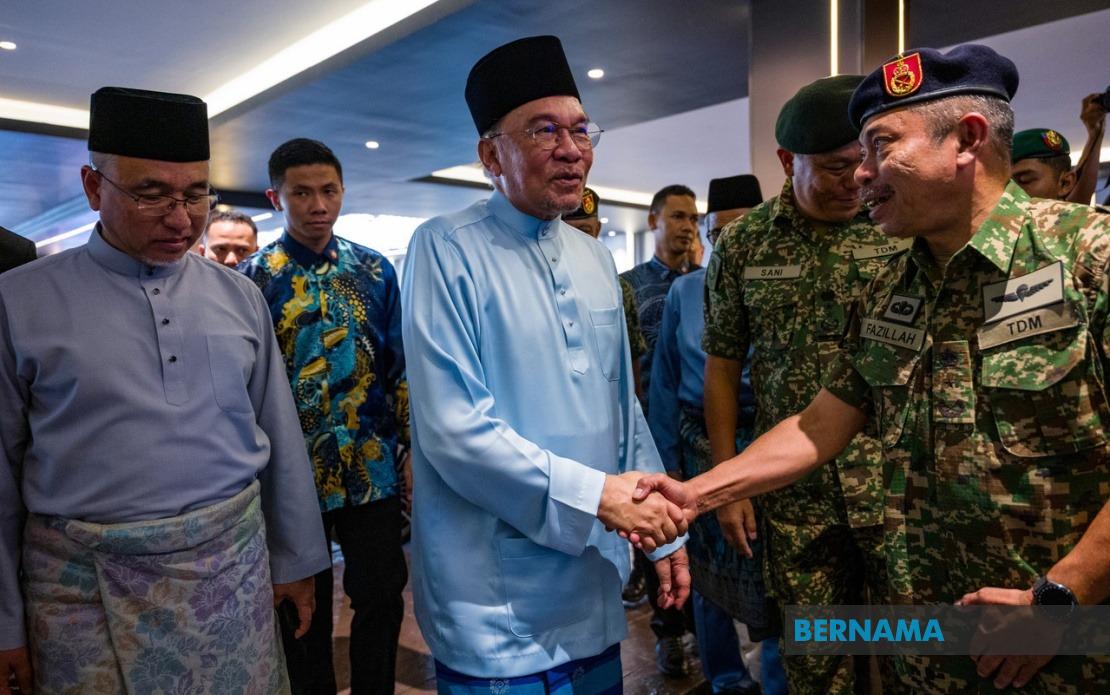
Prime Minister Datuk Seri Anwar Ibrahim has pledged to increase defence spending in the 2027 budget, signalling his administration's determination to overhaul the Malaysian Armed Forces and address longstanding concerns about servicemen's living conditions. The announcement, made during a national programme at Terendak Camp in Melaka, underscores a strategic shift toward investing in both military capability and the welfare of uniformed personnel—a dual focus that officials believe will strengthen readiness and morale across the defence establishment.
Chief of Defence Force General Tan Sri Malek Razak Sulaiman endorsed the initiative, framing the budgetary increase as evidence of government backing for institutional development. He emphasised that improved resource allocation would buttress the MAF's transformation into a cohesive, technologically advanced force capable of defending the nation's interests. The general's public support reflects confidence within the military hierarchy that sustained financial commitment will translate into tangible operational improvements and a more professional defence apparatus.
The modernisation component of the plan draws directly from the MAF's Future Force strategy, a comprehensive roadmap for acquiring and upgrading military assets and equipment. This framework has guided defence planning for years, but budgetary constraints have often delayed implementation of critical upgrades. Higher funding levels under the 2027 budget would accelerate procurement timelines and enable the force to replace ageing systems with contemporary platforms, particularly in areas such as naval and air capabilities where technological gaps have widened relative to regional counterparts.
Personnel welfare constitutes a particularly significant dimension of the proposed spending increase. Anwar, who serves concurrently as Finance Minister, highlighted improvements to military housing as a priority, recognising that substandard accommodation has long been a source of discontent among servicemen and their families. The construction of a new hospital facility signals commitment to healthcare infrastructure, an area where military medical services have faced resource constraints. Additionally, funding for basic utilities including water supply addresses fundamental quality-of-life issues that, while seemingly mundane, directly affect the day-to-day experience of armed forces personnel stationed across the country.
The correlation between improved living standards and operational performance is well understood in defence management circles. When soldiers, sailors, and airmen live in adequate accommodation with reliable utilities and access to quality medical care, retention rates typically improve and morale stabilises. This matters substantially for Malaysia, where recruitment and retention challenges have occasionally strained unit strength. By investing in barracks quality and support services, the government implicitly acknowledges that modernising the MAF extends beyond hardware to encompassing human capital development and personnel satisfaction.
Simultaneously, Anwar announced that the cabinet has agreed in principle to streamline and accelerate promotion mechanisms within the MAF and the Royal Malaysia Police. This reform addresses another long-standing grievance among uniformed services—career progression that has sometimes appeared opaque or glacial compared with civilian bureaucratic advancement. Aligning military promotion procedures with general public service schemes could enhance transparency and provide servicemen with clearer career pathways. Such harmonisation signals an attempt to professionalise military human resources management and make armed forces careers more competitive relative to civilian alternatives, potentially supporting recruitment efforts.
The timing of these announcements reflects broader regional dynamics that have influenced Malaysian defence thinking. Southeast Asia faces growing strategic uncertainty, with rising tensions in disputed maritime zones, expanding great-power competition, and evolving security threats ranging from transnational terrorism to cyber warfare. While Anwar did not frame the defence spending increase explicitly in terms of regional challenges, the underlying rationale is evident: a capable, modern-equipped, and well-motivated MAF serves as a credible deterrent and enables Malaysia to maintain strategic autonomy in a complex geopolitical environment.
From a budgetary perspective, identifying precisely how much the allocation will increase remains unclear from the announcements. The government has indicated an intention to boost defence funding but has not disclosed specific figures or the percentage increase relative to the current defence budget. This ambiguity may reflect ongoing internal budget discussions or a deliberate strategy to avoid premature commitment to numbers before parliamentary procedures finalise the 2027 fiscal framework. Defence spending represents a politically sensitive budgetary category, balancing security imperatives against competing demands for health, education, and social programmes.
The announcement carries implications for Malaysia's industrial and procurement landscape. Higher defence expenditure typically creates opportunities for both domestic defence contractors and foreign military equipment suppliers. Malaysian companies in aerospace, maritime, and electronics sectors may see expanded opportunities to participate in modernisation projects. Conversely, the armed forces will likely pursue international partnerships and acquisitions to address capability gaps that domestic industry cannot fill. Managing these procurements efficiently and transparently will be crucial, particularly given occasional public scrutiny of defence spending and recurring concerns about value for money.
International observers and regional neighbours will likely interpret the defence spending increase as reflecting Malaysian intentions to maintain military relevance and uphold security interests. For a middle-power nation like Malaysia, whose maritime domain is vast and whose strategic location places it at the intersection of multiple regional powers' spheres of influence, credible military capacity provides diplomatic weight. The modernisation initiative thus carries symbolic significance beyond its immediate operational implications, communicating resolve to external audiences regarding Malaysia's commitment to its own security.
The integration of personnel welfare into defence planning represents a subtle but important conceptual shift. Traditionally, military budgets prioritised equipment and infrastructure over servicemen's living standards. By explicitly packaging welfare improvements alongside weapons systems and capability development, the government signals understanding that force effectiveness depends on institutional health writ broadly. This approach aligns with contemporary military management practices in developed nations and reflects lessons learned from militaries worldwide regarding correlation between personnel satisfaction and operational readiness.
Implementing these initiatives will require sustained budget discipline and efficient project management. Defence modernisation projects frequently encounter delays, cost overruns, and technical challenges. The government's commitment to increasing allocations must be matched by institutional capacity to spend money effectively—a prerequisite that depends on robust procurement frameworks, project oversight mechanisms, and protection against waste or corruption. The success of these initiatives will ultimately be measured not merely by budgetary increases but by observable improvements in military capability and servicemen's quality of life over the coming years.

