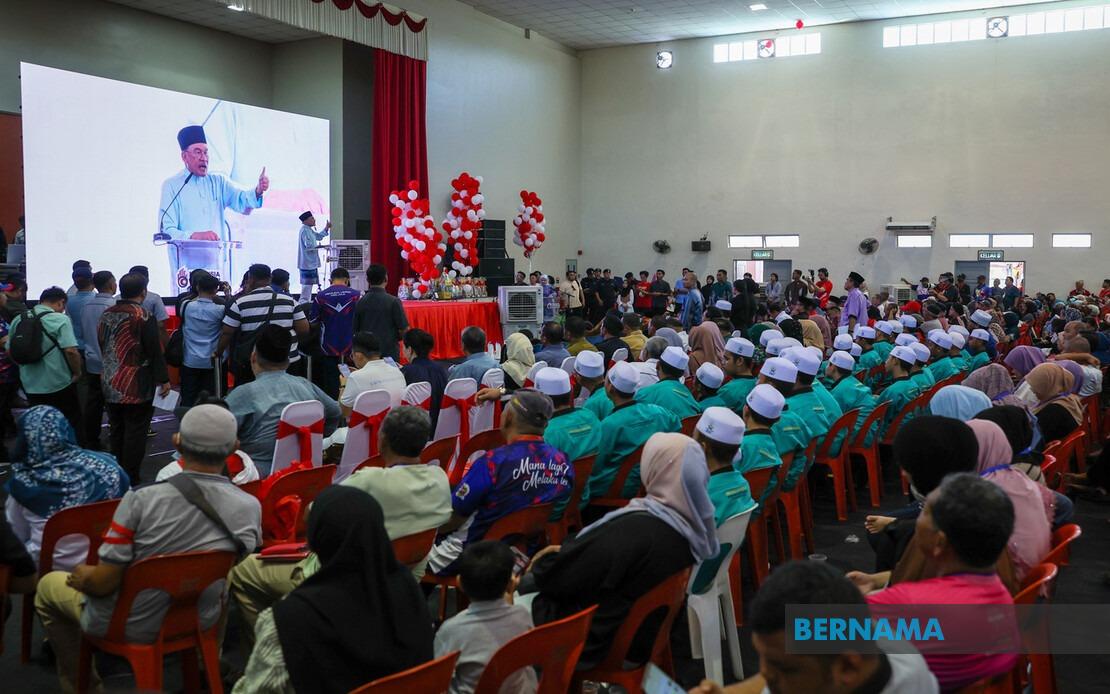
Prime Minister Datuk Seri Anwar Ibrahim has reaffirmed the MADANI Government's commitment to equitable support across Malaysia's diverse education landscape, addressing concerns that increased allocations to Islamic institutions might come at the expense of vernacular schools. Speaking at the Gelombang MADANI Carnival in Alor Gajah, Melaka, on August 7, Anwar stressed that the government's approach prioritizes balanced development without marginalizing any community or educational sector.
The Prime Minister emphasized that heightened investment in Islamic educational institutions represents a correction of historical neglect rather than preferential treatment. Pondok schools and tahfiz institutions had received inadequate government support for extended periods, he noted, and the current administration is rectifying this disparity. Simultaneously, Anwar highlighted that the government has already scheduled announcements regarding allocations for Chinese and Tamil schools, with details to be unveiled in Kuala Lumpur within approximately two weeks. This dual approach signals the administration's intention to demonstrate visible commitment to all education streams rather than pursuing incremental or delayed disbursements.
The timing and substance of Anwar's statements carry significant weight in Malaysia's educational and political landscape. Education funding has historically been a sensitive issue capable of inflaming communal tensions, particularly regarding the balance between national and vernacular school systems. By publicly affirming that Chinese and Tamil school support remains on the government's agenda, Anwar seeks to forestall perceptions of favoritism that could undermine social cohesion. The explicit announcement of forthcoming details also serves as a reassurance mechanism, preventing speculation or anxiety among non-Muslim communities about potential resource reallocation.
Anwar framed this equitable approach as foundational to Malaysia's broader social stability. In a country where diverse religious and ethnic communities coexist, he argued, ensuring that no segment feels systematically disadvantaged becomes essential for maintaining peace. The Prime Minister pointed to Malaysia's relative success as a plural society compared to other nations plagued by communal suspicion and conflict, attributing this to mutual respect and inclusive governance. This framing positions education funding decisions within a larger narrative about national identity and the preservation of Malaysia's distinctive multicultural model.
The Prime Minister's invocation of the Islamic concept of 'ummatan wasatan', derived from Surah Al-Baqarah verse 143, introduced a religious and philosophical dimension to his argument for balanced governance. This principle, emphasizing moderation and equilibrium in faith, knowledge, and conduct, becomes the theological justification for inclusive policymaking. Anwar suggested that true Islamic practice demands exemplary behavior across social, environmental, and governance spheres, positioning the MADANI Government as embodying these ideals through fair treatment of all communities. This rhetorical strategy allows him to ground secular principles of equality in Islamic doctrine, appealing to both Muslim voters and broader audiences concerned with national unity.
The announcement of RM1.29 million in allocations across thirteen Islamic educational institutions in Melaka provided concrete evidence of the government's commitment to upgrading religious schools. Recipients included Madrasah Tahfiz Al-Quran Wal Qiraat Kota Melaka, which received RM250,000, and Sekolah Rendah Arab JAIM Pernu with RM200,000, among others. These allocations specifically target infrastructure improvements and the integration of modern technology, including artificial intelligence and computer training. By modernizing pondok schools and tahfiz institutions with technological resources comparable to those available in Chinese and Tamil schools, the government attempts to eliminate perceived quality disparities that might otherwise fuel educational inequality.
Anwar's explanation of the rationale behind increased Islamic education support reveals the administration's concern with preventing institutional decay within this sector. If pondok schools and religious institutions were left without adequate resources while vernacular schools continued operating efficiently, these disparities would inevitably attract scrutiny and criticism. The government's strategy therefore involves bringing underinvested institutions up to contemporary standards rather than simply directing resources toward the most politically vocal groups. This logic reflects a broader commitment to equity as parity of investment rather than selective favoritism.
The historical context Anwar provided underscores how education funding became politicized under previous administrations. The Prime Minister noted that assistance to religious schools had been discontinued during earlier periods, necessitating restoration efforts beginning in 2023 and intensified support in 2024 following the formation of the Unity Government. This historical framing positions the current government as correcting past neglect rather than implementing novel preferential policies. The narrative suggests that rebalancing represents a return to fair allocation principles rather than a departure toward bias, though critics might argue that such framing obscures the distributional implications of policy shifts.
The presence of multiple government figures at the event, including Melaka Chief Minister Datuk Seri Ab Rauf Yusoh and Deputy Higher Education Minister Adam Adli Abdul Halim, alongside the Prime Minister's wife Datuk Seri Dr Wan Azizah Wan Ismail, emphasized the government's unified commitment to this message. The ceremonial nature of the announcement and the carnival setting provided a public platform for these commitments, generating media coverage and public awareness beyond the immediate beneficiary institutions. Such visibility serves the dual function of demonstrating government engagement with educational development while signaling to all communities that their respective educational sectors receive systematic attention.
Anwar's messaging strategy also incorporated implicit appeals to national pride and global perception. By suggesting that other countries should observe Malaysia's governance model regarding cleanliness, integrity, and absence of corruption, he positioned equitable education funding as part of Malaysia's international reputation. This externalization of motivation attempts to elevate the policy beyond domestic political calculations, framing it instead as essential to national standing. For Malaysian readers and regional observers, this rhetoric suggests that maintaining Malaysia's comparative advantage as a stable, multiethnic democracy depends significantly on educational equity and inclusive resource distribution.
The implications of these commitments extend beyond immediate budgetary considerations to questions about long-term sustainability and institutional development. If Chinese and Tamil schools are to receive substantial allocations soon, alongside ongoing Islamic education support, the government must demonstrate that funding commitments are durable rather than subject to fluctuation with political cycles or fiscal pressures. The announcement of specific timelines and amounts for Islamic institutions, paired with assured forthcoming announcements for vernacular schools, establishes baseline expectations against which future performance will be measured.
For Southeast Asian context, Malaysia's approach to education funding across diverse communities offers lessons regarding plural governance in developing democracies. The region includes numerous multiethnic, multireligious societies grappling with similar distribution questions. Anwar's articulation of how inclusive educational investment supports broader stability and national identity reflects thinking that extends beyond Malaysia's borders. Whether the government successfully delivers on these commitments will influence regional assessments of how democratic governments can reconcile diverse educational preferences with equity principles.
Looking forward, the government faces the challenge of translating these rhetorical commitments into sustained resource allocation patterns demonstrating genuine parity across education streams. The specific announcement regarding Chinese and Tamil school funding within two weeks represents a critical test of government credibility. If those allocations match the scale and urgency evident in Islamic education announcements, the MADANI Government will have substantiated its claims of balanced support. Conversely, delayed or diminished allocations to vernacular schools would undermine the narrative of equitable governance and revive concerns about preferential treatment. The coming weeks will therefore prove pivotal in determining whether the government's inclusive rhetoric translates into practice.

