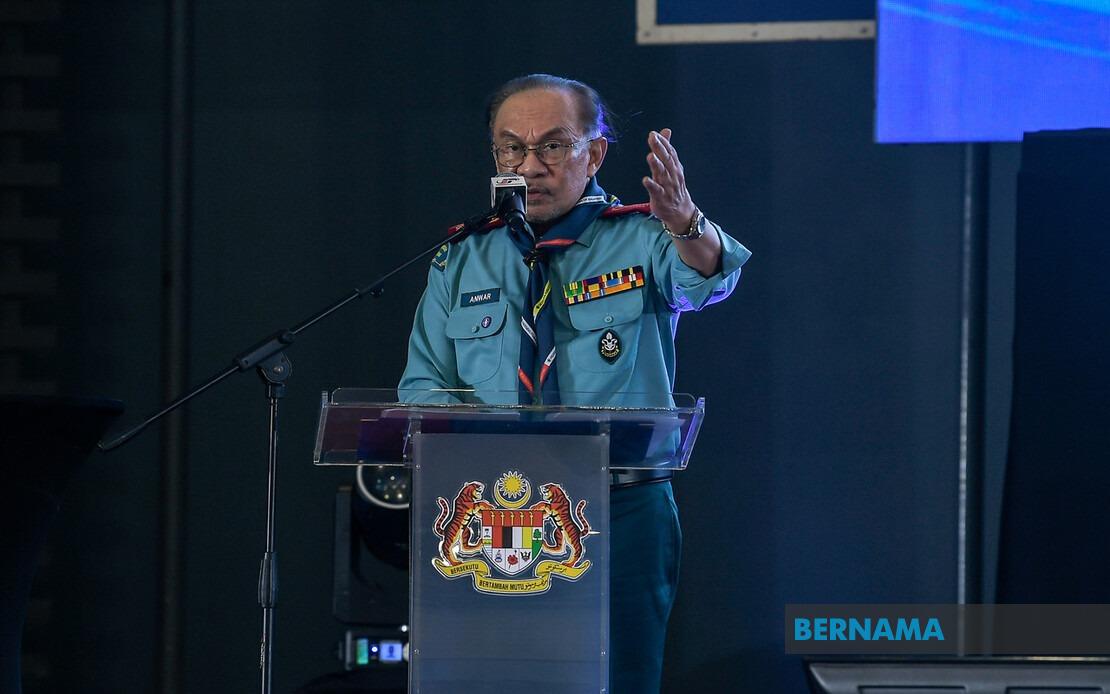
Prime Minister Datuk Seri Anwar Ibrahim has pushed back against the notion that championing Malay, Malaysia's official language, necessarily requires diminishing competency in other tongues, drawing a distinction that reflects broader concerns about language policy balancing in a multilingual nation. Speaking at the Ambang Merdeka Sahabat MADANI 2026 highlight programme at Universiti Teknologi MARA (UiTM) Permatang Pauh on August 29, Anwar articulated a framework positioning linguistic proficiency as complementary rather than competitive, suggesting that citizens can develop mastery across multiple languages without sacrificing national identity or economic standing.
The Prime Minister's remarks arrive amid ongoing tensions surrounding Malaysia's language landscape, where questions about the primacy of Malay in education and public discourse periodically resurface. Anwar's intervention seeks to reframe the conversation, asserting that all Malaysians, irrespective of ethnic origin, ought to possess strong command of the national language—a foundational requirement for civic participation and social cohesion. Simultaneously, he acknowledged that this aspiration need not preclude excellence in English, Mandarin Chinese, and Tamil, languages that carry substantial weight in contemporary economic and cultural contexts.
The Prime Minister specifically highlighted English's evolution into a dominant global lingua franca, one that operates across commerce, technology, diplomacy, and academia. Rather than positioning English as a threat to Malay, Anwar characterised it as a complementary tool that broadens horizons for Malaysian learners. This framing reflects a pragmatic assessment: in an increasingly interconnected world, English fluency provides Malaysian citizens—whether professionals, entrepreneurs, or students—with access to international markets, knowledge systems, and collaborative networks that remain essential for competitive advantage.
Mandarin Chinese received particular emphasis in Anwar's address, reflecting Malaysia's geographic and economic positioning within Southeast Asia and its ties to China as a major trading partner and source of investment. The Prime Minister noted that proficiency in Mandarin carries mounting significance as a regional economic language, positioning it not as a luxury but as a strategic asset. For Malaysian businesses, workers, and entrepreneurs seeking to engage with Chinese markets or multinational enterprises headquartered in China, linguistic capability becomes directly tied to commercial viability and career prospects. This recognition signals acknowledgment that Malaysia's future prosperity depends partly on citizens' ability to operate across multiple linguistic spheres.
Tamil, too, featured in Anwar's enumeration, though with slightly less elaboration than English or Mandarin. The inclusion reflects both Malaysia's significant Tamil-speaking population and broader cultural ties within the Indian diaspora across Southeast Asia. By naming Tamil alongside more economically dominant languages, Anwar gestures toward inclusive representation—suggesting that language policy should accommodate Malaysia's ethnic and cultural pluralism rather than prioritise only languages with immediate economic returns.
Crucially, Anwar invoked the phrase "zero-sum game" to reject the underlying assumption that linguistic resources are finite and that advancing one language necessarily comes at another's expense. This framing proves particularly valuable in the Malaysian context, where historical disputes over language education have occasionally been framed as either-or propositions. By contrast, the Prime Minister advocated for an additive model: children should master Chinese languages provided their Malay remains sufficiently robust; learning regional languages enhances rather than diminishes opportunity; economic imperatives drive multilingualism as a rational personal strategy rather than cultural betrayal.
Beyond technical questions of linguistic pedagogy, Anwar's remarks carried broader implications for national unity and interethnic relations. He cautioned against sowing discord among communities and warned that Malaysia's hard-won harmony cannot persist automatically without deliberate collective effort. This invocation of fragility reflects acknowledgment that language policy touches sensitive nerves in a society where ethnic and religious identities remain politically salient. By framing language acquisition as a shared national project—one requiring mutual respect and genuine commitment to each community's interests—Anwar attempted to reposition linguistic debates away from zero-sum ethnic competition.
The Prime Minister further advocated for cultivating a culture of reciprocal support and shared benefit, arguing that development gains should accrue inclusively across all racial groups rather than concentrating advantages. This appeal to equitable distribution carries particular weight given persistent disparities in educational access and economic outcomes along ethnic lines in Malaysia. Language proficiency, positioned as a key to unlocking opportunity, therefore becomes intertwined with aspirations for fairer distribution of prosperity.
For Malaysian policymakers and educators, Anwar's articulation offers guidance on navigation between competing pressures. National identity and linguistic cohesion—embodied in Malay—remain non-negotiable anchors in the constitutional and political order. Simultaneously, economic realities and global integration demand that citizens command additional languages. The challenge lies in designing educational curricula and language policies that genuinely cultivate excellence across multiple linguistic domains rather than settling for superficial exposure to several languages while ensuring deep proficiency in none.
The statement also carries implications for how Malaysia positions itself regionally and globally. A population capable of functioning across Malay, English, Mandarin, and Tamil represents a distinctive asset in an increasingly multilingual Southeast Asia. Such capacity facilitates cross-border commerce, diplomatic engagement, and cultural exchange while preserving local and national identity markers. For multinational corporations and international organisations, Malaysia's multilingual workforce becomes comparatively attractive, potentially anchoring foreign direct investment and high-skilled employment creation.
Anwar's intervention does not resolve all tensions inherent in language policy—questions about which language receives priority in education at different levels, resources allocation, and examination standards remain substantive policy matters requiring careful calibration. However, by establishing conceptually that linguistic diversity constitutes a collective strength rather than a threat, the Prime Minister has attempted to create psychological and political space for pragmatic compromise. Whether this reframing gains traction among educators, parents, and ethnic community leaders will significantly influence how Malaysia's language questions evolve over the coming years.

