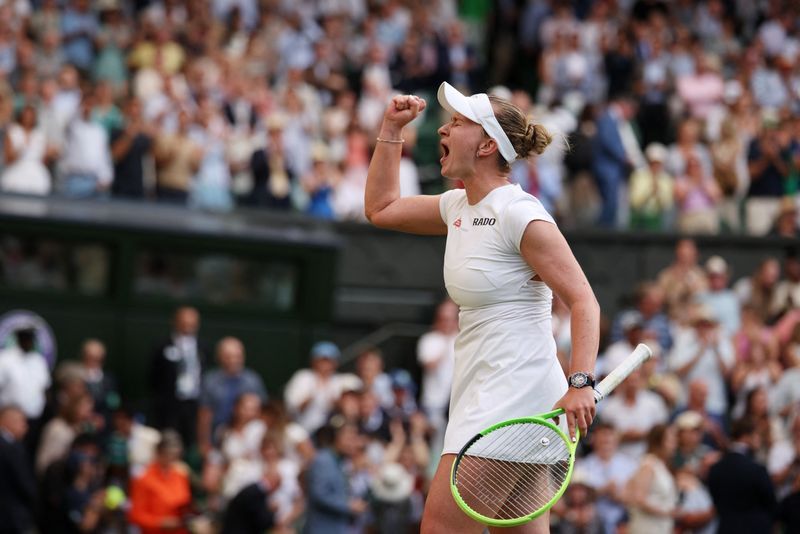
Barbora Krejcikova demonstrated the resilience that defines her career by recovering from a set deficit to overcome fifth seed Mirra Andreeva and advance into the third round of Wimbledon on Wednesday. The Czech player's 4-6 7-5 6-4 victory on Centre Court showcased her ability to recalibrate under pressure, a quality that has underpinned her success across tennis's major stages and made her one of the sport's most adaptable competitors.
Andreeva, the 19-year-old Russian who captured her maiden Grand Slam title at the French Open mere weeks earlier, initially appeared well-positioned to continue her remarkable early-season form against her more experienced opponent. The youngster claimed the opening set after Krejcikova's initial momentum dissipated, with the Czech player struggling to maintain the intensity that had given her an early 3-0 advantage before her performance noticeably declined.
The contrast between the two players highlighted a generational divide in professional tennis. Krejcikova, already a two-time major champion with triumphs at Wimbledon and the French Open under her belt, possesses the tactical maturity and match intelligence accumulated through years of high-level competition. Andreeva, conversely, remains in the intoxicating early stages of breakthrough success, still learning to navigate the psychological demands of consecutive weeks facing elite opposition.
Krejcikova's recovery in the second set demonstrated why tactical experience remains crucial in women's tennis. Rather than attempting to match Andreeva's youthful aggression, the Czech competitor imposed her own rhythm and forced the younger player into extended rallies where precision and court positioning proved decisive. This shift in approach forced Andreeva into mounting frustration, evident in her demeanor as the match progressed toward its climax.
The deciding set became a battle of wills and mental fortitude. Andreeva saved six match points against Krejcikova's sustained pressure, each saved point representing a moment when the Russian youngster refused to yield despite mounting pressure. Yet the accumulated toll of defending repeatedly proved insurmountable, and Krejcikova ultimately secured the breakthrough she had pursued throughout the final set, closing out the encounter with characteristic composure.
For Krejcikova, the victory represented only her second career triumph over Andreeva, and she acknowledged the difficulty of their encounter in her post-match remarks. The Czech champion, reflecting on their rivalry, noted that their fifth meeting had proven consistent with their previous encounters—intensely competitive affairs where neither player yields ground without justification. Krejcikova's respect for Andreeva's talents was evident in her assessment, recognizing that the Russian possesses the technical foundation and mental resilience to challenge the sport's established elite for years to come.
Krejcikova's advancement carries particular significance within the context of her recent career trajectory. The Czech player has maintained her position among tennis's upper echelon despite the perpetual emergence of younger competitors eager to claim their place at the sport's summit. Her continued success at Grand Slam events underscores the enduring value of experience, tactical sophistication, and the psychological fortitude required to perform consistently across multiple surfaces and tournament formats.
Andreeva's exit, while disappointing, offers valuable perspective on the nature of breakthrough success in professional tennis. The Russian's French Open triumph demonstrated genuine capability at the highest level, yet Wimbledon's specific demands—including the surface's unique characteristics and the mental reset required between major tournaments—proved difficult to navigate immediately following a major championship victory. Such experiences are commonplace among emerging talents and often provide crucial learning opportunities.
Looking ahead, Krejcikova will face Czech compatriot Nikola Bartunkova in the third round, setting up an all-Czech encounter that carries considerable national interest. The matchup between fellow Czech competitors adds a distinct narrative dimension to Krejcikova's pursuit of deeper advancement into the tournament. Both players carry the expectations and support of their tennis federation, though Krejcikova enters as the clear favorite given her established credentials and recent performance against a genuine top-five player.
For Malaysian and Southeast Asian tennis observers, Krejcikova's performance demonstrates the attributes that distinguish elite performers from rising challengers. Her capacity to reassess tactical approaches mid-match, maintain composure during critical junctures, and impose her strategic vision against a formidable opponent underscores why certain players consistently perform in high-pressure environments. As regional tennis development continues to produce promising young competitors, studying the mental and tactical approaches of established champions like Krejcikova provides valuable instructional framework for emerging talent seeking to establish sustained excellence.

