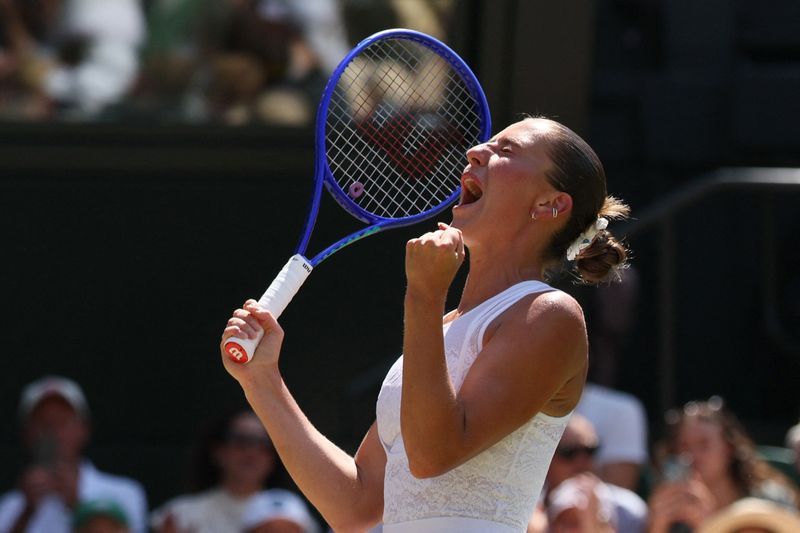
Ukraine's Marta Kostyuk delivered a commanding performance on Wednesday to eliminate Italy's Jasmine Paolini from the Wimbledon quarter-finals, progressing to the semi-finals with a decisive 6-3 6-2 victory in sweltering conditions on Centre Court in London.
The 12th-seeded Kostyuk entered the match with considerable momentum and immediately imposed her will on proceedings, seizing control from the opening moments. Her aggressive approach yielded immediate dividends as she captured the opening set in a brisk 36 minutes, showcasing the tactical ruthlessness required to succeed at tennis's most prestigious grass court championship. Two decisive service breaks, accomplished at 3-2 and again at 5-3, formed the foundation of her dominance in that opening stanza, leaving Paolini struggling to establish any meaningful rhythm.
For the 24-year-old Ukrainian, this quarter-final appearance on Centre Court represented a significant career milestone. Making her debut on grass tennis's most hallowed stage in the singles competition's latter stages, Kostyuk appeared entirely unfazed by the grandeur of the occasion and the weight of expectation that typically accompanies such moments. Her composure proved particularly noteworthy given that she arrived at the match having lost their previous two head-to-head encounters, suggesting that Paolini possessed tactical blueprints that could potentially neutralise her strengths. Yet Kostyuk systematically dismantled such patterns with clinical precision.
The Ukrainian's forehand emerged as the decisive technical weapon throughout the encounter. Wielding the shot with considerable pace and penetration, Kostyuk repeatedly forced Paolini into defensive positions, preventing the Italian from establishing her own aggressive baseline game. This tactical superiority manifested most starkly during the second set, where Kostyuk's command became even more pronounced. Breaking Paolini's serve at the opening opportunity to establish a 3-1 advantage, Kostyuk never relinquished her grip on proceedings. Critically, Paolini failed to manufacture a single break point opportunity during the entire match, an indicator of how thoroughly the Ukrainian had neutralised her opponent's capacity to generate attacking opportunities.
With Queen Camilla observing from the Royal Box, the crowd attempted to galvanise Paolini's challenge, sensing an opportunity to back the underdog narrative. However, such encouragement proved insufficient against Kostyuk's relentless execution. The Ukrainian methodically consolidated her service games with clinical efficiency, closing out the match after just 69 minutes when she converted a second match point on Paolini's serve. The rapidity of the contest reflected the gulf in performance levels that had emerged across the two hours of play.
Kostyuk's progression carries particular significance within the broader context of the tournament and Ukrainian sport more broadly. Representing her nation during a period of extraordinary national hardship, Ukrainian athletes have become symbols of resilience and determination for their homeland. Kostyuk's advance to the semi-finals extends that narrative, providing a source of national pride and inspiration at a moment when such positive affirmations hold profound cultural weight.
For Paolini, the defeat represents a disappointment following her appearance in the previous year's final. Despite her ranking and pedigree, the Italian's grass court form continues to oscillate, suggesting that the surface remains a relative vulnerability within her overall game despite her demonstrated capacity to succeed at major championships. At 13th seed, expectations had mounted that she might mount a deeper run at Wimbledon, yet Kostyuk's superior positioning and aggressive execution exposed limitations in how Paolini transitions between surfaces.
Kostyuk's pathway through this tournament has underscored the tactical versatility required to succeed on grass. Unlike clay or hard courts, where baseline rallies often determine points, grass rewards aggressive positioning and serves as a levelling surface where technical mastery and mental fortitude frequently override seeding hierarchies. The Ukrainian's demonstration of these qualities against a higher-ranked opponent suggests she has genuinely mastered the demands of the surface.
The semi-final draw now awaits Kostyuk, with her opponent to be determined by the remaining quarter-final results. Her performance here has established her as a serious contender for the championship, a prospect that would have seemed considerably less plausible before the tournament commenced. Her combination of powerful groundstrokes, tactical intelligence, and psychological resilience positions her as a threatening opponent for any remaining competitor, regardless of their ranking or tournament history.
As the tournament progresses toward its climax, Kostyuk's presence in the semi-finals enriches the competition's narrative dimension while simultaneously emphasising that Wimbledon continues to reward those players capable of executing their game plan with precision, clarity, and unwavering conviction under pressure.

