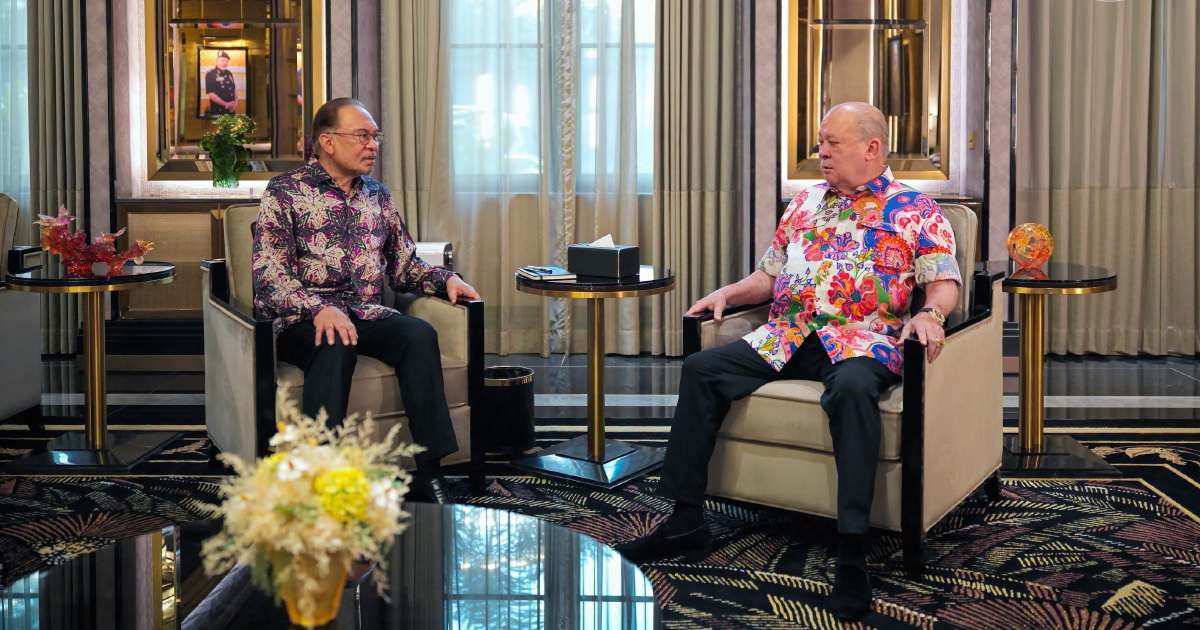
His Majesty Sultan Ibrahim, King of Malaysia, received Prime Minister Datuk Seri Anwar Ibrahim in a formal audience at Istana Bukit Tunku in Kuala Lumpur, underscoring the constitutional framework that underpins the kingdom's governance as the nation prepared to mark its 69th National Day celebration.
The meeting between Malaysia's head of state and head of government represents a significant moment in the ceremonial calendar, occurring on the eve of one of the most important national observances in the Malaysian political and social calendar. Such audiences between the Agong and the Prime Minister are conducted regularly as part of constitutional protocol, allowing the sovereign to remain informed of state affairs and government initiatives.
Istana Bukit Tunku, the official residence of the Yang di-Pertuan Agong, sits prominently in central Kuala Lumpur and serves as a symbol of the constitutional monarchy that has defined Malaysia's political structure since independence. The palace has hosted countless significant diplomatic and state functions throughout the nation's modern history, and continues to be the venue for formal constitutional interactions between the sovereign and senior government officials.
The National Day celebration, observed on 31 August each year, commemorates Malaysia's independence and the formation of the federation. The 69th observance represents nearly seven decades of nationhood and provides an occasion for Malaysians across all states and communities to reflect on shared identity and national achievement. Public holidays, flag-raising ceremonies, cultural performances, and patriotic displays typically characterise the nationwide commemoration.
Prime Minister Anwar Ibrahim's administration has placed emphasis on national unity and social cohesion since taking office, themes that typically feature prominently in National Day messaging and ceremony. The audience with His Majesty occurs within this broader context of the government's policy direction and the constitutional role of the monarchy in affirming national values.
Malaysia's constitutional framework vests certain powers and responsibilities in the Yang di-Pertuan Agong, who serves as the supreme head of state. The institution of the monarchy carries particular significance in the Malaysian context, representing continuity with the nation's pre-independence heritage whilst embodying the constitutional commitments that underpin the social contract governing the federation. Regular audiences between the sovereign and Prime Minister form an essential part of this constitutional relationship.
The timing of such formal engagements, particularly those preceding major national occasions, often carries symbolic weight beyond routine administrative necessity. By receiving the Prime Minister in official audience ahead of the National Day celebrations, His Majesty reinforces the constitutional monarchy's integral position within Malaysia's governmental and ceremonial life, whilst demonstrating the harmonious relationship between executive leadership and the institution of the Crown.
National Day in Malaysia has evolved significantly since the nation's independence on 31 August 1957. What began as a commemoration of the end of British colonial rule has expanded to incorporate the formation of Malaysia in 1963, when Sabah, Sarawak, and Singapore joined the federation alongside Malaya. Though Singapore subsequently left the federation in 1965, the collective memory of Malaysia's founding continues to shape how the nation understands itself and its historical trajectory.
The address and activities surrounding National Day typically include official ceremonies attended by high-ranking government and state officials, public receptions, and media engagements through which the government communicates its current priorities and vision for national development. Such occasions provide platforms for articulating messages about progress, inclusive governance, and the challenges and opportunities facing the nation.
For Malaysian readers and regional observers, the formal interaction between the sovereign and Prime Minister signals the continuation of constitutional norms and peaceful governance structures that have characterised much of Malaysia's political history. In a region where institutional stability remains a significant concern, the regular functioning of constitutional relationships between crown and government carries reassuring implications for political predictability and the rule of law.
The audience also reflects the ceremonial dimensions of governance that remain important features of Westminster-influenced constitutional systems. While executive power flows through the Prime Minister and cabinet, the presence and blessing of the Yang di-Pertuan Agong confers additional legitimacy and ceremonial gravitas upon the state's institutions and major national occasions.
Looking forward, the 69th National Day will provide an occasion for assessing Malaysia's progress across various sectors including economic development, infrastructure, education, and social welfare. The government's messaging during these celebrations often previews policy directions and spending priorities for the coming year, making the period surrounding National Day significant for those tracking Malaysian domestic governance and regional economic trends.

