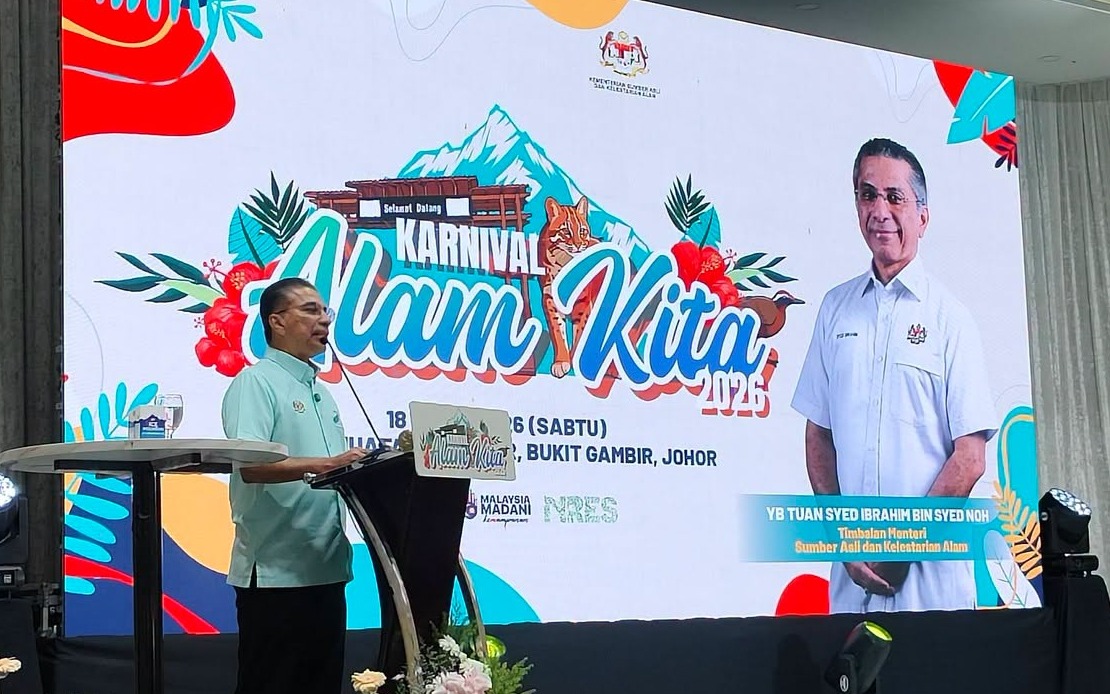
The Ministry of Natural Resources and Environment (NRES) has launched its Karnival Alam Kita (KAK) 2026 initiative in Johor, signalling an intensified effort to embed environmental consciousness directly into community routines and family decision-making. Rather than positioning sustainability as a top-down government mandate, the ministry's strategy centres on demonstrating tangible ways that ordinary households can participate in green practices. Deputy Minister Syed Ibrahim Syed Noh articulated this philosophy at the festival's opening in Tangkak, emphasising that environmental stewardship belongs not exclusively to bureaucrats but to every household, school, and workplace throughout the nation.
The conceptual foundation of KAK 2026 reflects a deliberate pivot away from abstract environmental rhetoric towards lived experience. The ministry recognises that while most Malaysians acknowledge rare earth elements, e-waste, and climate change as critical challenges, the average person struggles to understand how these global phenomena connect to their daily purchasing decisions, waste disposal habits, and energy consumption. By transporting information, technological solutions, and service providers directly to communities through this carnival format, the NRES aims to collapse the distance between policy frameworks and household implementation. This grassroots engagement model mirrors successful sustainability campaigns elsewhere in Southeast Asia, where community participation rates increase markedly when citizens witness tangible environmental improvements in their own neighbourhoods.
Central to this year's push is the establishment of the Young Environmental Ambassador Programme, a structured training initiative targeting secondary school students across Johor and eventually nationwide. The programme's design acknowledges that adolescents wield considerable influence over family consumption patterns and are more likely to adopt and advocate for green habits if given peer-led rather than purely institutional leadership. By cultivating young ambassadors, the ministry creates multiplier effects whereby trained students become change agents within their households and social circles, gradually shifting cultural norms around waste, recycling, and resource conservation. This intergenerational approach has proven effective in other nations where youth-driven environmental movements have preceded broader policy shifts.
Parallel to the ambassador scheme, the NRES launched KUDAH, a structured waste collection initiative implemented by the ministry's Lestari Squad in partnership with Bateriku (M) Sdn Bhd, a specialist in battery and electronic waste recycling. At the Johor event, participants collected 37 kilogrammes of waste, with 17.3 kilogrammes comprising plastic bottles alone. The ministry quantified the environmental benefit in terms legible to everyday Malaysians: the collected waste will prevent an estimated 43.2 kilogrammes of carbon dioxide equivalent from entering the atmosphere, equivalent to the emissions generated by driving a petrol vehicle approximately 100 kilometres. This translation of abstract carbon metrics into relatable benchmarks—comparing emissions reductions to familiar transportation distances—demonstrates the ministry's sophisticated approach to communicating environmental impact.
The carnival itself functions as a marketplace of sustainability solutions, bringing together government bodies, non-governmental organisations, and commercial partners under a single platform. Visitors encounter interactive exhibits on biodiversity conservation, practical demonstrations of electronic waste recycling, and information sessions on used cooking oil collection programmes. Simultaneously, vendors showcase green products, creating economic incentives for businesses to develop and market environmentally responsible goods. This commercial dimension proves important for regional economies like Johor's, where environmental sustainability must align with economic opportunity rather than compete against it. Companies that position themselves as green innovators gain competitive advantage while meeting consumer demand increasingly evident among middle-class Malaysian households.
Malaysia's stated commitment to achieving net-zero carbon emissions by 2050 provides the macroeconomic backdrop for KAK 2026 and related initiatives. Reaching this ambitious target requires not merely incremental improvements in industrial efficiency or renewable energy adoption but a fundamental reshaping of consumer behaviour across decades. The festival represents one tactical component of a much larger strategic transition. Southeast Asia broadly faces pressure to decarbonise rapidly whilst managing competing demands for economic growth and poverty reduction. Malaysia's approach—leveraging entertainment and community engagement rather than regulatory enforcement—reflects pragmatic understanding that voluntary behavioural change, once established culturally, proves more durable than compliance driven by rules and penalties.
The geography of Karnival Alam Kita's deployment across Johor carries particular significance given the state's role as Malaysia's second-largest economy and home to major industrial, agricultural, and manufacturing sectors. Johor's forest reserves, river systems, and coastal zones face cumulative pressures from development, agricultural runoff, and pollution. Building environmental consciousness among Johor's 4.2 million residents therefore creates ripple effects throughout regional supply chains and consumption networks. Consumer behaviour shifts in Johor influence purchasing decisions that extend across the Klang Valley, Kuala Lumpur, and increasingly throughout ASEAN as Malaysian firms embed sustainability into their operations to meet international standards.
The ministry's partnership with Bateriku (M) Sdn Bhd and other private-sector entities underscores a recognition that government capacity alone cannot scale environmental action. The carnival model functions partly as procurement showcase where organisations discover suppliers, technologies, and service providers essential for implementing sustainability commitments. For waste management companies, renewable technology vendors, and green product manufacturers, events like KAK 2026 provide market intelligence and customer access that might otherwise require expensive marketing campaigns. This symbiosis between government agenda-setting and commercial innovation creates self-reinforcing loops whereby environmental progress generates business opportunities, which attract further investment and talent.
Looking forward, the success of KAK 2026 will depend on whether initial awareness translates into sustained behaviour modification. Environmental campaigns frequently generate temporary enthusiasm followed by reversion to prior habits once the event concludes and media attention fades. The Young Environmental Ambassador Programme potentially addresses this challenge by institutionalising environmental education within secondary school curricula and creating peer accountability structures that persist beyond the carnival. Similarly, ongoing KUDAH collection operations, if adequately resourced and marketed, could become routine fixtures in community calendars rather than one-off initiatives. The ministry faces the ongoing challenge of demonstrating that green lifestyle practices offer not merely abstract planetary benefits but tangible improvements to air quality, water purity, and health outcomes that citizens experience directly.
For Malaysian policymakers monitoring environmental outcomes, KAK 2026 represents an important experiment in grassroots mobilisation strategies. As regions throughout Southeast Asia grapple with rapid urbanisation, industrialisation, and climate impacts, the success or limitations of Malaysia's carnival-based engagement model will inform approaches adopted elsewhere. The initiative's emphasis on making sustainability personal, achievable, and economically sensible—rather than portrayed as sacrifice or constraint—may offer lessons applicable across the region. Whether Johor's residents ultimately achieve the shifts in consumption, waste management, and resource conservation that the festival aims to catalyse will reveal much about the prospects for voluntary environmental transformation in developing economies balancing growth with ecological preservation.

