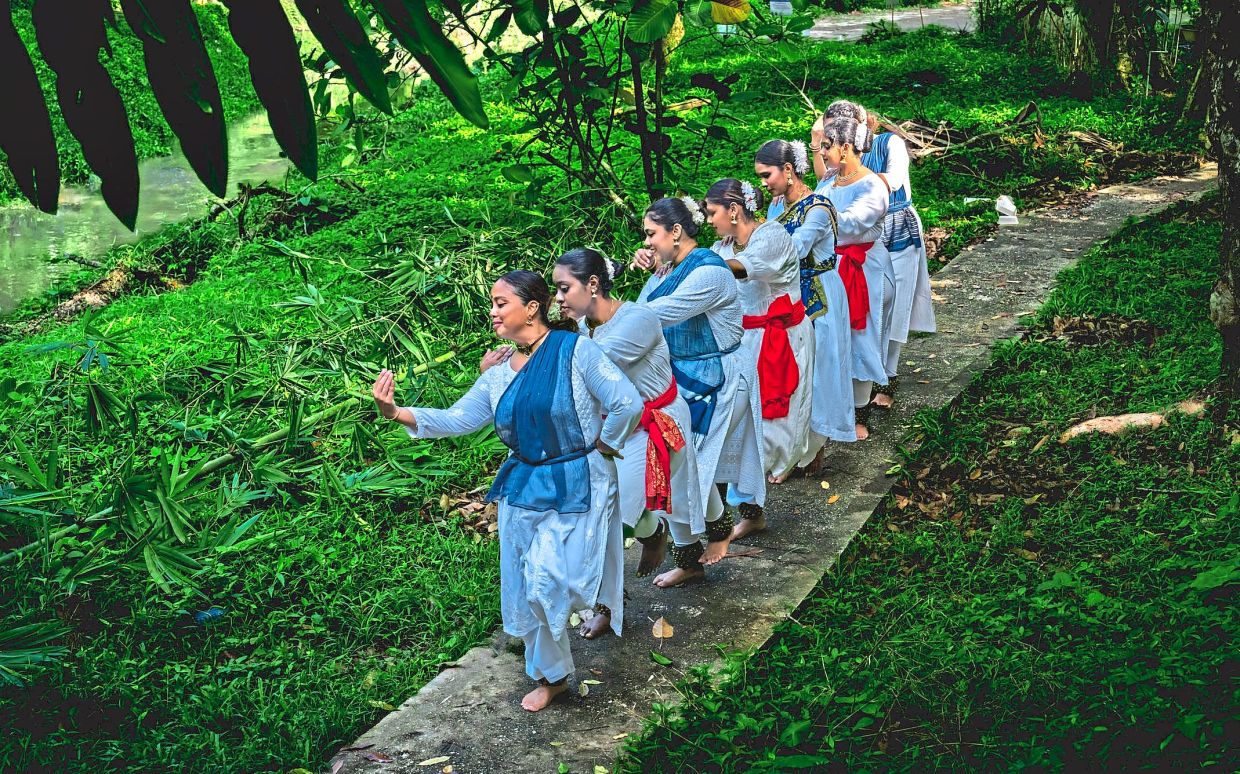
Kuala Lumpur-based Kalpana Dance Theatre (KDT) has reached a significant milestone this year – three decades of artistic practice in an industry where financial uncertainty and unpredictability often force organisations to close their doors. Like a river carving its own course through challenging terrain, the company has survived through constant creative reinvention, a feat that founder-director Shangita Namasivayam attributes to unwavering dedication and vision. To mark this anniversary, KDT is presenting an ambitious bharatanatyam concert at the Shantanand Auditorium, Temple of Fine Arts in Kuala Lumpur on August 8, a production that demonstrates how classical Indian dance can address contemporary environmental concerns.
Shangita describes the creative process as akin to nurturing life itself. Every production begins as a fragile idea, requiring patience, meticulous care and steadfast belief before it can materialise into a lived experience for audiences. This particular anniversary production draws conceptual inspiration from two major Indian river systems – the Ganga in northern India and the Kaveri in southern India. These waterways carry profound spiritual and cultural significance; the Ganga is revered as India's most sacred river, while the Kaveri has earned the epithet "Ganga of the South" for its indispensable role in irrigation, agriculture and hydroelectric power generation across the southern peninsula.
Beyond their practical utility, both rivers function as cultural lifelines for surrounding communities, facilitating the exchange of commerce, traditions and spiritual practices across generations. For centuries, Indian classical and folk dance traditions have drawn upon these rivers as sources of inspiration, with performances weaving together mythological narratives, musical traditions and regional movement vocabularies to capture their sacred essence. This thematic focus allows KDT to embed its anniversary celebration within a broader conversation about resource management and environmental stewardship – concerns that resonate deeply with contemporary Malaysian audiences grappling with urban development pressures and water security challenges.
Shangita's conceptual framework positions the Ganga as "the shore of compassion" and the Kaveri as "the mother of prosperity", two complementary principles that together illustrate how rivers function not merely as physical resources but as repositories of spiritual peace. By selecting rivers as her organisational metaphor, Shangita deliberately chose a vehicle to engage her young dancers in critical thinking about humanity's relationship with water systems. She emphasises that water represents the most essential and vulnerable resource on our planet, yet contemporary societies routinely abuse, pollute and neglect the river and ocean ecosystems that sustain all life. Through this production, she seeks to cultivate environmental consciousness among her dancers, transforming them from performers into informed advocates for water protection.
This pedagogical commitment extends beyond the rehearsal studio. Since January, KDT dancers have been actively participating in community clean-up initiatives alongside The Alliance of River Three (ART!), a volunteer-driven Malaysian environmental organisation founded in 2018 by Kennedy Michael. ART! operates with a specific mission: rehabilitating the Klang River through the development of River Three Parks, routine ecological restoration work and community engagement activities. The organisation gained recognition when it received The Star Golden Hearts Awards in 2020, validating its grassroots approach to urban river ecosystem restoration. Under ART!'s ambitious timeline, the Taman Melawati River Three SDG Park and the Mid Valley River Three SDG Park are targeted for completion by 2030, with KDT dancers contributing their labour to this effort.
For many of these young performers, the hands-on environmental work represents a revelatory experience. Shangita observes with some amusement that contemporary youth rarely engage in activities that soil their hands or challenge their comfort zones, making these river clean-up sessions particularly valuable for their character development. The partnership between an arts organisation and an environmental group demonstrates how creative sectors can amplify sustainability messaging by embedding it within cultural production, rather than treating environmental advocacy as separate from artistic practice. This integration allows dancers to understand themselves not merely as technical executors of choreography but as agents of social and environmental change.
The production itself represents a culmination of extensive collaborative dialogue. Shangita worked alongside three Chennai-based collaborators whom she has known for decades: choreographer PT Narendran, musician OS Arun and scriptwriter Dr Va Ve Subramanian. Through months of artistic exploration and exchange, these seasoned practitioners converged upon a unified creative vision that balances aesthetic ambition with social purpose. The familiarity and trust developed over many years of prior collaboration created an environment where complex ideas could be workshopped thoroughly, allowing the final production to achieve both artistic integrity and thematic coherence.
The concert will feature 54 dancers ranging in age from six to 62 years old, including performers with disabilities, across a 90-minute thematic presentation. Rather than showcasing individual virtuosity through featured soloists, the production deliberately distributes performing opportunities equitably, ensuring that every dancer contributes meaningfully to the collective narrative. The script, composed in Tamil with English narration, balances poetic language with philosophical depth, crafting a story that speaks across generational and linguistic boundaries. Complementing the dancers, a 30-member music ensemble will provide live accompaniment, though logistical and financial constraints necessitated limiting the size of the international team travelling to Malaysia.
This limitation actually created unexpected pedagogical opportunities. Shangita recognised that having accomplished international master artistes work directly with Malaysian dancers represented a valuable cross-cultural exchange. These renowned practitioners bring distinctive technical vocabularies, interpretive philosophies and performance aesthetics developed through their own artistic journeys. When young Malaysian dancers train alongside such internationally recognised figures, they absorb far more than refined technique; they develop deeper understanding of bharatanatyam's richness, internal diversity and capacity for contemporary expression. These mentoring relationships prove instrumental in cultivating thoughtful, intellectually engaged artists rather than merely technically proficient performers.
Producing a theatrical work invariably presents multifaceted challenges, particularly regarding funding and resource constraints. Shangita's sustained commitment to her artistic vision persists despite these substantial obstacles, driven by her conviction that her students deserve the transformative experience of public performance. She emphasises that classical dance education cannot rely solely on studio classes; live performance represents an irreplaceable dimension of training where dancers encounter different psychological and physical demands. The stakes feel higher, the focus sharpens and the awareness of serving an audience creates an intensity that classroom instruction cannot replicate. For Shangita, facilitating these performance experiences represents essential transmission of cultural heritage to the next generation.
This 30th anniversary production ultimately reflects how traditional art forms can evolve without sacrificing their essential character or integrity. By anchoring the work in sacred rivers that carry both literal and metaphorical significance, KDT demonstrates that classical Indian dance remains vitally relevant to contemporary conversations about environmental sustainability, intergenerational responsibility and community engagement. The concert succeeds as both an artistic presentation and an educational intervention, positioning dance not as an elite cultural commodity but as a medium through which communities can examine their relationship with the natural world and their shared responsibility for its preservation.

