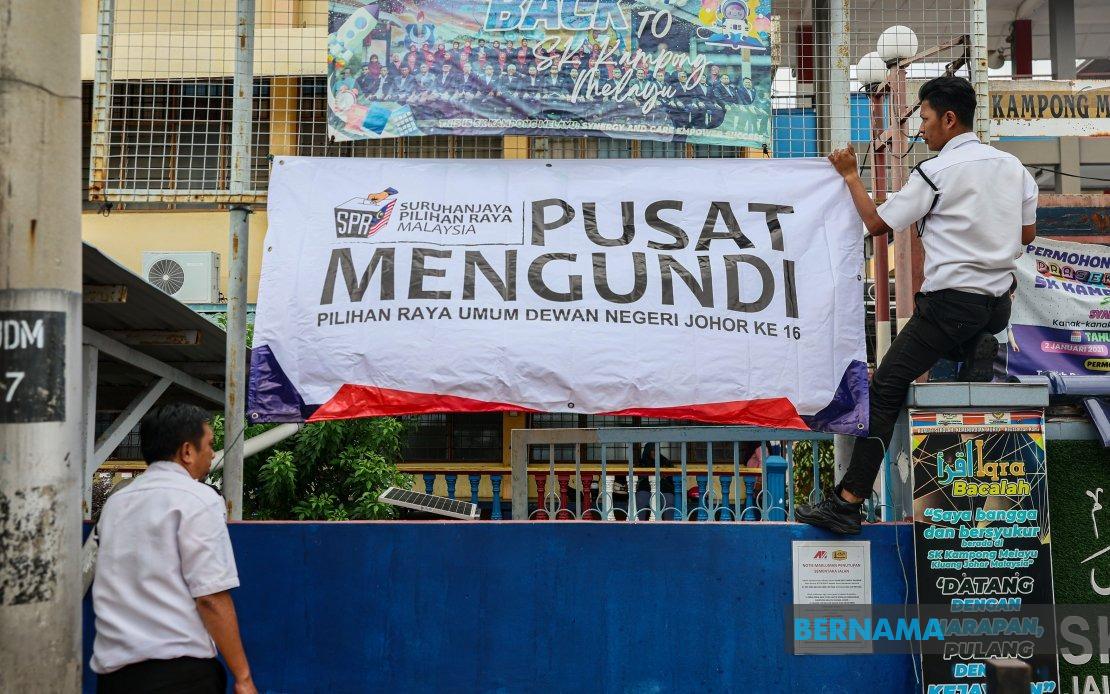
Johor entered a crucial political moment on July 11 as polling stations across Malaysia's southern state opened their doors to 2.7 million eligible voters determined to reshape the 56-member State Legislative Assembly. The 16th state election represents a significant juncture in the state's political trajectory, coming almost two years after the previous general election and following the dissolution of the assembly on June 1. Voters face a choice between competing coalitions and parties that have each campaigned intensively over the past two weeks to capture the state's mandate.
The Electoral Commission orchestrated a meticulously planned operation to accommodate this massive voting exercise. Beginning simultaneously at 8 am across the state, 1,076 designated polling centres operated in tandem, with 4,889 individual voting streams enabling voters to move through the process efficiently. The staggered closure of polling stations between 11 am and 6 pm reflected geographical considerations, with island communities voting earlier—Pulau Besar closing at 11 am, while Pulau Aur and Pulau Pemanggil concluded at noon. This careful orchestration necessitated the deployment of 43,036 election workers, underlining the logistical complexity involved in managing a state-wide ballot.
The electoral landscape presented voters with multiple choices across 172 candidates representing eight political entities. Pakatan Harapan and Barisan Nasional each fielded the maximum 56 candidates, positioning themselves as the primary contenders for state control. Perikatan Nasional offered 33 candidates, establishing itself as a significant alternative force. Smaller parties and independent candidates completed the field, including Parti Bersama Malaysia with 15 candidates, the Malaysian United Democratic Alliance with four, and single candidates from Parti Orang Asli Malaysia and Parti Sosialis Malaysia, alongside six independent hopefuls. This diversity of options reflected Malaysia's competitive multi-party democracy, though the race effectively centred on the two major coalitions.
The previous assembly composition provided important context for understanding the contest's significance. Before dissolution, Barisan Nasional dominated with 40 seats, while Pakatan Harapan controlled 12. Perikatan Nasional held three seats, and the Malaysian United Democratic Alliance claimed one. The substantial coalition advantage that Barisan Nasional had established made the election an opportunity for opposition forces to challenge that dominance, while the ruling coalition sought to consolidate and expand its position. This mathematical reality shaped campaign strategies and voter expectations throughout the two-week campaign period that concluded at midnight the previous day.
The Election Commission targeted an impressive 70 per cent voter turnout, a substantial increase from the 54.92 per cent achieved in the 2022 state election. This ambitious goal reflected the commission's expectation of heightened voter engagement and public interest in the contest. The improvement would indicate growing political consciousness among Johor's electorate and stronger participation in the democratic process. Should the 70 per cent target materialize, it would represent a notable reversal of the declining turnout trend that had characterized recent Malaysian elections, suggesting that state-level contests retain capacity to mobilize voters effectively.
Weather conditions potentially influenced voting patterns across different districts. The Malaysian Meteorological Department forecast morning rainfall affecting Johor Bahru, Batu Pahat, Kulai, Muar, Pontian and Tangkak, with improving conditions anticipated by afternoon and evening hours. Kluang, Kota Tinggi and Segamat faced afternoon thunderstorm risks, while Mersing experienced similar volatile conditions extending into evening hours. These meteorological realities could affect voter accessibility and participation rates, particularly in areas experiencing heavier precipitation, though election officials presumably factored weather probabilities into their operational planning.
Postal voting participation provided early indicators of engagement levels. Early voting on Tuesday saw 20,607 ballots cast by police personnel, armed forces members and their spouses—categories permitted to vote before the general election. The substantial early voting numbers suggested heightened interest among security personnel and their families, constituencies traditionally considered integral to electoral participation. Additionally, 24,677 postal ballots issued to registered voters required collection by 6 pm on election day, adding administrative complexity to the counting process and extending the full results timeline.
Employers received official reminders to facilitate employee participation in the democratic exercise. This administrative guidance recognized the potential tension between commercial operations and civic responsibilities, establishing clear expectations that reasonable time allocations for voting represented non-negotiable workplace obligations. The directive reflected broader societal commitment to ensuring accessibility for all eligible voters regardless of employment circumstances, recognizing that work schedules could otherwise present barriers to participation.
Vote-counting would commence following station closures, with the Electoral Commission targeting preliminary results as early as 10 pm. This ambitious timeline depended on efficient organization at polling centres and rapid compilation of results from dispersed locations. The acceleration compared to historical patterns reflected improved coordination systems and administrative procedures developed for managing state-level elections. Full completion remained subject to the mechanics of counting and verification across all 56 constituencies, though officials clearly aimed to provide voters with outcomes before the night concluded.
Johor's election carried broader implications for Malaysian politics extending beyond the state's boundaries. As the nation's second-most populous state and a consistently significant political battleground, Johor's electoral outcome would signal voter sentiment toward competing national coalitions and their state-level leadership. The result would inform calculations regarding federal political dynamics and potentially influence strategic planning by national parties. For Malaysian observers monitoring political trends and coalition strength, the Johor result represented a crucial data point for assessing the country's evolving political landscape and the relative standing of major political forces.
The election day itself presented voters with the culmination of months of political positioning and two intensive weeks of campaigning. Beyond the immediate contest for 56 state seats, the election represented a moment for Johor's electorate to express preferences regarding state governance, development priorities and political direction. The scale of participation—2.7 million voters across numerous constituencies—underscored the significance of this democratic exercise and the substantial political stakes involved in determining which coalition would shape the state's governance and policy directions for the years ahead.

