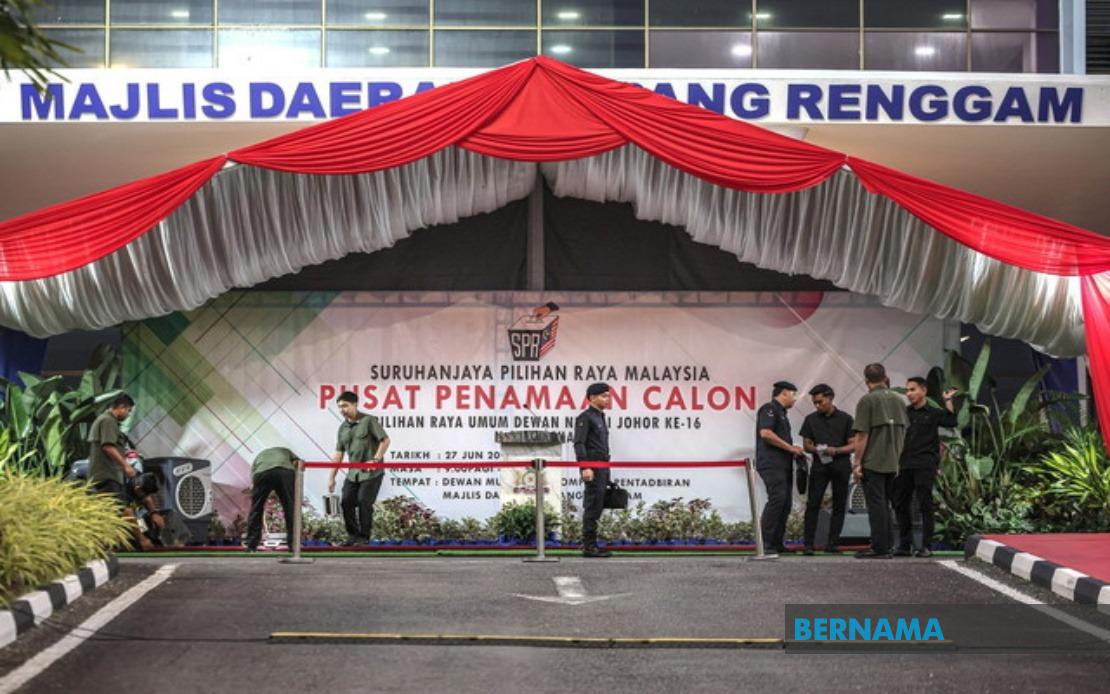
The 16th Johor State Election formally commenced this morning as all 56 nomination centres unlocked their doors simultaneously at 9am, marking the official beginning of the electoral process. The coordinated opening across the state represents a critical juncture in Malaysia's democratic machinery, with candidates and their representatives now having a narrow window of opportunity to lodge their candidacy papers before the verification process begins.
Candidates faced a strictly enforced one-hour deadline, with the nomination window closing at 10am sharp. During this compressed timeframe, hopefuls were required to present their nomination forms directly to the returning officer at their designated nomination centre. The submission could be completed by the candidate alongside their proposer and seconder, by any two of these parties, or even by a single representative, providing some flexibility within a rigid overall schedule. This procedural formality, though seemingly straightforward, determines the official list of those deemed eligible to contest for seats in the Johor state assembly.
Once the Election Commission's verification process concludes and candidates are formally confirmed as eligible, the campaign machinery shifts into high gear. A precisely scheduled 14-day campaign period will run from now until 11:59pm on July 10, giving political parties and candidates a defined period to canvas voters, organise rallies, and make their electoral pitches. This timeframe, established by the Election Commission, balances the need for adequate campaigning opportunity against electoral regulation requirements that prevent prolonged periods of political mobilisation.
The enthusiasm from party supporters was palpable from the early morning hours, with representatives from various political factions gathering outside nomination centres from as early as 6:30am. These demonstrations of grassroots support, featuring party flags, banners, and chanting supporters, have become an expected spectacle during nomination day ceremonies across Malaysia. The visible presence of party faithful serves both to energise candidates and to signal organisational strength to observers monitoring the electoral landscape.
Weather conditions posed a variable factor in today's proceedings, with the Malaysian Meteorological Department forecasting scattered rainfall across several districts in the northern and eastern portions of Johor. Centres in Johor Bahru, Muar, Batu Pahat, Kota Tinggi, Pontian, Tangkak and Kulai faced the prospect of morning showers, potentially complicating logistics around nomination venues. However, the southern districts of Segamat, Kluang and Mersing were expected to remain clear, at least during the morning hours. The forecast took a more dramatic turn for the afternoon, with thunderstorms predicted to develop across most districts, including Johor Bahru, Segamat, Kluang and Kota Tinggi, raising the possibility of disruptions to campaign preparations.
Maintaining order and security during this crucial phase required substantial police deployment supported by volunteers from the People's Volunteer Corps (RELA). Officers were stationed around nomination centres throughout the day, implementing traffic control measures and strict security protocols designed to prevent disorder or interference with the electoral process. This precautionary approach reflects the recognised potential for tensions on nomination day, when competing political factions converge on concentrated locations and emotions run high regarding candidate selection and party fortunes.
The electoral roll for this contest reflects Johor's substantial population and the state's significance within Malaysia's political framework. The Election Commission has registered approximately 2.73 million eligible voters across the state, representing a diverse electorate comprising ordinary voters, military personnel and their spouses, and police officers and their families. The breakdown shows 2,703,175 ordinary voters forming the overwhelming majority, while military and police categories together account for nearly 25,000 registered electors, reflecting the defence and security establishment's integration into the civilian electoral process.
The Commission has structured the subsequent electoral calendar with meticulous precision. Early voting has been scheduled for July 7, allowing voters unable to participate on polling day—including those working far from home or with mobility constraints—to cast their ballots several days in advance. The main polling day itself is set for July 11, providing a firm deadline by which all voting must be concluded. This staggered approach, increasingly common in Malaysian elections, acknowledges practical realities of modern life while maintaining the concentrated, single-day polling tradition that remains central to Malaysian electoral culture.
For Malaysian observers monitoring Johor's electoral dynamics, this contest carries significance extending beyond state-level politics. Johor remains one of Malaysia's most politically consequential states, serving as a bellwether for national sentiment and as a crucial component in any political coalition's parliamentary mathematics at the federal level. The outcome will provide valuable indicators regarding voter sentiment in the southern corridor, reflecting satisfaction or dissatisfaction with incumbent administration and opposition party appeals. The competition for Johor's assembly seats therefore resonates throughout Malaysia's broader political ecosystem, influencing calculations about coalition viability and national political trajectories in the months and years ahead.

