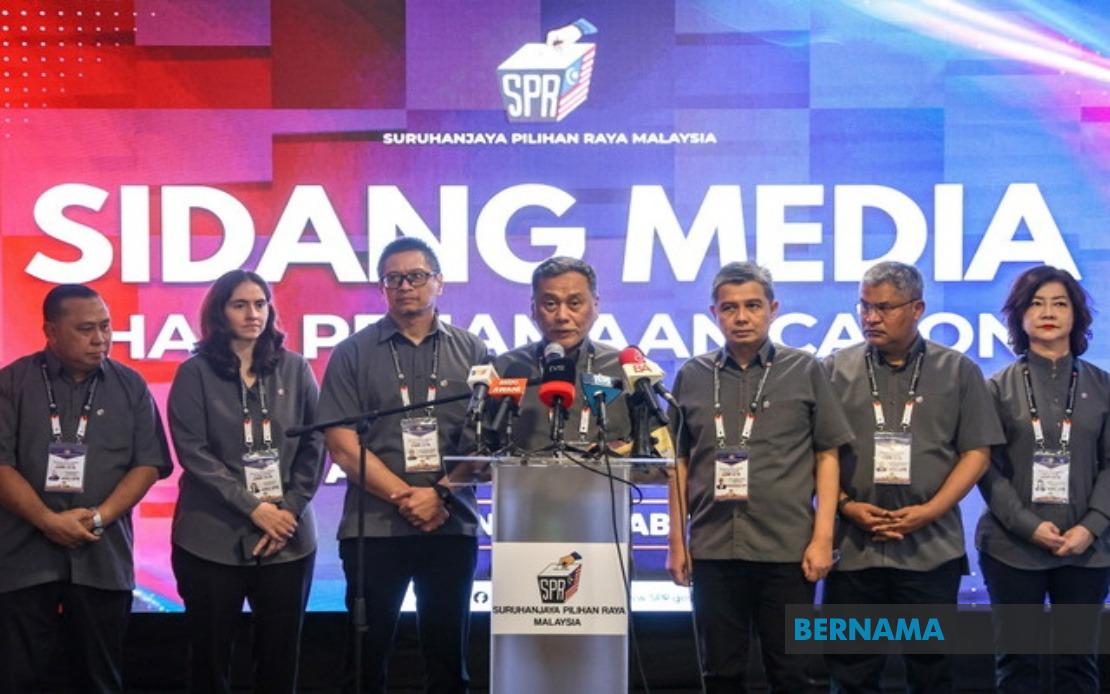
The Election Commission has formally confirmed that 172 candidates from multiple political parties will compete in Johor's 16th state election, after the nomination process wrapped up at all 56 nomination centres on June 27. EC chairman Datuk Seri Ramlan Harun announced that every nomination paper submitted had been accepted without any candidate being disqualified, signalling a smooth completion of the registration phase ahead of polling day.
The final candidate roster reflects a notable gender imbalance in Malaysian electoral participation, with men representing the overwhelming majority of contenders. Among the 172 nominees, 138 are male while just 34 are female—roughly 80 per cent male representation across all parties and independent candidates combined. This disparity, consistent with historical trends in Malaysian elections, has become an increasingly discussed issue among observers who note the underrepresentation of women in electoral contests despite gradual improvements over successive election cycles.
Barisan Nasional and Pakatan Harapan have fielded identical slates of 56 candidates each, positioning themselves as the primary contenders with coverage across all constituencies. This equal distribution reflects both coalitions' strategic commitment to contesting every seat and signals their confidence in having viable candidates throughout the state. Perikatan Nasional, the third-largest coalition, has nominated 33 candidates—substantially fewer than the two major alliances but still representing a comprehensive campaign presence.
Smaller political entities and independent candidates round out the field. Parti Bersama Malaysia has put forward 15 candidates, demonstrating its aspiration to gain a foothold in Johor's political landscape. Four candidates representing MUDA, the youth-oriented reformist party, seek representation, while Parti Orang Asli Malaysia and Parti Sosialis Malaysia each fielded single candidates. Additionally, six independent candidates are running outside any party framework, reflecting the diverse political orientations present among Johor voters.
The constituency-level contest dynamics vary considerably, creating distinctly different electoral scenarios across the state. In 14 seats, voters will face straight fights between two candidates—the simplest ballot configuration offering a direct binary choice. A significantly larger cohort of 27 constituencies will present three-cornered contests involving three candidates, the most common configuration throughout Johor. The complexity increases in 12 seats where four candidates compete, requiring voters to deliberate among more options and potentially creating more fragmented vote distributions. Three constituencies present the most complicated scenario with five candidates each, maximising voter choice but potentially making consensus victories more difficult to achieve.
This candidate distribution and constituency-level arrangement has profound implications for both major coalitions' strategic positioning. For Barisan Nasional, which has governed Johor continuously since independence, maintaining its electoral dominance will depend on retaining support in the straight fights and competitive three-cornered contests. The coalition's extensive ground machinery and long-established voter networks face a serious challenge from an reinvigorated Pakatan Harapan, which contests with equal numerical strength and momentum from recent federal-level gains.
Pakatan Harapan's matching of Barisan Nasional's 56-seat candidacy represents a significant tactical statement about the coalition's seriousness in contesting a state historically viewed as a Barisan stronghold. The presence of nearly identical candidate numbers suggests the coalition believes it possesses sufficient organisational capacity and electoral appeal to compete vigorously across all constituencies, marking a departure from previous elections where it conceded certain seats. This aggressive posturing reflects broader shifts in Malaysian political competition, where opposition coalitions increasingly contest marginal and traditionally safe seats rather than strategically withdrawing.
Perikatan Nasional's 33-candidate approach suggests a more selective strategy, likely focusing resources on constituencies where it believes it has competitive advantages or where its core support base is concentrated. The coalition's absence from 23 seats may reflect realistic assessments of electability or deliberate choices to avoid three-way splits that could benefit rivals. This selective approach contrasts sharply with the comprehensive ambitions of Barisan Nasional and Pakatan Harapan, indicating Perikatan Nasional's perception of itself as a challenger rather than a primary contender for state government formation.
The confirmation of candidates without any disqualifications underscores the Election Commission's administrative efficiency and suggests all nominations met prescribed procedural and constitutional requirements. This flawless processing contrasts with instances in other elections where technical irregularities forced rejections, potentially creating delays or uncertainties. For Johor voters, the absence of disqualifications means the full breadth of political choice reflected in the nomination process will be available on election day.
The composition of this candidate field reflects contemporary Malaysian political fragmentation, where the once-dominant two-coalition framework now competes alongside a revitalised Perikatan Nasional and various smaller parties pursuing distinct ideological or communal mandates. Johor's election will serve as a crucial barometer of voter sentiment toward these competing visions, with implications extending beyond the state to influence calculations about potential federal-level realignment. The distribution of 172 candidates across Johor's constituencies sets the stage for what promises to be a competitive and potentially consequential test of political support in one of Malaysia's most significant states.

