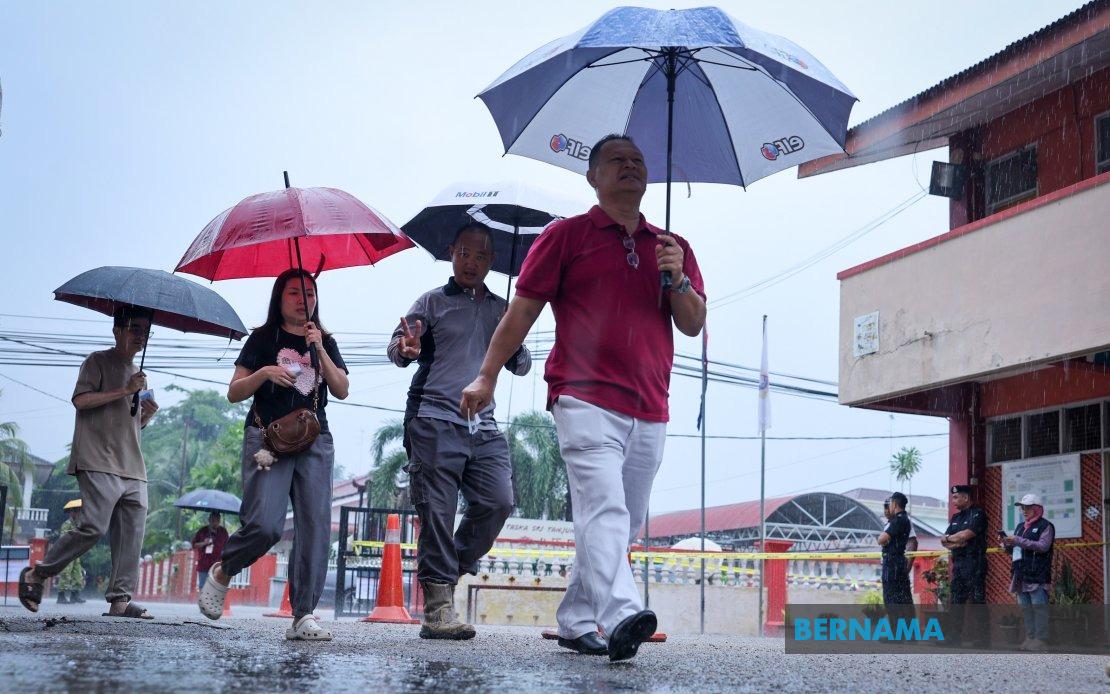
Voting in the 16th Johor State Election got underway this morning with largely pleasant atmospheric conditions prevailing across most of the state, marking a relatively smooth start to proceedings that will determine representation across 56 legislative seats. The notable exception came in Muar, where torrential rainfall from dawn onwards tested the resolve of voters keen to participate in the democratic exercise. Despite the meteorological variance across different regions, Electoral Commission preparations appeared seamless, with officials, security contingents and media observers positioned at polling venues from 7 o'clock in the morning.
Election observers visiting multiple voting stations documented a pattern of clear conditions dominating most population centres. Sekolah Kebangsaan Seri Pantai in Mersing exemplified this trend, with bright sunshine accompanying the arrival of early voters including persons with disabilities and elderly citizens who traditionally access polling stations during initial hours. The coastal town of Mersing, located in the eastern reaches of Johor, experienced conditions typical of what would be considered ideal polling weather by electoral standards. Similarly, observers reporting from Dewan Raya Taman Ungku Tun Aminah in the state capital of Johor Bahru noted uninterrupted clear skies throughout the morning period, facilitating smooth foot traffic and voter movement through the centre.
State constituencies including Batu Pahat and Kulai also reported comparable meteorological circumstances, with Sekolah Menengah Kebangsaan Senggarang and Sekolah Jenis Kebangsaan Cina Kulai both experiencing clear atmospheric conditions that encouraged consistent voter participation. These observations from multiple polling locations suggested that geographic variation in weather patterns, whilst notable, did not substantially impede the electoral process across the majority of operational centres. Johor's typically humid tropical climate occasionally produces localized rainfall phenomena, and this particular polling day appeared representative of such seasonal variability.
The situation in Muar presented a contrasting scenario, where sustained heavy precipitation beginning in pre-dawn hours created potentially challenging conditions for voters navigating to polling stations. However, accounts from centres including Sekolah Jenis Kebangsaan Cina Limbong and Sekolah Kebangsaan Ismail 1 demonstrated that meteorological adversity failed to suppress democratic participation. Voters in the Muar district, positioned in western Johor along the Selangor border, persisted in arriving at designated polling venues despite the inclement weather, suggesting strong motivation amongst the electorate to cast their ballots irrespective of atmospheric obstacles.
The electoral exercise involved unprecedented participation numbers by Johor standards, with election authorities facilitating voting opportunities for more than 2.7 million registered electors across a network of 1,076 distinct polling locations. The 56 state legislative seats attracted competition from 172 candidates representing various political formations, presenting voters with meaningful choice across diverse constituencies ranging from urban centres to rural areas. Voting commenced at 8 o'clock in the morning, with individual polling stations adhering to staggered closing times as predetermined by the Electoral Commission, followed immediately by ballot counting procedures at each venue. This logistical framework required substantial coordination involving thousands of election officials and support personnel stationed throughout Johor.
The political landscape confronting voters reflected significant changes from the previous parliamentary configuration. Prior to the legislative assembly's dissolution on June 1, Barisan Nasional maintained dominant control with 40 seats, substantially exceeding the representation held by Pakatan Harapan with 12 seats. Perikatan Nasional held three seats whilst the Malaysian United Democratic Alliance commanded a single seat, indicating a fragmented opposition presence relative to the governing coalition's commanding majority. The dissolution triggered this fresh electoral mandate, creating opportunities for political reconfiguration based on contemporary voter preferences.
For Malaysian observers and regional analysts, the Johor election represented a significant barometer of political sentiment within Southeast Asia's fourth-most populous state. Johor's geographic proximity to Singapore and its substantial economic importance to the broader Malaysian federation meant that electoral outcomes possessed implications extending beyond state-level governance. The state traditionally functioned as a political bellwether, with voting patterns often reflecting broader national trends and shifting coalition dynamics. Consequently, the participation level and demographic composition of the 2.7 million voters would provide valuable insights into evolving electoral preferences amongst Malaysians.
The Electoral Commission's visible presence and operational readiness at polling centres from dawn onwards underscored the institutional preparedness required for managing such large-scale democratic exercises. Security personnel deployed across venues ensured that voting processes proceeded without disruption whilst maintaining the integrity of ballot casting. The simultaneous engagement of media practitioners at multiple locations facilitated transparent documentation of polling day proceedings, enabling public confidence in the electoral mechanism's fairness and impartiality. These institutional dimensions proved particularly important given the substantial voter population requiring accommodation within defined operating hours.
The contrast between meteorologically favourable conditions in most Johor regions and the challenging circumstances in Muar illustrated the unpredictable nature of tropical weather systems and their potential impact on electoral logistics. Election planners and administrators had presumably accounted for such variability in their preparations, ensuring that weather variations would not materially compromise voting accessibility. The persistent voter turnout despite Muar's heavy rainfall suggested that neither meteorological challenges nor logistical complexities substantially deterred electoral participation, reflecting the importance voters assigned to exercising their franchise. This demonstrated commitment to democratic participation across diverse geographic and climatic circumstances would ultimately determine the composition of Johor's next state government and the policy direction the administration would pursue during the subsequent term.

