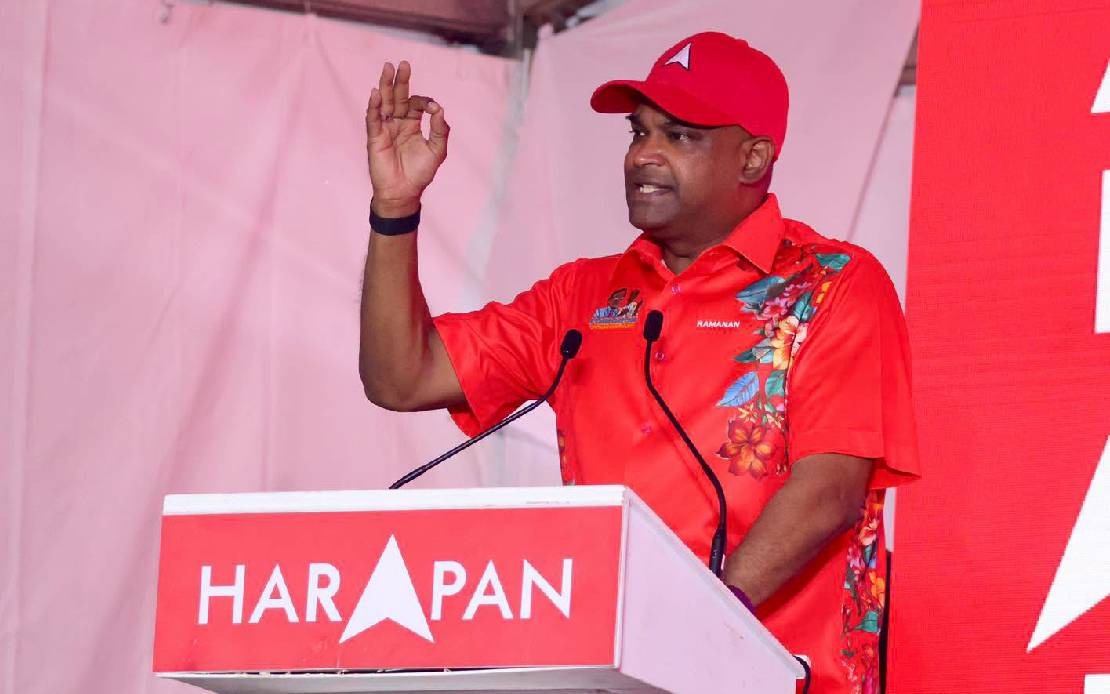
The Federal Government remains steadfast in its commitment to advancing Johor's development agenda through a comprehensive programme of strategic investments and large-scale infrastructure initiatives, according to PKR Vice-President Datuk Seri R Ramanan. Speaking at a Pakatan Harapan campaign roadshow in Simpang Renggam, Ramanan underscored that the state occupies a central position within the federal administration's national priorities, with ongoing efforts designed to translate development gains into tangible improvements in living standards across all households in Johor.
Ramanan's remarks come as the coalition intensifies its campaign efforts ahead of the July 11 state election, during which voters will choose representatives from among 172 candidates contesting across various constituencies. The PKR leader's emphasis on federal-state coordination reflects a strategic messaging approach centred on the notion that political alignment between state and federal governments facilitates smoother implementation of development programmes. This framing carries particular resonance in Johor, where economic contributions and strategic geographic positioning make the state economically significant within Malaysia's broader development narrative.
The assistance programmes referenced by Ramanan encompass a multifaceted approach spanning infrastructure modernization, business development support, and social welfare provisions. These initiatives aim to distribute development benefits equitably across Johor's diverse demographic and geographic profile, ensuring that both urban centres and rural constituencies experience tangible improvements in public services, connectivity, and economic opportunities. The federal government's investment strategy reflects recognition that Johor's prosperity directly influences national economic performance and regional competitiveness in Southeast Asia.
Johor's status as a priority state within the federal framework stems from multiple converging factors. The state serves as Malaysia's southern gateway, hosting critical port facilities, industrial zones, and cross-border economic linkages with Singapore. Additionally, Johor's substantial population base and diverse economic sectors ranging from manufacturing to agriculture create multiple pressure points for government intervention and investment allocation. Federal policymakers recognize that addressing infrastructure gaps, unemployment concerns, and public service delivery deficiencies in Johor yields significant returns in terms of broader national stability and growth prospects.
The coalition's campaign messaging emphasizes administrative coherence as a mechanism for accelerating development delivery. By urging voters to grant Pakatan Harapan a mandate in the state election, Ramanan implicitly suggests that political fragmentation or opposition-controlled governance could create bureaucratic friction that impedes project implementation and resource allocation. This argument resonates particularly strongly in states where federal and state administrations operate under different political leadership, potentially creating coordination challenges in executing time-sensitive infrastructure projects or social programmes that require cross-agency cooperation.
Ramanan was not alone in articulating this message at the Simpang Renggam event. The gathering brought together multiple coalition figures including PKR Vice-President Datuk Seri Amirudin Shari, Amanah Secretary-General Faiz Fadzil, and several Pakatan Harapan candidates contesting state seats including Machap, Benut, and Layang-Layang. This concentration of high-ranking coalition representatives demonstrates the strategic importance attached to the Johor election, with party leadership deliberately deploying senior figures to reinforce core messaging themes and mobilize voter enthusiasm across target constituencies.
For Malaysian readers and observers in Southeast Asia, the Johor election carries significance extending beyond state-level politics. As Malaysia's largest state by population and third-largest by economic output, Johor election outcomes influence federal political dynamics and potentially reshape the balance of power within the Pakatan Harapan coalition itself. The state's result will provide crucial indicators regarding urban-rural voting patterns, opposition effectiveness in rural mobilization, and the coalition's capacity to maintain political momentum heading toward the next federal election cycle.
The early voting arrangement scheduled for July 7, ahead of the main polling on July 11, reflects standard electoral procedures designed to accommodate voters unable to cast ballots on the primary election date. This staggered voting mechanism ensures maximum participation across Johor's geographically dispersed constituencies while maintaining election security and administrative feasibility. The decision to hold the election during the monsoon season, when parts of Johor experience increased rainfall, adds logistical complexity to voter turnout efforts.
From an analytical perspective, the federal government's emphasis on Johor development funding and infrastructure projects during election season warrants careful scrutiny regarding spending timelines and project announcement patterns. Opposition observers frequently argue that government resource allocation demonstrates cyclical patterns correlating with electoral calendars, a criticism that transcends partisan boundaries and reflects broader concerns about development planning integrity. The legitimacy of development spending matters substantially for voter perception, particularly among constituencies where residents have experienced repeated campaign promises followed by delayed or unfulfilled project completion.
The coalition's development narrative also reflects changing Southeast Asian economic priorities. Infrastructure investments in Johor increasingly emphasize regional connectivity, digital transformation, and green development objectives aligned with Malaysia's net-zero commitments and broader ASEAN integration frameworks. These investments position Johor as a critical node within evolving regional supply chains and digital economies, extending beyond traditional manufacturing-focused development models that characterized previous decades.
Looking forward, the Johor election outcome will substantially influence federal government resource allocation patterns and coalition confidence levels entering subsequent electoral contests. A decisive coalition victory would validate the administrative coherence argument and likely accelerate project implementation timelines. Conversely, a weakened coalition performance would necessitate recalibration of political strategy and potentially slow development spending as the federal administration navigates heightened political uncertainty. For Johor residents and Malaysian businesses with vested interests in state stability and development continuity, the election results carry material consequences extending well beyond symbolic political significance.

