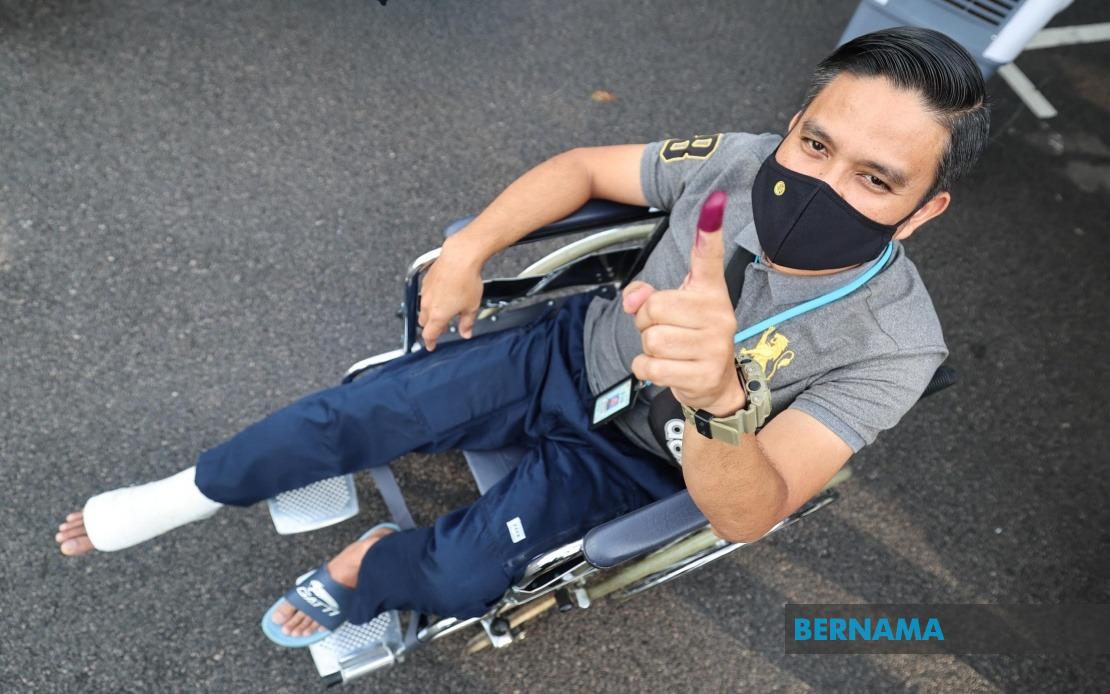
In a demonstration of civic commitment, a senior police officer in Johor refused to let a serious sports injury prevent him from exercising his fundamental right to vote during the 16th state election's early polling period. Sergeant Syahrizal Musa, 40, arrived at the voting centre at Johor Police Contingent Headquarters in a wheelchair on July 7, having sustained an Achilles tendon tear just days earlier while playing sepak takraw. His determination to cast his ballot despite medical restrictions underscores a broader theme of participation and responsibility that often characterises election cycles across Malaysia.
The injury occurred during casual play of the traditional Southeast Asian sport, a pastime Syahrizal has enjoyed actively since youth. Medical assessment confirmed the severity required him to take leave until July 16, yet the prospect of missing this electoral opportunity proved unacceptable to the long-serving officer. Accompanied by a colleague from the police quarters in Tampoi, he navigated the wheelchair to the early voting centre, a journey that would have tested anyone's resolve given his physical condition. His presence at the polling station that morning carried symbolic weight, representing the principle that democratic participation transcends temporary physical challenges.
Syahrizal's service record underscores his personal investment in national institutions and processes. Having worked with the Royal Malaysia Police for more than two decades, he has maintained an unblemished record of voting in every election during his 22 years of service. This was a distinction he took seriously enough to protect even while immobilised. His attachment to the Internal Security and Public Order Department at Johor's police headquarters placed him in a role contributing to the country's security apparatus, making his advocacy for electoral participation particularly resonant. The contrast between his demanding professional responsibilities and his physical limitations on voting day created a poignant narrative about choosing civic duty.
Johor's electoral framework accommodated such participation through its early voting provisions, a system designed specifically to enable security and armed forces personnel to cast ballots before the general population. The infrastructure supporting this represented a logistical achievement in itself: 64 polling centres operated statewide on July 7 to facilitate 24,751 eligible early voters. The composition of this early electorate reveals the security sector's substantial presence in democratic processes. Among those casting ballots were 12,041 personnel from the Malaysian Armed Forces and their spouses, alongside 12,710 police and General Operations Force members and their families. This structured approach to military and police voting recognises both their democratic rights and their operational constraints during election periods.
The broader electoral contest unfolding in Johor represented significant stakes for the state's political direction. With 172 candidates vying for 56 available seats, the election promised to shape Johor's governance trajectory. The ordinary voting population stood at approximately 2.7 million eligible voters scheduled to participate on the following Saturday. For a state of Johor's size and economic importance within Malaysia's federation, the electoral outcome carried implications extending beyond local administration to regional influence and national coalition mathematics. Syahrizal's insistence on participating, despite his temporary incapacity, reflected an understanding that individual votes collectively determine these outcomes.
Syahrizal's background before joining Johor Police Contingent Headquarters further contextualises his commitment. He spent nine years at the Muar police district before transferring in 2014, accumulating substantial institutional knowledge and experience across different operational environments. His tenure in different postings had exposed him to diverse communities and electoral dynamics across Johor. The experience of observing how different constituencies and communities exercised their franchise likely reinforced his conviction about voting's importance. His willingness to travel while injured and in need of assistance sent a message about civic values transcending convenience and comfort.
The sepak takraw injury itself merits brief consideration as it reveals an often-overlooked dimension of life among security personnel. Despite their professional focus on law enforcement and national security, police officers maintain personal lives, including recreational pursuits and sporting interests. Syahrizal's participation in sepak takraw tournaments on behalf of the police contingent suggested a culture of physical activity and inter-departmental competition. The accident that resulted in his Achilles tendon tear was therefore not a workplace injury but rather an occupational hazard of athletic engagement during off-duty hours. This distinction mattered because it illustrated how life's unpredictable events could suddenly constrain mobility, yet could not necessarily constrain the exercise of democratic rights with sufficient planning and determination.
The early voting system in Malaysia represents an important accommodation for those whose occupational commitments might otherwise prevent full electoral participation. Security personnel, whether military or police, frequently face scheduling constraints during general election periods due to their deployment responsibilities. By establishing dedicated early voting centres and extended voting periods for these populations, the electoral system ensures their democratic voice remains meaningful. Syahrizal's participation exemplified how such institutional arrangements enabled inclusion. His decision to vote, communicated to reporters with evident pride, suggested satisfaction that the system functioned as intended to protect his rights despite his temporary physical constraints.
The narrative dimension of Syahrizal's voting journey carries implications for public discourse around civic engagement in Malaysia. His commitment resonated beyond the immediate transaction of casting a ballot; it embodied a statement about how individuals weigh their obligations to democratic participation. In an era when voter turnout occasionally becomes a subject of national concern and debate, the image of a wheelchair-bound officer making his way to a polling centre reinforced messaging about voting's centrality to national life. His quoted remarks about voting representing a responsibility rather than merely a right reflected a values framework that emphasised civic contribution over personal convenience or circumstance.
As the 16th Johor state election proceeded toward its scheduled polling day, Syahrizal's participation among the early voters contributed to the overall tally that would influence state representation. The 24,751 early votes cast across 64 centres represented a meaningful proportion of the electorate, particularly within the security sector. His individual act of casting a ballot while recovering from injury served as microcosm of the broader democratic exercise unfolding across Johor. The election would ultimately determine resource allocation, policy priorities, and political direction for Malaysia's southern state, decisions shaped by cumulative choices of voters like Syahrizal who prioritised participation despite competing demands and unexpected complications.

