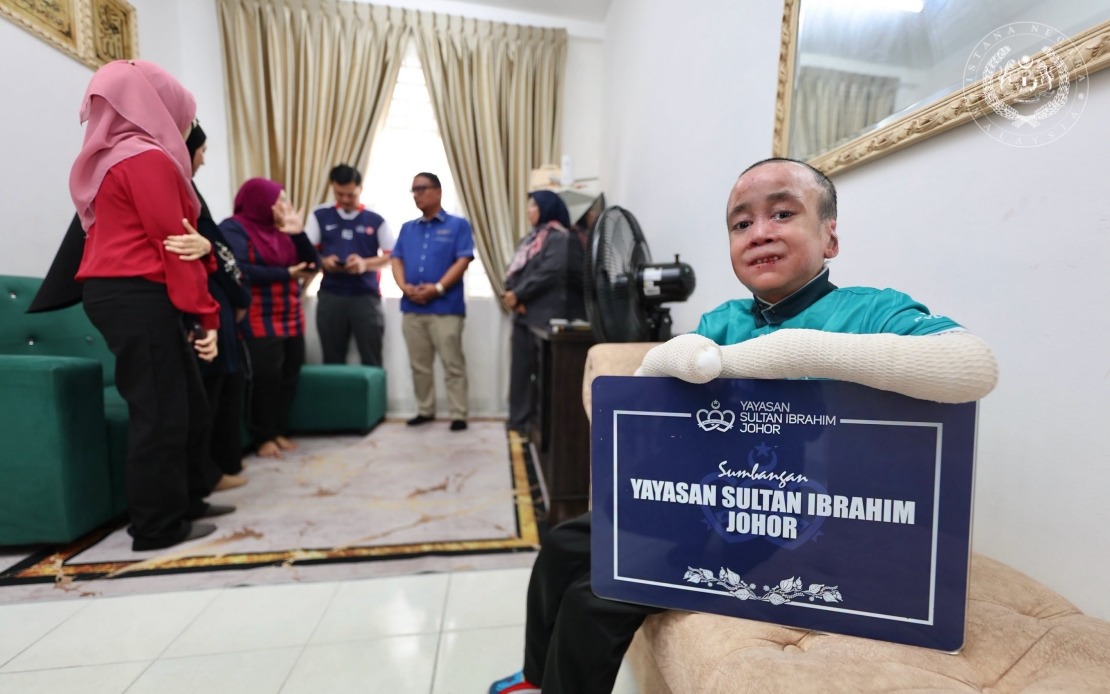
The Yayasan Sultan Ibrahim Johor (YSIJ) has stepped in to support the family of Muhammad Hazreel Mikhail Hizar, a 15-year-old battling epidermolysis bullosa, a severe hereditary skin disorder that has affected him since birth. The financial assistance was delivered on August 18 through the foundation's Ziarah Kasih programme, a welfare initiative designed to reach vulnerable families within the Johor community, at the residence of Hazreel's mother in the Sungai Tiram People's Housing Project in Johor Bahru.
Epidermolysis bullosa, commonly abbreviated as EB, represents one of the most challenging chronic skin conditions a young person can endure. The disease causes the skin to become extremely fragile, with even minor friction or trauma triggering painful blistering and wounds. For someone like Hazreel, managing the condition demands rigorous daily protocols including meticulous wound cleaning and dressing changes to minimise infection risks—a particularly critical concern given the compromised integrity of the skin barrier. Beyond the physical demands, the condition necessitates a carefully controlled living environment maintained at cool temperatures with consistent air conditioning, adding substantial expenses to already stretched household budgets.
Hazreel's situation reflects a broader challenge facing families with children suffering from rare genetic disorders across Southeast Asia. The combination of medical complexity and financial strain creates a vicious cycle: the child requires intensive parental care and supervision, preventing caregivers from pursuing stable employment, while simultaneously generating significant healthcare and environmental management costs. In Hazreel's case, this burden falls entirely on his mother, Noor Halimaton Hashim, who as a single parent supports three children whilst being unable to work full-time due to her son's round-the-clock care requirements. The intervention by YSIJ acknowledges both the immediate financial pressure and the hidden cost of being a primary caregiver for a child with a life-altering condition.
The Ziarah Kasih programme represents an important mechanism through which state-level foundations attempt to bridge gaps left by conventional social welfare systems. By providing direct assistance to families identified through community networks, the initiative can respond with flexibility and cultural sensitivity to situations that might fall through bureaucratic cracks. Such programmes are particularly valuable in Malaysia's context, where a significant portion of the population still relies on informal community support structures alongside government assistance schemes. For families like Hazreel's in the Sungai Tiram PPR area, this targeted approach provides essential supplementary help that can ease the burden of managing both household expenses and ongoing medical care.
The public acknowledgement of this assistance, documented through the official channels of Sultan Ibrahim Sultan Iskandar's office, underscores the symbolic importance of royal patronage in Malaysian welfare contexts. When senior state figures publicly associate themselves with such initiatives, it elevates the status of affected families, reducing potential stigma whilst simultaneously drawing attention to broader issues facing rare disease patients and their families. Noor Halimaton's gratitude, as conveyed through the Royal Press Office statement, indicates how meaningful such recognition can be beyond the material assistance itself—the message that her family's struggles have been noticed and validated by leadership carries psychological and social weight.
For Malaysian readers, Hazreel's case illuminates the hidden vulnerabilities within the healthcare and social support ecosystem. Epidermolysis bullosa, whilst rare, is not unique—families across Malaysia manage numerous genetic and chronic conditions with comparable demands and costs. The question of how medical expenses, environmental modifications, and lost income potential should be collectively managed remains contentious in policy discussions. YSIJ's intervention suggests that state foundations view such cases as legitimate concerns worthy of action, though it also highlights the reality that ad-hoc charitable responses, however generous, cannot substitute for systematic provision of support to rare disease families.
The broader implications extend to questions about disability support, caregiver recognition, and the economic rights of families managing chronic illness. Noor Halimaton's inability to pursue full-time employment represents a form of hidden unemployment—she remains economically inactive not through choice or circumstance beyond her control, but through necessary caregiving responsibilities. Multiply this across hundreds or thousands of Malaysian families managing similar situations, and the aggregate economic impact becomes significant. Meanwhile, the career development and earning potential of primary caregivers remains largely uncompensated and unrecognised in formal labour statistics.
From a regional perspective, the experiences of families like Hazreel's resonate across Southeast Asia, where healthcare infrastructure and social welfare systems continue to develop unevenly. Malaysia's relatively robust foundation sector and royal patronage structure provide advantages absent in some neighbouring countries, yet even here, the adequacy of support remains questioned. Rare disease organisations internationally emphasise that families often endure years of misdiagnosis, delayed treatment, and social isolation before accessing comprehensive care. The speed with which YSIJ responded to Hazreel's situation may thus represent an atypical best-case scenario rather than the norm.
Looking forward, Hazreel's story raises important conversations about preventive investment in family support structures. Early financial and emotional support to families managing rare conditions can prevent downstream crises including parental burnout, deteriorating family stability, and compromised health outcomes for affected children. Countries and states that prioritise such upstream intervention often observe better long-term outcomes and reduced demands on emergency social services. Malaysia's approach through foundations like YSIJ, whilst valuable, remains reactive rather than systematic, responding to identified cases rather than proactively identifying and supporting all families managing similar conditions.
The effectiveness of Ziarah Kasih and comparable programmes ultimately depends on community awareness, reliable identification mechanisms, and adequate resourcing to meet demonstrated needs. Success stories like Hazreel's assistance can encourage other families facing comparable circumstances to seek help, potentially strengthening referral networks. However, sustainability requires moving beyond individual acts of charitable patronage towards institutional frameworks that guarantee support as a matter of right rather than royal grace. For Malaysian policymakers, the question becomes whether such support should eventually transition from voluntary foundation initiatives to structured social insurance or government-funded disability support mechanisms.

