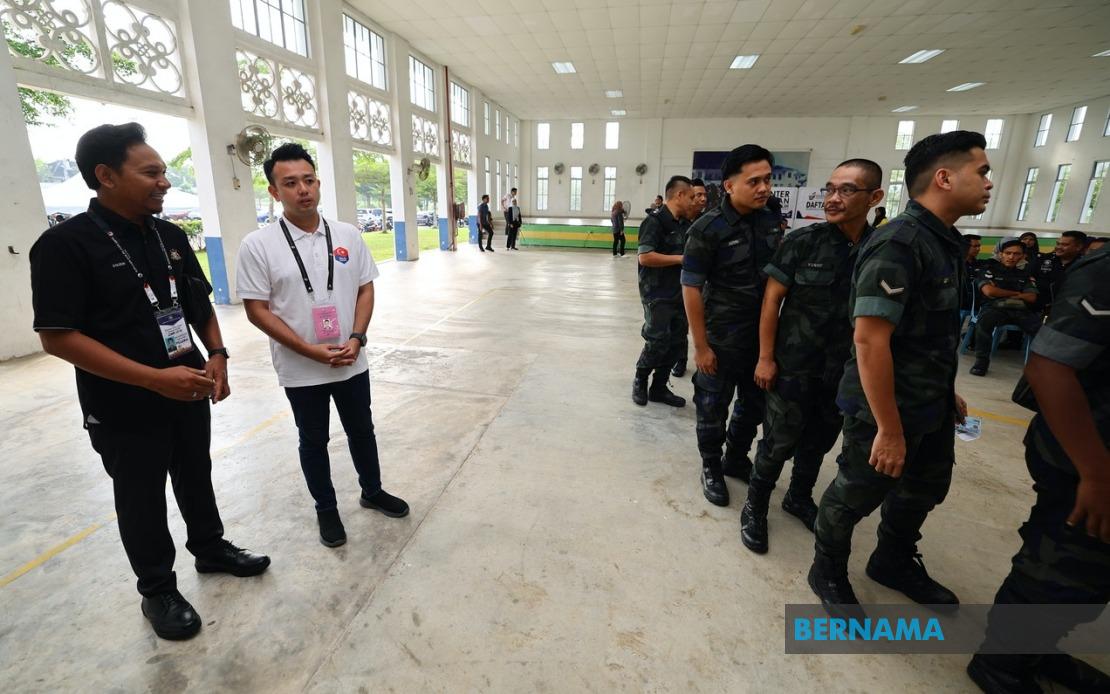
With the Johor state election entering its final stretch towards Saturday's polling day, candidates spanning the political spectrum set aside their campaign duties to witness the early voting mechanism for security forces. The exercise, conducted on Thursday across 64 early voting centres statewide, provided a window into how the Election Commission manages balloting for military personnel and police officers unable to vote on election day due to operational commitments. The occasion highlighted the logistical complexity underlying Malaysia's electoral system and the measures in place to ensure all eligible citizens can participate in the democratic process, even those with demanding security responsibilities.
The Layang-Layang constituency drew particular attention when all three of its candidates converged at the 5th Battalion General Operations Force Camp in Simpang Renggam to monitor proceedings. Representing the three main political formations, Guna Balakrishnan from Pakatan Harapan, Chua Jian Boon of Barisan Nasional, and Abd Mutalip Abd Rahim from Perikatan Nasional each witnessed firsthand how security voters exercised their franchise. This unified attendance, despite intense electoral competition, underscored the candidates' commitment to maintaining the integrity of the voting process and respecting the institutional framework governing Malaysia's elections, even as they pursued divergent political agendas.
Similarly, the Tenggaroh constituency saw all three competing candidates—Muhamad Amerul Muhamad representing Perikatan Nasional, Mohd Youzaimi Yusof from Barisan Nasional, and Md Yusof Dawam of Pakatan Harapan—observe the early voting centre at Iskandar Camp in Mersing. This pattern of cross-party participation at early voting stations suggested a broader consensus among Johor's candidates regarding electoral transparency and the importance of maintaining public confidence in the voting mechanism. By personally witnessing the process, candidates from competing parties could attest to fair procedures and help counter any future claims of irregularities, thereby strengthening democratic legitimacy.
Other notable candidates also made their presence felt at designated voting centres. Lim Chin Eng, identified as the oldest candidate in the Johor contest, observed proceedings at the Johor Contingent Police Headquarters, while Muhammad Faezuddin Mohd Puad, the Pakatan Harapan candidate for Kempas, monitored voting at Kempas Police Station. Datuk Jafni Md Shukor, representing Barisan Nasional in the Bukit Permai seat, attended the Kulai District Police Headquarters early voting centre. This widespread participation demonstrated that election observation transcended individual constituencies, reflecting a statewide commitment to transparent democratic processes.
The presence of senior military and security officials amplified the significance of the early voting exercise. Army Chief General Tan Sri Azhan Md Othman, accompanied by Major General Datuk Ahmad Shuhaimi Mat Wajab of the 21st Special Service Group, visited the Iskandar Camp centre in Mersing, signalling the armed forces' institutional investment in ensuring service members could fulfil their civic duties. Johor police chief Datuk Ab Rahaman Arsad also cast his own ballot at Dewan Dato Onn at Johor IPK, embodying the principle that security personnel leadership participates in the democratic process they help facilitate.
The logistical undertaking proved substantial in scope. A total of 20,607 security personnel and their spouses registered for early voting: 8,544 from the Malaysian Armed Forces and their families, and 12,063 police personnel with spouses. This figure represented a significant voter population that would have been effectively disenfranchised without the early voting mechanism. The Election Commission allocated 64 separate voting centres across Johor, opening from 8 am with staggered closing times between noon and 6 pm depending on voter numbers and location, ensuring adequate time for the entire eligible cohort to participate.
Despite inclement weather—brief rain fell at several locations—the early voting process unfolded without disruption. Security personnel arrived in orderly stages, adhering meticulously to Election Commission protocols and procedures. This smooth execution provided confidence that Malaysia's electoral infrastructure, tested under challenging circumstances, possessed the resilience and coordination necessary to manage a complex voting environment. The discipline displayed by voters and administrators alike suggested that the machinery of democracy in Johor functioned effectively even when extended beyond standard polling day arrangements.
The 16th Johor State Election itself represented a competitive battle across 56 state assembly seats, with 172 candidates contesting—an average of just over three candidates per seat. This concentration of competition reflected the three-way ideological contest dominating Malaysian politics: Pakatan Harapan, which holds the federal government after the 2022 general election; Barisan Nasional, seeking to reclaim electoral ground after years of diminished influence; and Perikatan Nasional, which governed several states and maintained substantial grassroots support. The Johor election thus functioned as a significant bellwether for regional political sentiment and the trajectory of national coalition dynamics.
From a Southeast Asian perspective, the early voting procedures and candidate participation illuminated Malaysia's approach to inclusive democratic participation. While many regional nations restrict franchise and voting access, Malaysia's framework explicitly accommodates security sector personnel, acknowledging their service requires flexibility in electoral arrangements. This institutional accommodation reflects a mature understanding that democratic processes must adapt to operational realities while maintaining voter participation and franchise universality. For Malaysia and the wider region, such mechanisms strengthen democratic credibility and citizen legitimacy in electoral outcomes.
The candidate observation of early voting carried practical and symbolic significance. Practically, it allowed candidates to verify electoral procedures and build confidence in the system's fairness, potentially reducing post-election disputes rooted in procedural concerns. Symbolically, it demonstrated that electoral competition remained bounded by shared institutional commitment, with opposing candidates united in ensuring the integrity of the voting mechanism. This distinction between policy disagreement and procedural consensus represents a hallmark of functioning democracies, particularly important in diverse, competitive electoral environments where trust in institutions underpins peaceful power transfers and democratic stability.

