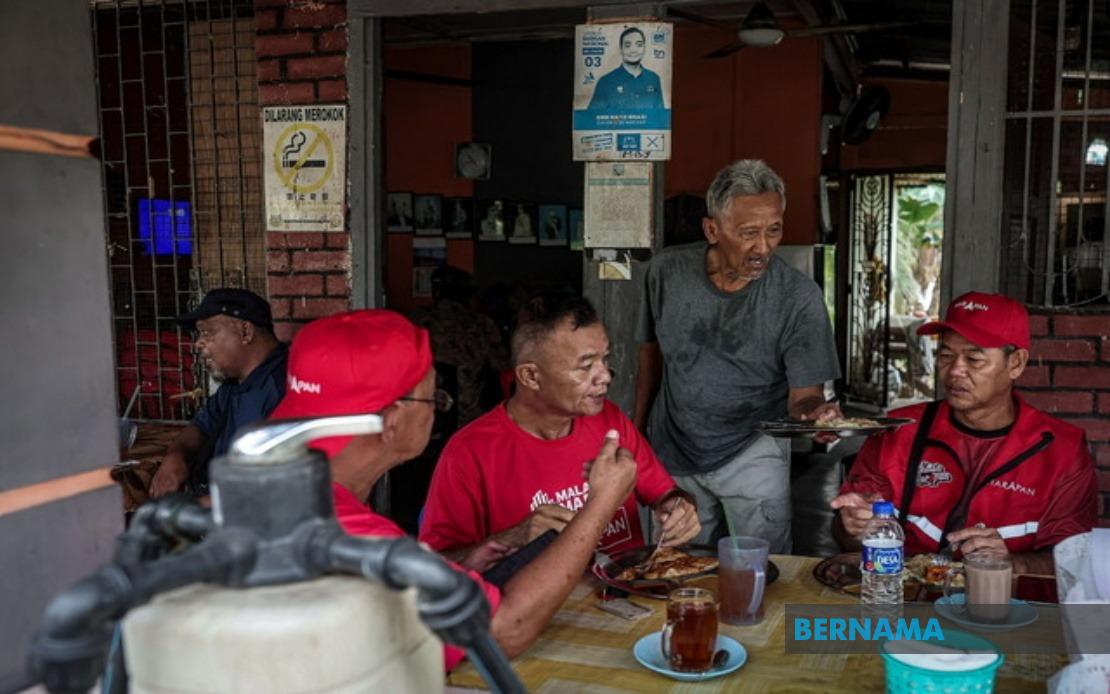
The Johor State Election has delivered an unexpected economic dividend to petty traders and hawkers scattered across the state's smaller towns and settlements. Beyond its role as a democratic exercise, the campaign period has catalysed measurable business growth for food vendors and small enterprises, particularly in areas like Layang-Layang and Simpang Renggam, where the concentration of political activity has drawn unprecedented customer volumes. This phenomenon illustrates how electoral cycles can generate tangible economic activity at the grassroots level, benefiting informal sector workers who form a crucial segment of Malaysia's economic fabric.
In the Felda Layang-Layang settlement, stall operator Noorma Zafmeeden has witnessed a dramatic transformation in her daily takings. The 70-year-old, who operates a modest warung with her husband Bahari Madiran, typically generates less than RM400 in morning sales on ordinary days when foot traffic remains predictable. The campaign period, however, has completely altered this baseline, with substantially higher revenues becoming the new norm. For a couple who has maintained their early-morning food preparation routine since 1987, when they first settled in the Felda scheme, the election-driven surge represents a meaningful improvement in household income that could not have been anticipated at the campaign's outset.
Bahari, now 76 years old, has observed that his warung has evolved beyond a simple commercial transaction point into a social gathering space where unity finds practical expression. Customers representing Malaysia's different ethnic and religious communities gather in warm familiarity, creating an atmosphere that transcends the typical vendor-customer relationship. For a father of five, this social dimension adds purpose to the long hours spent preparing and serving Malaysian breakfast staples such as roti canai and nasi lemak, followed by various fried dishes in the evening. The influx of campaign workers and political delegations from across the country has provided opportunities for genuine human interaction that extends beyond commerce.
The economic impact has proven similarly pronounced in nearby Simpang Renggam, where Ahmad Ridzuan Awang operates a nasi campur stall. The 45-year-old trader has documented a doubling of sales since the state election campaign commenced. His experience sharply illustrates the magnitude of demand surge: dishes that normally remain unsold until late afternoon are now completely exhausted by 1.30 pm, thanks to bulk orders from the various political organisations and campaign teams operating throughout the region. This acceleration of sales turnover has implications beyond simple revenue multiplication, as it affects inventory management, supplier relationships, and the temporal structure of his daily business operations.
Ahmad Ridzuan's observations extend beyond his individual enterprise to encompass the broader economic ecosystem. He has identified what he terms a "political tourist" effect, whereby the concentration of election-related activity generates demand that cascades through the local supply chain. Food vendors benefit directly from increased customer volumes, but this primary effect stimulates secondary economic activity among suppliers, logistics operators, and complementary service businesses in the surrounding area. This multiplier effect demonstrates how concentrated economic activity in one sector can generate employment and income opportunities across a wider network of small enterprises.
The systemic nature of this electoral economic stimulus warrants consideration as a recurring phenomenon in Malaysian political cycles. Election campaigns, by their structure, concentrate significant human and financial resources into specific geographic areas over compressed timeframes. Campaign headquarters, candidate movements, political rallies, and the associated workforce migration create pockets of elevated economic activity that directly benefit local service providers. For informal sector workers in smaller towns and rural settlements, these periodic surges can represent meaningful contributions to annual household income.
The timing and magnitude of benefits, however, remain structurally uncertain. Traders cannot reliably forecast electoral cycles or plan capital investments around them, as election schedules depend on political circumstances beyond their control. Noorma and Bahari, despite decades of experience, could not have anticipated this particular campaign's intensity or its economic consequences. This unpredictability creates a fundamental mismatch between the irregular nature of electoral booms and the need for stable, predictable income streams in informal enterprises.
The Johor state election itself encompasses significant political scope, with 172 candidates contesting 56 seats in what represents a competitive electoral contest. The campaign period, culminating in polling day on July 11 with early voting scheduled for July 7, spans sufficient duration to generate meaningful commercial activity. The concentration of candidates, media attention, and political worker movement across the state ensures that traders in strategic locations experience sustained customer flows rather than isolated spikes.
This election-driven economic activity also reflects broader structural characteristics of Malaysian electoral politics. The intensity of campaign activity, the volume of resources deployed, and the concentration of political worker movement create genuine but temporary economic opportunities for service providers. For established traders like Noorma and Ahmad Ridzuan, these periods offer proportionally significant income improvements, yet the benefits remain contingent on maintaining service quality and managing supply chains effectively during compressed timeframes.
The experiences documented in Layang-Layang and Simpang Renggam suggest that electoral cycles function as informal economic stimulus mechanisms, distributing benefits to those positioned to capture increased demand. Yet this distribution remains unequal and geographically uneven. Traders in areas of intense campaign activity benefit substantially, while those in peripheral locations may experience minimal impact. The mechanism operates through market forces rather than deliberate policy, generating benefits as an incidental byproduct of democratic processes rather than through targeted economic intervention.
For Malaysia's informal sector workers, these electoral windows represent valuable but fundamentally uncertain income opportunities. As the Johor election demonstrates, election campaigns can substantially improve short-term earnings for traders positioned to capture campaign-driven demand. However, the sustainability and equity of this arrangement remain questionable, particularly as reliance on episodic electoral booms cannot substitute for stable, predictable income streams necessary for household financial security and business development.

