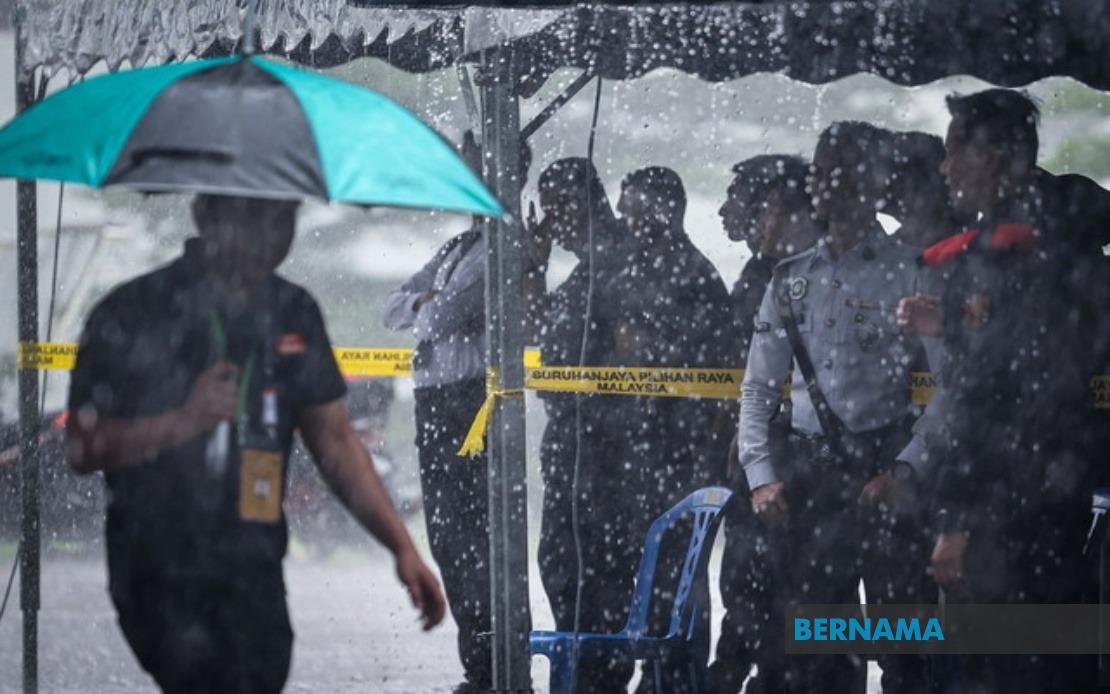
Weather challenges proved no obstacle to the orderly conduct of early voting for the 16th Johor state election on Thursday, as police personnel navigated a heavy downpour to cast their ballots at the State Police Contingent Headquarters in Johor Bahru. The rain, which arrived shortly before 9.40 am, temporarily intensified conditions at the polling centre but failed to disrupt the voting process or deter officers and personnel from participating in the democratic exercise.
The smooth progression of early voting reflects careful planning by election administrators to accommodate members of the uniformed services, who require special arrangements due to operational commitments on election day. Polling officers reported that despite weather challenges, the centre maintained normal operations throughout the morning and afternoon, with voting stations remaining fully staffed and operational. Media observers covering the election process adapted to conditions by sheltering under temporary tents, maintaining their coverage while remaining respectful of the voting environment.
Participation levels remained consistent despite the inclement weather. A steady flow of officers and personnel arrived throughout the day to exercise their franchise, with many observers noting the commitment shown by voters willing to venture out in heavy rain to cast their ballots. This pattern reflects broader trends in Malaysian electoral participation, where weather and logistical challenges rarely dampen voter enthusiasm for significant state elections.
The scale of early voting in Johor underscores the electoral machinery's capacity to handle large numbers of voters efficiently. A total of 12,067 police personnel and their spouses voted in person at designated polling centres throughout the state, with an additional 643 registered for postal voting arrangements. These figures demonstrate the comprehensive nature of early voting provisions, which ensure that those unable to participate on the main polling day can still exercise their democratic rights. The postal voting option particularly benefits those stationed outside their home constituencies or facing operational constraints.
The 16th Johor state election represents a significant political event for Malaysia's southern region, attracting considerable attention from political observers and analysts. A total of 172 candidates are contesting 56 state seats across the state, reflecting the competitive nature of electoral contests in one of Malaysia's largest states by population and economic significance. The breadth of candidature suggests vigorous competition across multiple parties and independent contenders, each vying for voter support in their respective constituencies.
The main polling day, scheduled for Saturday, is expected to see over 2.7 million ordinary voters casting their ballots across the state. This substantial electorate makes Johor elections closely watched indicators of political sentiment in Malaysia, with outcomes often influencing broader national political trajectories and coalition dynamics. The turnout in early voting and projected participation rates on the main polling day will provide insight into voter engagement levels in the state.
The successful conduct of police early voting carries symbolic and practical significance. Symbolically, it demonstrates the orderly and professional administration of elections in Malaysia, with security forces participating openly in democratic processes they help secure. Practically, the early voting mechanism ensures that essential personnel can fulfil their civic responsibilities without compromising operational readiness or security obligations. This balance between democratic participation and institutional functionality reflects mature electoral systems.
For Malaysian elections, the management of early voting has evolved considerably over successive elections, with each exercise incorporating lessons learned and improvements to efficiency. The Johor election provides a contemporary example of this refinement, with multiple designated polling centres, postal voting options, and weather contingency measures all contributing to accessible and inclusive voting processes. Election observers have noted that such infrastructure improvements enhance public confidence in electoral systems and facilitate higher participation rates.
The weather conditions encountered in Johor on Thursday are not uncommon for Malaysia's electoral calendar, which typically falls during months prone to afternoon thunderstorms and heavy precipitation. Election authorities have increasingly factored such contingencies into planning, with covered polling stations, temporary shelters, and provisions to extend voting hours if weather causes disruptions. The successful navigation of Thursday's rain demonstrates that these preparations are effective and adequate.
Beyond the immediate conduct of voting, the early voting process for police and military personnel reflects broader questions about electoral accessibility and inclusivity. As Malaysia's population grows and voter rolls expand, election authorities must continually adapt systems to accommodate diverse voter needs while maintaining security and integrity. Early voting provisions for service personnel, government officials, and those overseas represent evolved thinking about how to maximise participation across different population segments.
Looking forward, the completion of early voting sets the stage for the main polling day on Saturday, when the vast majority of Johor's electorate will determine the state assembly composition and government direction for the coming years. Political analysts and campaign teams have identified early voting participation as a potential indicator of overall turnout and voter enthusiasm. Preliminary observations from smooth early voting processes often suggest robust participation in subsequent general voting, though actual results remain uncertain until ballots are counted.

