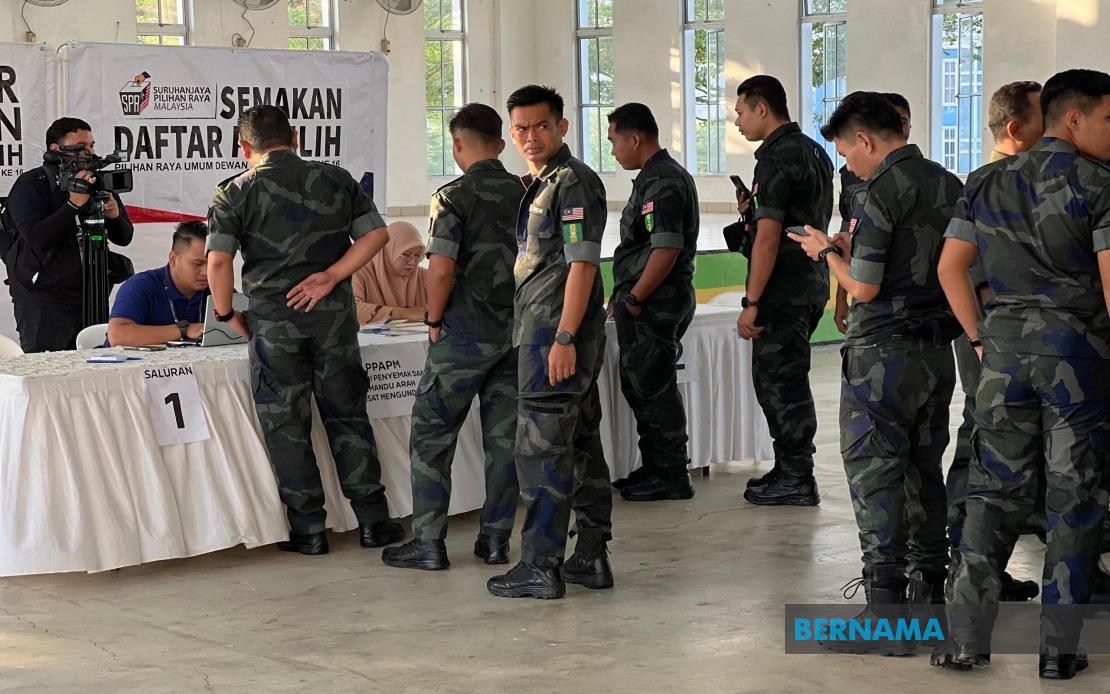
Malaysia's Johor state election moved into its early voting phase on Sunday as the Election Commission opened 64 designated centres to accommodate members of the security forces and their immediate families ahead of the main polling day scheduled for Saturday. The morning saw security personnel and their spouses begin casting their votes from 8 am, with the process staggered across multiple locations to manage the large number of eligible early voters within the Johor framework.
The logistics of the 16th Johor state election reflect a well-established practice in Malaysian electoral administration where uniformed personnel are granted early voting privileges due to their operational commitments. The Election Commission's data revealed that approximately 24,751 security force members and their spouses participated in this preliminary phase, a substantial bloc that required careful coordination across the state's 56 contested seats. This early voting mechanism ensures that even those bound by duty rosters or security postings can exercise their democratic rights without compromising operational readiness.
The Malaysian Armed Forces contingent represented a significant portion of the early voters, with some 12,041 service members and their families allocated to 11 dedicated polling centres across Johor. These facilities underwent standard preparations to handle the expected throughput while maintaining the integrity of the polling process. The Military's participation in elections underscores the principle of universal suffrage within Malaysia's democratic framework, regardless of professional obligations that might otherwise create logistical obstacles.
The Royal Malaysia Police and General Operations Force made up the remaining cohort, comprising 12,710 potential voters who were distributed across 53 polling locations. This larger number of centres for the police and paramilitary contingent reflects the more dispersed nature of their operational presence throughout Johor's diverse districts and municipalities. The Election Commission's distribution strategy attempted to minimise travel distances while accommodating the varied jurisdictions where these personnel are stationed and domiciled.
Voting schedules for the early centres operated on a cascading timeline, with individual locations closing at different intervals beginning from noon and concluding by 6 pm on Sunday. This phased approach prevented bottlenecks at counting centres and allowed election officials to manage the influx of completed ballots in manageable batches. The staggered closure mechanism has become standard practice in Malaysian electoral administration, particularly when dealing with concentrated voter populations in specialised early voting scenarios.
Weather observations from field correspondents indicated relatively favourable conditions across several Johor districts during the early voting period. Reports from Batu Pahat, Muar, Pontian and Tangkak indicated sunny skies, which typically ensures higher voter participation by removing weather-related deterrents. Clement conditions on the early voting day set a positive tone for the broader electoral process ahead, though Saturday's weather remains a variable that could influence turnout among the general population.
The early voting provisions for security forces reflect a unique aspect of Malaysian electoral practice that balances democratic principles with operational necessities. Unlike many democracies that grant absentee voting to military and police personnel, Malaysia's approach concentrates these votes into dedicated early polling days, creating a manageable administrative framework while maintaining the visibility and transparency of the process. This mechanism has proven particularly important in states like Johor, where the security establishment maintains substantial presence and personnel numbers.
The main polling day on Saturday will see approximately 2.7 million ordinary voters across Johor's 56 state seats cast their ballots in a wider expression of democratic choice. The early voting by security personnel thus represents merely the opening movement of a broader electoral process that will determine the state's political direction. The contrast between the organised, concentrated early voting and the dispersed Saturday polling highlights the logistical complexity inherent in managing elections across constituencies ranging from urban centres to rural hinterlands.
For Johor, a state with significant political importance in the Malaysian context, the election carries implications beyond local governance. The outcome will influence broader federal political dynamics and provide indicators of voter sentiment on national issues. The security forces' early participation ensures that this important demographic segment contributes to the overall result without creating operational disruptions, a pragmatic arrangement that has served Malaysian electoral administration well across multiple election cycles.
The conduct of early voting represents the Election Commission's confidence in its operational frameworks and the maturity of Malaysia's electoral culture, where security personnel can be trusted to vote responsibly and in accordance with established procedures. The absence of complications during the early voting phase typically augurs well for the main polling day, suggesting that Saturday's voting across Johor's constituencies should proceed smoothly barring unforeseen circumstances. The groundwork laid on Sunday thus becomes foundational to the broader exercise of democratic choice that will define Johor's governance for the coming years.

