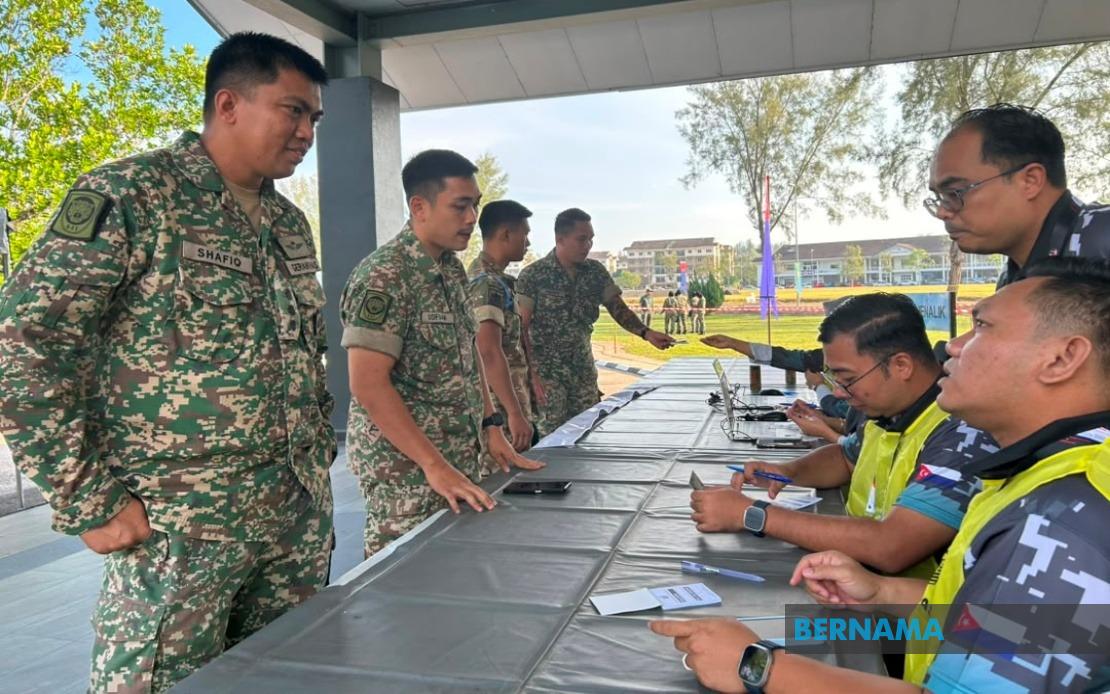
Johor's 16th state election got underway on July 7 with the commencement of early voting, as favourable morning weather enabled security personnel to exercise their democratic right ahead of the main polling day scheduled for Saturday. Beginning at 8 am across 64 designated centres, the process unfolded without significant hiccups, with security staff arriving from 7.30 am onwards to participate in what election authorities described as a smoothly run operation.
The early voting mechanism accommodated a total of 24,751 registered voters whose operational duties or service roles entitled them to vote before the general population. This cohort comprised 12,041 personnel from the Malaysian Armed Forces along with their eligible spouses, supplemented by 12,710 officers and family members drawn from the Royal Malaysia Police and General Operations Force. The separation of security personnel into an early voting window is a longstanding practice designed to ensure their participation despite shift patterns and deployment schedules that may conflict with Saturday's main election day.
Weather conditions proved cooperative throughout the morning, with clear skies facilitating the smooth transit of election officials and voters to the various polling locations. The Election Commission had completed preparatory inspections at each venue before doors opened, ensuring that procedures were standardised and that staff possessed the necessary materials and training. Observers stationed at several facilities, including the 5th Battalion GOF Camp in Simpang Renggam and the Johor Contingent Police Headquarters, reported that voting proceeded without congestion or procedural delays.
However, the Malaysian Meteorological Department issued an advisory regarding potential deteriorating conditions later in the day, warning of thunderstorms that could sweep across Johor during the afternoon and early evening hours. This forecast prompted the Election Commission to stagger the closing times of various polling centres, arranging closures between noon and 6 pm depending on each centre's geographical location and voter registration numbers. Such contingency planning reflects growing attention to weather-related disruptions in electoral administration, particularly given Malaysia's tropical climate patterns.
The early voting phase represents merely the opening chapter of what promises to be a keenly contested state election. A total of 172 candidates are vying for seats across 56 state assembly constituencies, offering voters a competitive range of options when they proceed to the ballot box on Saturday. This candidate density suggests meaningful multi-cornered contests in several constituencies, which could complicate vote-splitting dynamics and potentially yield surprising outcomes in closely marginal seats.
Johor's electoral register encompasses 2,727,926 qualified voters distributed among 1,140 polling stations throughout the state. This substantial electorate makes Johor one of Malaysia's most significant electoral contests, given the state's economic importance and its position as home to Malaysia's second-largest metropolitan area. Results from Johor have traditionally influenced regional political trajectories and sometimes foreshadowed national sentiment shifts in subsequent federal elections.
The logistics of managing such a large voting population present considerable challenges for the Election Commission, requiring coordination across multiple agencies and careful resource allocation. The decision to commence early voting for security personnel reflects both practical necessity and the commitment to universal adult suffrage principles, ensuring that those in public service do not forfeit their electoral participation due to occupational obligations. This arrangement particularly benefits military and police personnel, whose scheduling constraints and potential deployment during the election period could otherwise disenfranchise them.
For Malaysian observers, the Johor election carries significance beyond state-level governance, as Johor remains strategically important for political developments across the country. The state has experienced considerable political realignment over recent years, with shifting voter preferences reflecting broader changes in the national political landscape. How different demographic groups and constituencies respond to the competing candidates and parties on offer will provide valuable signals about evolving electoral sentiment.
The smooth execution of early voting on July 7 suggested that the Election Commission had learned valuable lessons from previous state and federal elections, implementing procedural refinements and administrative improvements that contributed to the generally positive assessments from observers. The absence of reported disruptions or administrative failures during the morning voting period provided encouragement that the main election day operations would similarly proceed without significant incident.
Looking toward Saturday's main voting day, all attention now focuses on whether turnout will match or exceed the participation rates seen in recent state elections. Early voting participation rates often serve as a bellwether for overall interest levels and engagement, though weather conditions and campaign momentum during the interim days can influence Saturday's numbers. The forecasted thunderstorms may impose logistical challenges and potentially depress turnout if they materialise as predicted.
Johor's election cycle has assumed particular prominence given the broader context of Malaysian politics, where state-level contests increasingly serve as testing grounds for party strategies and messaging approaches before federal elections. The range of candidates and parties participating demonstrates the competitive intensity that characterises contemporary Malaysian electoral politics. For political analysts and practitioners, the Johor outcome will warrant careful study regardless of which political coalitions ultimately prevail.

