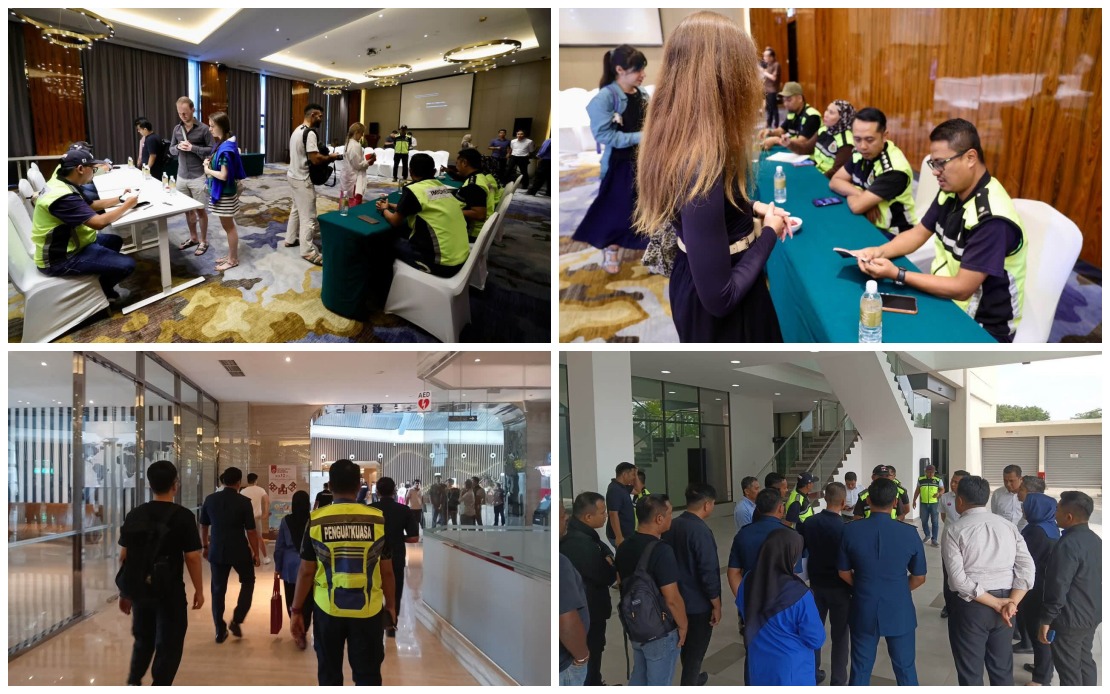
The Iskandar Puteri City Council (MBIP) has taken enforcement action against Network School's operations in the Forest City development, issuing a formal stop-business notice after investigators discovered multiple breaches of licensing conditions and misuse of approved premises. The action marks a significant escalation in local authority oversight of educational and commercial ventures within the Johor development, which has attracted considerable scrutiny in recent months over its governance standards and the nature of activities conducted within its precincts.
Menteri Besar Datuk Onn Hafiz Ghazi disclosed the enforcement measures in a statement, explaining that the MBIP's investigation had uncovered systematic violations of the company's business licence terms. The council discovered that Network School was operating from two separate locations, a critical finding that revealed the full scope of the operation's deviation from approved parameters. One premises held valid documentation as a business office, but the second location operated entirely without the required MBIP business licence despite being owned by a Malaysian citizen, creating a significant compliance gap under local authority regulations.
Beyond the basic licensing failures, the investigation revealed that the company had fundamentally misused the purpose-designation of its licensed premises. Facilities registered for standard office business operations had been repurposed as classroom spaces where educational instruction and business promotional activities took place. This conversion of use violated the specific conditions attached to the business permit, which strictly defines permissible activities. The company had not sought or obtained the necessary approval through a detailed application process that would have allowed such a change in operational category, suggesting either negligence in understanding regulatory requirements or deliberate circumvention of oversight mechanisms.
The formal enforcement instruments deployed demonstrate the council's multi-layered approach to addressing the violations. MBIP issued Stop-Business Notice IP012N260714001 targeting the unlicensed premises, effectively commanding cessation of all operations from that location. Simultaneously, the council issued an Advertisement Licence Notice (6103) under Section 107(2) of the Local Government Act 1976, indicating that signboards and external advertising materials had violated their own licensing conditions and were inconsistent with the permits that had been granted. This additional notice suggests the company had been publicly promoting its services in ways that exceeded what the existing documentation authorised.
Onn Hafiz emphasised the seriousness with which the Johor state government regards such violations, positioning the enforcement action within a broader commitment to regulatory compliance across the state. He indicated that MBIP would continue its investigation into all aspects of the school's operations that fall within the council's purview, with clear warning that additional enforcement measures would follow should further breaches be identified. This language suggests the investigation may still be ongoing and could yield additional findings that would trigger further action under relevant legal provisions.
A particularly noteworthy dimension of the case concerns the involvement of foreign nationals in the school's operations. Onn Hafiz carefully delineated jurisdictional boundaries, stating that matters relating to the status of foreign individuals associated with the institution fall entirely under the Home Ministry's authority rather than that of the state government. The Menteri Besar explicitly urged the federal ministry to make a prompt and final determination regarding both the status of the individuals involved and the permissibility of the school's continued operations, suggesting potential complications around immigration and visa compliance that go beyond mere local licensing issues.
This case emerges against a background of sustained social media attention and public discourse surrounding Network School and its presence in Forest City. Online discussions had circulated unverified claims linking the institution to an Israeli agenda to establish a foothold in Malaysia through activities ostensibly related to currency investment operations. While such allegations remained unsubstantiated at the point of the enforcement action, they had succeeded in drawing public attention to the school's activities and may have prompted closer scrutiny from local authorities.
The enforcement action carries broader implications for how authorities in Malaysia are managing educational and commercial ventures in large-scale property developments, particularly when such operations involve international components or attract public controversy. Forest City, as a major transnational development project, has experienced previous governance challenges, and this incident suggests Malaysian authorities are applying increasing regulatory pressure to ensure compliance with domestic licence and safety requirements regardless of the scale or prominence of individual operators within such developments.
For Malaysian parents and educational consumers, the case underscores the importance of verifying that schools and educational institutions maintain proper licensing and compliance with local authority regulations. The discovery that Network School was operating from unlicensed premises without regulatory approval demonstrates that operating permits and facility registrations represent more than bureaucratic formalities; they constitute essential safeguards that local authorities use to monitor and oversee institutional operations.
The incident also reflects evolving tension between the federal government's immigration and home security responsibilities and state-level local authority enforcement powers. While MBIP could move swiftly against licence violations, the determination of whether foreign nationals should remain in Malaysia or whether their presence represents a security concern rests with federal authorities. This jurisdictional separation means that even as local enforcement has proceeded, the broader questions surrounding the school's legitimacy and the status of international individuals involved remain subject to separate federal review processes.
Moving forward, the case will likely depend on Home Ministry determinations regarding the foreign nationals connected to the school and whether those individuals can maintain lawful presence in Malaysia under appropriate visa categories. Should the ministry conclude that such individuals lack appropriate authorisation or status, the federal decision would render the state-level licensing violations somewhat secondary, as the fundamental legal basis for the operation would be compromised at the federal level. Conversely, should federal authorities clear the individuals involved, the state would still need to address whether Network School could obtain appropriate licences to continue educational operations within Forest City, either by relocating to properly designated premises or by securing fresh approval for its current locations.

