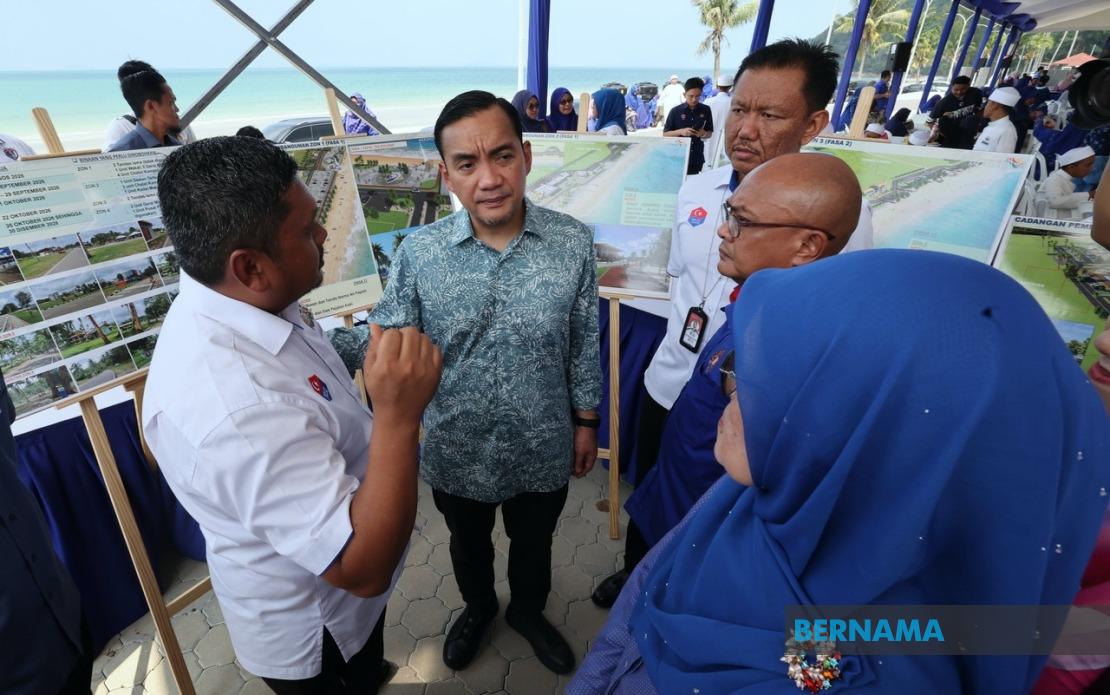
The Johor government has committed RM1.5 million towards revitalizing Mersing, marking a strategic push to extend the prosperity experienced in more developed areas to the state's periphery. Menteri Besar Datuk Onn Hafiz Ghazi announced the investment during a district gathering, underscoring the administration's intention to distribute economic gains equitably across all constituencies rather than concentrating development in urban centres.
The underlying philosophy driving this allocation reflects a shift in Malaysian regional governance toward inclusive growth models. Onn Hafiz articulated this perspective when he noted that maintaining tourism assets and economic infrastructure without delivering tangible benefits to the 80,000 Mersing residents would be counterproductive. This recognition acknowledges a persistent tension in Malaysian development policy: that coastal and rural districts often possess natural advantages and visitor appeal yet struggle to translate these assets into sustained employment and improved standards of living for their populations.
The Johor Economic Transformation Plan, from which this allocation emerges, represents an attempt to systematize development across the state through defined short, medium and long-term targets. Rather than ad-hoc project announcements, the JETP framework seeks to align infrastructure spending with job creation and human capital development. For Mersing specifically, this means the current funding round should be understood as part of a larger sequenced approach to district modernization rather than an isolated investment gesture.
Healthcare infrastructure receives substantial emphasis within the allocation. RM500,000 will upgrade the Mersing Hospital Haemodialysis Unit, addressing a critical gap in specialized medical services. For residents currently requiring dialysis treatment, this upgrade could eliminate the need for costly travel to larger medical centres in Johor Bahru or beyond, reducing both financial burden and health complications associated with transportation delays. This targeting of healthcare reflects growing awareness among state policymakers that quality medical services represent essential infrastructure for attracting and retaining skilled workers in secondary cities.
Religious and community facilities form another significant component of the spending. The RM200,000 allocated for carpet replacement at Kampung Sri Lalang Mosque represents investment in community gathering spaces beyond mere religious function. In Malaysian districts, mosques often serve as social hubs and civic nodes, making their maintenance relevant to broader quality-of-life metrics. Similarly, the commitment to establish a Religious Affairs Office in Mersing signals institutional investment in administrative capacity, enabling more localized governance and reducing bureaucratic friction for residents managing religious affairs.
Sports and recreational infrastructure receives RM480,000 across three projects: construction of a futsal court at Taman Sri Mersing, repair of an existing facility in Felda Nitar, and a new sepak takraw court in Felda Tenggaroh 6. These investments carry dual significance for youth engagement in a district where limited entertainment infrastructure can drive out-migration to urban areas. By establishing modern sporting facilities, the government creates spaces for physical activity while potentially catalyzing grassroots sports culture that could channel youth energy productively.
Particular attention has been directed toward the Orang Asli communities within Mersing's territory. RM100,000 each has been allocated for solar-powered streetlights in Kampung Peta and Kampung Tanjung Tuan, representing recognition of indigenous settlements that frequently lag in basic utility provision. Solar installation technology addresses both immediate illumination needs and aligns with sustainability principles increasingly emphasized in Malaysian development narratives. For these communities, improved lighting enhances safety and extends productive hours during evening periods.
Felda settlements, which constitute a significant portion of Mersing's population, receive targeted support through multiple projects. Beyond the futsal court repair and sepak takraw facility, RM100,000 supports the Kami Anak Felda Malaysia building upgrade in Felda Tenggaroh Timur. These allocations acknowledge that Felda communities, despite historical government support, often encounter gaps in modern amenities compared with non-scheme residential areas, and deliberate investment seeks to narrow this disparity.
Beyond the immediate capital expenditure, Onn Hafiz's announcement included forward-looking strategic initiatives that may prove more consequential for long-term development. The proposal to construct a petrol station serving the Special Forces Group at Camp Iskandar, while logistically specific, potentially signals military institutional expansion in the district. More significantly, plans to establish a Technical and Vocational Education and Training campus represent commitment to skills development infrastructure that could reshape Mersing's labour market profile. Vocational education institutions, when properly resourced and aligned with local industry needs, generate pathways for youth employment in technical sectors often offering better wages than traditional agricultural or service roles.
The proposed Religious Affairs Office similarly addresses administrative infrastructure gaps that affect how effectively the district can serve its population. Religious administration in Malaysia encompasses marriage registration, inheritance matters, and Islamic education coordination—functions currently requiring residents to travel or navigate centralized systems. Localizing these services reduces transaction costs for citizens while improving state administrative presence.
The involvement of local assemblypersons Mohd Youzaimi Yusof and Alwiyah Talib in the announcement reflects the political architecture through which such initiatives proceed. State-level development funding flows through district representatives whose electoral interests align with visible project delivery. This dynamic creates accountability mechanisms where local politicians must demonstrate tangible returns to constituents but can also result in project selection driven by political geography rather than optimal resource allocation.
For Malaysian observers, the Mersing investment offers insights into contemporary state governance priorities. The balance between hard infrastructure (roads, utilities, healthcare facilities) and soft infrastructure (education, skills training) suggests growing sophistication in development thinking. The explicit acknowledgment that economic growth must visibly benefit citizens in less prominent districts represents response to political pressures regarding equitable development that resonate across Malaysia's federal structure.
The RM1.5 million allocation, while substantial in absolute terms, remains modest relative to Mersing's development needs across its 80,000-person population. Per capita, the investment amounts to approximately RM18.75 per resident, suggesting this funding round addresses specific priorities rather than comprehensive district rehabilitation. The genuine test of effectiveness will emerge in implementation quality and whether these investments catalyze broader private sector and federal government interest in Mersing's development trajectory.

