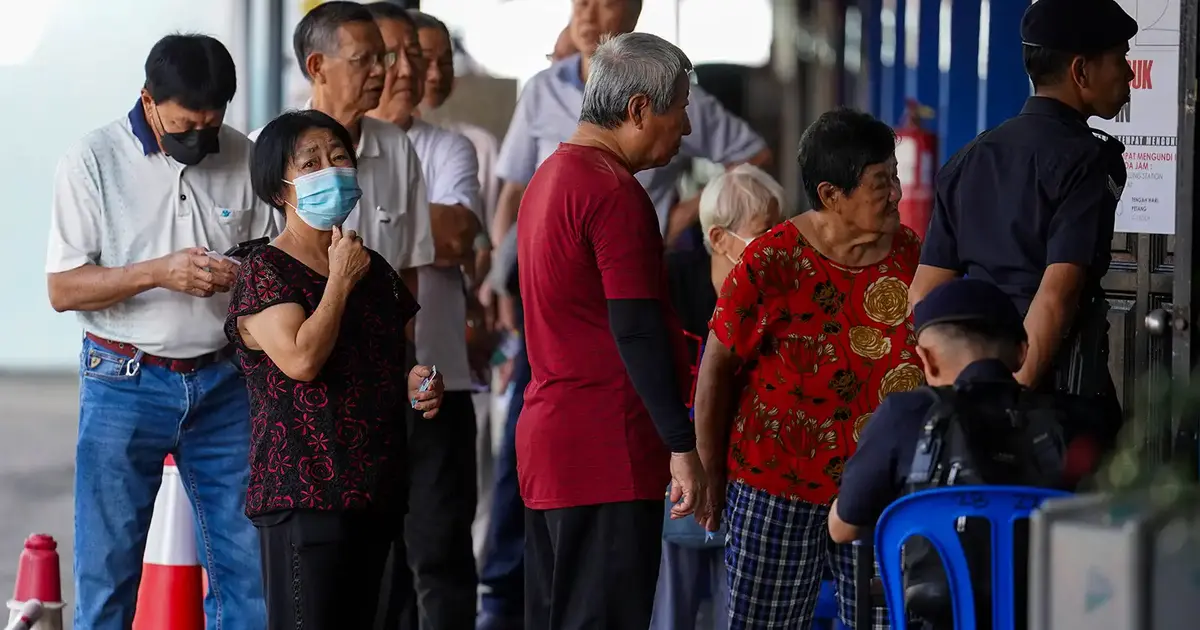
Pakatan Harapan's disappointing performance in the Johor state election cannot be attributed to a mass exodus of Chinese voters to the Barisan Nasional, according to Ong Teng Cheong, the former Member of Parliament for Bangi. Instead, the coalition's struggles reflect a more modest but strategically significant problem: a substantially depressed turnout among Chinese electors across the state. This distinction carries important implications for understanding the coalition's current electoral standing among a demographic group historically central to opposition politics in Malaysia.
Ong's assessment suggests that the narrative of a broad realignment in Chinese political allegiance—a concern that has animated much post-election commentary—may be overstated. His analysis indicates that only a comparatively small proportion of Chinese voters actively switched their ballots from Pakatan Harapan to Barisan Nasional during the contest. The more damaging factor was the absence of voters at the polls, a phenomenon that typically proves costlier for opposition parties that depend on robust mobilisation to overcome incumbent advantages and institutional structures favouring established coalitions.
Low voter turnout operates as a particular vulnerability for Pakatan Harapan in Chinese-majority or Chinese-plurality constituencies. Opposition movements ordinarily require proportionally higher participation rates to translate voter sympathies into actual electoral victories, given that administrative machinery, campaign resources, and media access frequently favour ruling coalitions. When the electorate becomes disengaged or apathetic, these structural disadvantages intensify, allowing Barisan Nasional to consolidate support among the proportion of voters who do participate.
The Johor election result reflects broader patterns evident across Malaysian electoral contests in recent years. Chinese voters, once considered a relatively reliable demographic for Pakatan Harapan, have shown signs of flagging enthusiasm—though the precise degree of this shift remains contested among analysts. Some observers interpret recent results as evidence of fundamental realignment, while others, like Ong, emphasise the role of participation mechanics rather than preference shifts. Understanding which factor dominates carries significant consequences for opposition strategy going forward.
From a broader Southeast Asian perspective, Malaysia's experience with fluctuating Chinese voter engagement offers instructive parallels to neighbouring democracies. In Singapore, Taiwan, and Thailand, shifts in Chinese-community political behaviour have proven consequential for national outcomes. However, Malaysia's particular context—with its multiethnic society, constitutional provisions addressing communal concerns, and the prominence of race-based political organisation—creates a distinct dynamic. Chinese voters in Malaysia operate within a political system structured around explicit ethnic representation, a framework that simultaneously constrains and shapes their electoral choices.
The implications for Pakatan Harapan are significant across multiple dimensions. If Ong's diagnosis proves accurate, the remedy involves reinvigorating voter mobilisation rather than fundamentally repositioning policy or messaging to recover lost votes. Turnout challenges can be addressed through ground organisation, voter contact programmes, and renewed efforts to convince supporters that voting represents a worthwhile exercise—a particularly important challenge when voters may harbour doubts about opposition prospects or feel resigned to incumbent dominance.
Johor carries special weight in Malaysian politics as the largest state by population and a longstanding Barisan Nasional stronghold. The state's Chinese-majority and Chinese-plurality constituencies have historically represented potential breakthrough opportunities for opposition coalitions, particularly during periods of broader anti-government sentiment. A consistent pattern of depressed Chinese turnout in Johor would suggest that Pakatan Harapan faces particular challenges in sustaining enthusiasm among this group in the coalition's traditional heartland.
The distinction between defection and disengagement also bears implications for internal Pakatan Harapan dynamics. If Chinese voters remain sympathetic to the coalition's broader project but simply declined to participate, this suggests the problem may lie with perception of the coalition's viability or relevance rather than with fundamental policy disagreements. Addressing such perceptions—through demonstrating tangible progress on constituency concerns, achieving concrete legislative victories, or presenting a compelling vision of governance alternatives—differs markedly from attempting to recapture voters who have actively embraced Barisan Nasional alternatives.
Ong's commentary arrives amid broader questions about Chinese voter positioning ahead of federal elections. The community has long served as a swing demographic capable of influencing national outcomes, particularly in an electoral system where seat distribution amplifies the political importance of modest shifts in voter preference across strategically located constituencies. Trends evident in Johor may foreshadow broader patterns affecting Chinese political behaviour nationally, or may reflect state-specific factors including leadership, local development priorities, and responses to particular state government decisions.
The role of Chinese voters in Malaysian politics extends beyond simple vote counting. Their political choices carry symbolic significance for questions of national cohesion, inter-communal relations, and the viability of multiethnic coalition-building in Malaysian democracy. Whether their recent electoral patterns reflect principled policy preferences, strategic calculations about political effectiveness, or simple variation in participation enthusiasm carries different meanings for Malaysia's political trajectory.
Moving forward, both Pakatan Harapan and political analysts must grapple with the fundamental question of whether depressed Chinese turnout in Johor represents a temporary phenomenon amenable to organisational correction, or whether it signals deeper erosion in the coalition's appeal to this critical voter group. The answer will substantially shape opposition strategy and electoral prospects in coming contests, while also influencing broader debates about political coalitional possibilities in Southeast Asia's largest multiethnic democracy.

