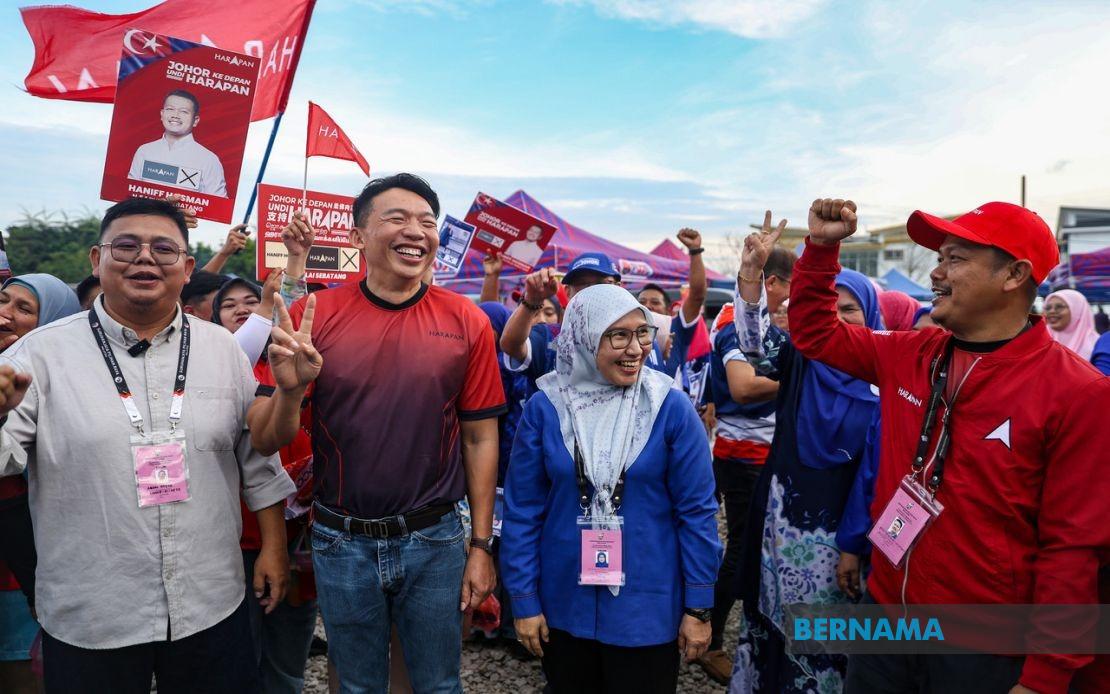
Campaign trails across Malaysia's southern state have taken on a notably cordial tone as the Johor state election enters its final stretch, with an impromptu meeting between candidates from opposing political coalitions at a Pontian night market highlighting the civil nature of this year's electoral contest. The encounter at Taman Megah on June 29 involved three Pakatan Harapan contenders—Haniff @ Ghazali Hosman from Pulai Sebatang, Abd Razak Ismail representing Benut, and Cheah Chee Hong campaigning for the Kukup seat—who were conducting a joint walkabout when they crossed paths with Hasrunizah Hassan, the Barisan Nasional candidate competing for the same Pulai Sebatang division.
What could have been an awkward intersection between two rival campaign teams, distinguishable by their contrasting red and blue flags, instead became a moment of genuine camaraderie. The candidates exchanged warm greetings as they navigated the bustling night market, pausing briefly from their respective voter engagement activities to acknowledge one another across the political divide. The scene drew the curiosity of onlookers at the market, with shoppers and traders momentarily suspending their evening routines to observe the unusual spectacle of opposing candidates meeting with evident friendliness rather than confrontation.
In remarks to journalists following the encounter, Haniff characterised the interaction as reflective of Malaysia's democratic health and institutional maturity. He underscored that the campaign period in Pontian had proceeded without rancour or disruption, and that meeting political opponents during canvassing represented a normal and healthy aspect of competitive democracy. The Pulai Sebatang candidate emphasised that the candidates involved maintained a relationship of mutual respect despite their competing interests, describing themselves as friends despite their formal rivalry at the ballot box.
Cheah expressed satisfaction at conducting his campaign alongside coalition partners, particularly noting the solidarity demonstrated by the joint walkabout strategy adopted by PH candidates in the three constituencies. He leveraged the media attention from the encounter to appeal directly to voters in Pulai Sebatang, Benut, and Kukup, urging them to maintain their political support for Pakatan Harapan throughout the election cycle. The Kukup candidate's remarks suggested that the informal, friendly tone of campaigning in Pontian had created a positive environment for presenting his party's message.
Hashunizah, representing the ruling Barisan Nasional alliance, similarly downplayed the significance of the chance meeting while celebrating what she characterised as evidence of electoral maturity in Johor's political culture. Rather than viewing the interaction as problematic or uncomfortable, she framed such encounters between opposing candidates as entirely normal occurrences that, if anything, strengthened resolve among campaign teams. She noted that despite the intensifying competitive atmosphere typical of election periods, Johor's political landscape remained remarkably stable and free from the violence or serious misconduct that has occasionally marred electoral contests elsewhere.
Hasrunizah's perspective reveals an important dimension often overlooked in coverage of Malaysian elections: the underlying consensus among competitors about the basic rules and norms governing political contests. Her assertion that the Johor campaign environment remained controlled and incident-free suggests that political actors across the spectrum continue to respect boundaries around acceptable behaviour, even as they pursue competing visions of governance. This restraint, while perhaps less dramatic than instances of electoral conflict, represents a significant achievement in sustaining democratic institutions.
The timing of this incident, occurring just weeks before the July 11 polling day, illustrates how Johor's campaign has unfolded in a fundamentally different register from electoral contests characterised by polarisation or hostility. The early voting scheduled for July 7 provides voters additional flexibility in participating, reflecting broader institutional improvements in Malaysia's electoral administration. The Pontian night market encounter thus becomes emblematic of a larger narrative about electoral conduct during this state election, where competition remains vigorous but civility prevails.
For Malaysian observers and international commentators monitoring democratic health in Southeast Asia, such incidents carry significance beyond their face value. They demonstrate that competitive elections need not inevitably breed animosity among participants, and that institutional frameworks supporting peaceful transitions of power can function effectively even amid genuine political disagreement. The willingness of candidates from different coalitions to acknowledge one another publicly, rather than engage in theatrical displays of hostility, suggests a baseline agreement about democratic legitimacy that transcends partisan interests.
The Johor state election represents a meaningful electoral exercise given the state's status as a major economic and political centre within Malaysia. With multiple constituencies contested across different demographic contexts—from the more urbanised areas to constituencies with significant rural populations—the election will test voter preferences across diverse communities. The conduct demonstrated at the Pontian night market, if representative of broader campaign dynamics across the state, suggests that voters will be able to make their choices based on policy platforms and candidate records rather than within an atmosphere of fear or intimidation.
As campaigns continue through early July, the significance of the Taman Megah encounter lies not merely in its immediate niceness but in what it reveals about the political culture's capacity for restraint and mutual respect. When candidates from competing coalitions can meet, greet, and then resume their campaigning without incident or rancour, it affirms that Malaysian democracy, despite periodic challenges and controversies, retains essential features of institutional stability. The Johor election, culminating in the July 11 polling day, will provide voters with clear choices to determine their state government's direction while proceeding within a framework that all major participants appear committed to respecting.

