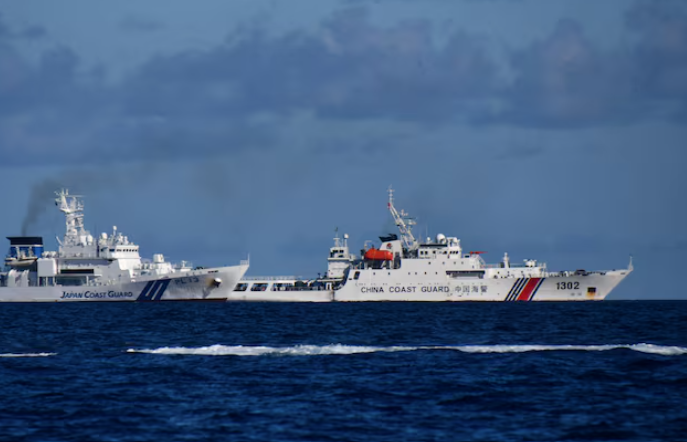
Japan's coast guard successfully forced two Chinese coast guard vessels to withdraw from waters it claims near the strategically important Senkaku Islands on Tuesday morning, according to official statements from Tokyo. The expulsion occurred at approximately 9:20am local time after the Chinese ships were spotted approaching a Japanese fishing vessel operating in the contested area. The incident underscores the persistent friction over maritime territorial claims in one of Asia's most sensitive geopolitical flashpoints, where competing sovereignty claims continue to generate regular confrontations between the two nations' maritime authorities.
The Senkaku Islands, called Diaoyu by China, sit strategically positioned between Taiwan and Japan's Okinawa prefecture and have been a source of bilateral contention for decades. Although Chinese coast guard vessels have previously entered waters that Japan administers in the region, direct approaches to Japanese fishing operations remain relatively uncommon occurrences. The presence of a civilian fishing boat in the area during Tuesday's encounter added a civilian dimension to what is typically a purely governmental maritime dispute, prompting Japan's coast guard to position vessels specifically to shield the fishing operation from potential interference.
According to Japan's coast guard statement, four Chinese ships were initially observed operating in the vicinity before two of them proceeded into what Tokyo considers its territorial waters. The Japanese authorities characterised the entire operation as a violation of international maritime law and signalled their commitment to maintaining control over the disputed zone. Officials stated unequivocally that Japan's coast guard would maintain its vigilant posture, continuing to respond to future incursions with both calm determination and strict adherence to both international conventions and domestic regulations.
The broader context of Japan-China tensions has noticeably deteriorated since November of last year, when Japanese Prime Minister Sanae Takaichi made remarks regarding potential military intervention should Taiwan face armed aggression from Beijing. Takaichi's comments directly contradicted China's consistent assertion that Taiwan represents an internal matter and triggered sharp rebukes from Chinese officials. Beijing's subsequent response has extended beyond diplomatic protests, including efforts to discourage Chinese citizens from travelling to Japan and implementing selective trade restrictions targeting certain Japanese companies.
China maintains a systematic presence of coast guard assets throughout the contested waters, deploying these vessels regularly around the Senkaku Islands in what Beijing views as exercises of sovereignty. These routine operations frequently generate dangerous maritime confrontations with their Japanese counterparts, creating an inherent risk of escalation through miscalculation or accident. The pattern reflects China's broader strategic approach to the disputed territories, which involves consistent application of pressure through administrative and coast guard presence rather than military vessels.
Beyond the Senkaku dispute, China has extended similar coast guard operations to other contested areas throughout the East China Sea. These waters are believed to contain significant potential reserves of petroleum and natural gas, adding economic incentives to the political and strategic dimensions of the territorial claims. Despite Tokyo's repeated diplomatic protests and demands for cessation of these activities, Beijing has maintained its operational tempo, suggesting that both nations view these waters as too strategically and economically significant to cede through reduced presence.
The last reported instance of Chinese vessels entering waters claimed by Japan occurred on June 10, making Tuesday's encounter part of an accelerating pattern of maritime incursions. Each such episode carries the potential to trigger unintended escalation, particularly given the involvement of civilian fishing vessels whose operators may not be fully trained in international maritime protocols or equipped to de-escalate dangerous situations. The deliberate positioning of Japan's coast guard vessels around the fishing boat reflects official concern that Chinese operations might target civilian maritime activity as a means of asserting territorial claims.
For regional observers, particularly in Southeast Asia where multiple overlapping maritime claims exist, the Japan-China disputes over the Senkaku Islands serve as a critical example of how territorial disagreements can persist and intensify despite decades of bilateral relations. The situation demonstrates the limitations of diplomatic channels when underlying strategic interests diverge sharply. Malaysia, Vietnam, and other Southeast Asian nations with their own contentious maritime boundaries watch these developments closely, recognising that Japanese and Chinese approaches to enforcing territorial claims through coast guard deployments may establish precedents that affect their own regional security environments.
Japan's consistent messaging emphasizes its commitment to maintaining order in its claimed waters through lawful means and international legal frameworks. However, the escalating frequency of these encounters suggests that deterrence through administrative responses may have limited effectiveness against a rival nation pursuing its own territorial objectives through sustained operational presence. The challenge facing Tokyo involves maintaining credible control over disputed waters while avoiding military confrontation that could trigger broader regional instability. As these maritime tensions persist, they continue reshaping the security architecture of East Asia and influencing broader calculations among regional powers regarding military capabilities and alliance relationships.

