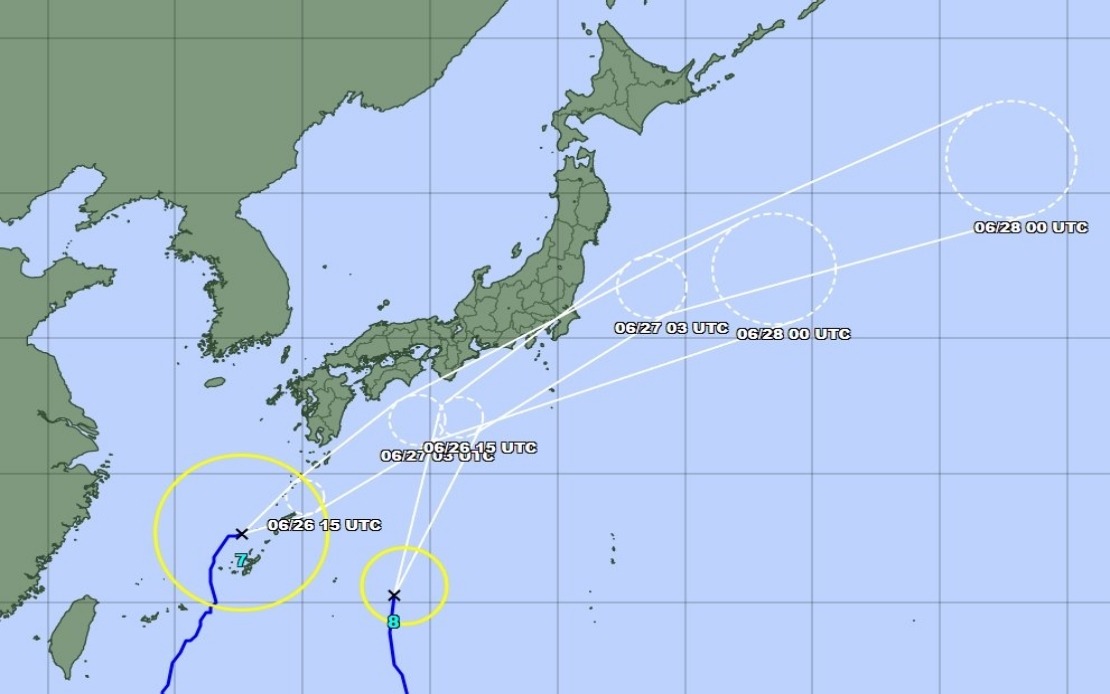
Japan's meteorological authorities issued urgent warnings on Friday as two separate typhoons converged on the island nation, threatening widespread disruption across multiple regions throughout the weekend. The Japan Meteorological Agency cautioned that Typhoon Higos was advancing from the Pacific Ocean with landfall expected within hours, while simultaneously monitoring Typhoon Mekkhala, which had already begun affecting southwestern coastal areas. The dual threat created an exceptionally challenging situation for disaster management officials attempting to coordinate evacuation procedures and emergency response across an unusually broad geographic area.
Typhoon Mekkhala demonstrated its immediate danger by reaching the Amami region in Kagoshima Prefecture on Friday, where it commenced its northeastward trajectory toward the densely populated Kanto region encompassing Tokyo and surrounding areas. As of mid-morning Friday, the storm system was positioned off Kume Island in Okinawa Prefecture, advancing at fifteen kilometres per hour toward Japan's central corridor. Meteorologists indicated that while both typhoons would gradually weaken into extratropical cyclones as they moved inland, the transition period would coincide with peak rainfall across vulnerable terrain susceptible to mudslides and flash flooding.
The scale of evacuation efforts underscored the severity of the situation. The Fire and Disaster Management Agency reported that more than two million residents across thirteen prefectures in the Kinki and Kyushu regions had received official evacuation orders by early Friday morning. These figures reflected the geographical scope of the threat, which spanned multiple prefectures from southwestern Japan northward. In Seika, Kyoto Prefecture, authorities implemented the highest level five emergency alert for specific districts after landslides materialized during the morning hours, indicating that the rainfall had already triggered ground instability in vulnerable locations.
Accumulated precipitation measurements revealed the exceptional intensity of the meteorological system. The Goto area in Nagasaki Prefecture received six hundred millimetres of rain between Tuesday and Friday morning—equivalent to several weeks of typical summer rainfall concentrated within four days. Neighbouring regions experienced comparably severe conditions, with Aso in Kumamoto Prefecture and Ureshino in Saga Prefecture each recording more than five hundred millimetres. These measurements quantified the extraordinary moisture delivery that had already affected the region prior to the weekend typhoon landfalls, leaving soil conditions dangerously saturated and prone to catastrophic failure on hillsides and mountainous terrain.
The projected rainfall for the weekend intensified concerns about compounding water accumulation and cascading natural disasters. As Typhoon Higos tracked northward along Japan's southern coastline, the meteorological agency predicted that precipitation would intensify across the Tokai and Kanto regions, with conditions remaining hazardous through Saturday. The Tokai area, encompassing Shizuoka and surrounding prefectures, faced the prospect of up to three hundred millimetres of additional rainfall by noon Saturday, while the broader Kanto-Koshin region—which includes Tokyo and its metropolitan sprawl housing tens of millions of people—anticipated up to one hundred fifty millimetres. These forecasts raised serious concern about the cumulative impact on infrastructure, drainage systems, and particularly on hillside communities built in zones of known geological vulnerability.
MeteorologistsWarned of strong storm conditions across Okinawa Prefecture and eastern Japan, emphasizing that the combination of two separate typhoon systems would create complex wind and pressure patterns across a vast area. Rather than simple progression from one location to another, the interaction of the two systems created potential for intensified conditions in certain zones where their circulation patterns overlapped or reinforced each other. This complicated meteorological scenario meant that residents in the affected regions faced not a simple passing storm, but a multi-day period of dangerous weather that could shift unpredictably based on the precise track and intensity of each typhoon system.
For Malaysian and Southeast Asian observers, the Japanese experience offers instructive parallels regarding typhoon preparedness and the cascading impacts of extreme precipitation in populated areas. The scale of evacuation coordination and the meticulous measurement and forecasting systems deployed by Japanese authorities reflect the sophisticated disaster management infrastructure that developed economies maintain. However, the event also underscores how even highly advanced warning systems and robust emergency protocols cannot entirely prevent casualties or property damage when natural systems of such magnitude strike densely inhabited regions. The particular vulnerability of hilly terrain throughout Japan mirrors geographic challenges faced across Southeast Asia, where rapid urbanization and hillside settlement patterns have created populations at heightened risk from landslides triggered by extreme rainfall.
The economic implications of the typhoon system extended beyond immediate physical damage considerations. Transportation networks, manufacturing operations, and agricultural activities across multiple prefectures faced disruption lasting days beyond the actual passage of the weather system. The need to mobilize two million people—providing shelter, coordination, logistics, and subsequent cleanup and recovery operations—represents an enormous logistical undertaking that strains resources even in a wealthy, technologically advanced nation. For less developed economies in the region, comparable events of similar scale would create far more severe human and economic consequences, highlighting the vulnerability disparities that persist across Asia despite overall regional economic growth.
The situation reflected broader climate patterns affecting Japan and the broader Western Pacific region. The accumulation of atmospheric moisture in the region and the presence of two significant typhoon systems simultaneously suggested conditions of heightened tropical cyclone activity tied to seasonal patterns and potentially to longer-term climate trends. Meteorological agencies across Asia maintain constant vigilance during typhoon season, but the density of multiple strong systems in close temporal proximity represents the kind of compound natural disaster scenario that climate scientists increasingly warn may become more frequent under evolving atmospheric conditions. Japan's response to this dual-typhoon event would provide valuable data for disaster management professionals considering how to enhance preparedness for scenarios involving multiple simultaneous or near-simultaneous extreme weather events.

