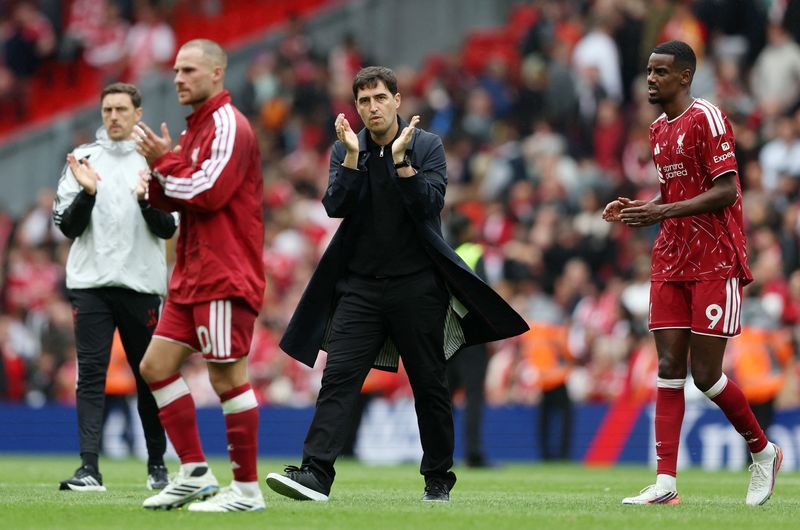
Andoni Iraola, Liverpool's newly appointed manager, continues to search for his maiden Premier League victory at the helm, yet the Spaniard discovered enough encouragement during Saturday's 2-2 draw against Nottingham Forest to believe his tactical blueprint for the club is beginning to materialise. The draw, following a similar scoreline against Newcastle six days earlier, suggests that despite an absence of three points on the board, the underlying trajectory of Liverpool's revival is moving in the right direction—at least in the manager's assessment.
Iraola arrived at Anfield during the summer following a disappointing campaign in which Liverpool descended from defending champions to fifth place, having invested an unprecedented £446 million in new talent under the previous regime. The Merseyside club's collapse last season remains a source of considerable frustration among supporters and board members alike, transforming what should have been a period of consolidation into an existential reckoning about the club's direction and identity. Against this backdrop, Iraola inherits not merely a squad requiring reconstruction, but an institution struggling to recapture its competitive edge after years of European prominence.
The 42-year-old's mandate extends beyond simply accumulating points. He must restore Liverpool to English football's pinnacle whilst reintroducing the suffocating intensity and relentless pressing that once transformed Anfield into a fortress capable of unsettling even Europe's elite. This task assumes particular significance for a support base schooled on Jurgen Klopp's frenetic, all-consuming approach to football—a style fundamentally at odds with the more circumspect methodology employed by his predecessor Arne Slot during a two-year tenure that ultimately yielded disappointing returns.
Iraola's solution to Liverpool's predicament centres not on pragmatism or defensive solidity, but rather on an even more aggressive interpretation of attacking football. He demands his players operate at pace, press opponents relentlessly, and maintain possession in advanced positions—a philosophy that should align with the philosophical preferences of Liverpool's traditionally ambitious support. Yet the gap between tactical aspiration and matchday execution remains vast. Against Forest, Liverpool's vulnerability to swift counterattacks manifested immediately when Dan Ndoye capitalised on poor defensive positioning to open the scoring, whilst large swathes of the opening forty-five minutes were characterised by laboured passing and a concerning lack of urgency.
The transformation evident after the interval proved far more aligned with Iraola's vision. Alexander Isak restored parity shortly after the hour, before substitute Victor Munoz, one of the manager's summer acquisitions, secured a late equaliser. Iraola praised Munoz effusively following the match, highlighting not merely the winger's attacking contributions but his defensive work ethic and willingness to engage in the pressing system repeatedly and without complaint. For a manager attempting to embed a demanding football philosophy into an underperforming squad, such character traits assume considerable importance alongside technical ability.
The recurring frustration for Iraola centres on Liverpool's habitual sluggishness during opening periods. This pattern, inherited from the previous campaign, suggests deeper structural issues within the squad's mentality or conditioning rather than isolated tactical oversights. The manager identified the root cause as a passive approach when defending without possession, wherein Liverpool retreated into defensive comfort and afforded opponents excessive spatial freedom. Only when the team elevated its pressing intensity, closed down opponents more aggressively, and recycled possession at greater tempo did the underlying quality become apparent. This diagnosis offers hope—demonstrating that improved performance stems from intensity and application rather than requiring fundamental personnel overhaul.
Despite the absence of victories, Iraola has correctly identified that panic would be premature. He recognised from the outset that transitioning an entire squad toward a higher-tempo, more aggressive playing model requires patience and incremental adjustment. Two consecutive matches where Liverpool recovered from losing positions demonstrate resilience and character—valuable assets during any rebuilding phase. Nevertheless, the manager acknowledged candidly that whilst entertainment value and competitive spirit merit encouragement, the currency of professional football remains the acquisition of points, a reality that leaves him frustrated regardless of performance improvements.
Liverpool's transfer window developments suggest the club hierarchy shares Iraola's vision and is prepared to invest strategically in players suited to his tactical demands. British media reports confirm that the Merseyside club has finalised an agreement to acquire Bradley Barcola, the 23-year-old French winger currently at Paris Saint-Germain. Barcola's profile—rapid, direct, incisive in one-on-one situations—aligns perfectly with a system demanding immediate ball progression and attacking penetration. His arrival would further reinforce Iraola's ability to populate his team with players possessing the physical attributes and tactical discipline his system demands.
The broader context for Iraola's appointment and Liverpool's trajectory extends beyond the club itself. Manchester City's continued dominance of English football has created a vacuum at the summit that ambitious clubs with substantial resources remain desperate to fill. Liverpool, possessing the financial capacity and historical gravitas to challenge City's hegemony, represents an obvious candidate for resurgence. Yet doing so requires managerial acumen capable of extracting maximum efficiency from expensive personnel whilst simultaneously installing a cohesive tactical framework. Whether Iraola possesses such qualities remains uncertain, but his willingness to court positive risk through attacking football suggests a fundamental faith in his footballing principles.
For Malaysian and Southeast Asian football enthusiasts, Iraola's approach offers an intriguing philosophical contrast to the more cautious, efficiency-oriented management styles increasingly prevalent across Europe. His commitment to entertaining, aggressive football despite current competitive circumstances reflects the kind of principled football vision that has attracted devoted followings throughout the region. As Liverpool's season progresses and the Spaniard's tactical evolution becomes clearer, the club will provide a valuable case study in whether uncompromising attacking philosophy can generate sustained success in modern football's ruthlessly competitive environment.

