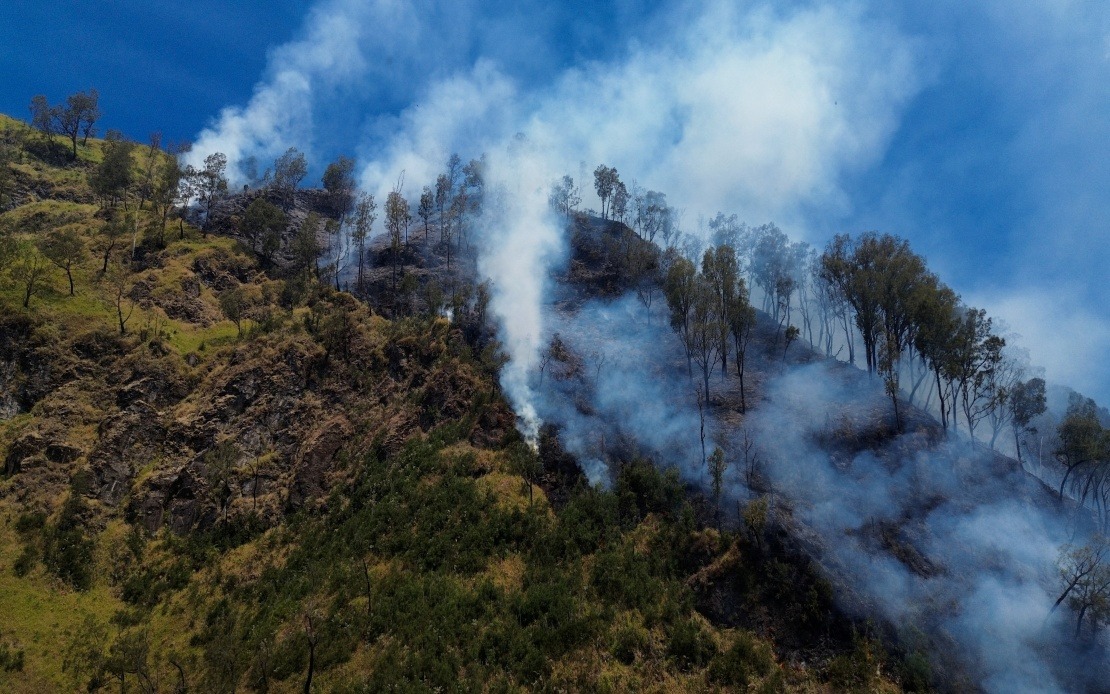
Indonesia's Mount Bromo, one of Southeast Asia's most visited volcanic attractions, has been sealed off from tourists as a spreading wildfire continues to ravage the iconic landscape in East Java. The Bromo Tengger Semeru National Park authority implemented a comprehensive closure of all entry points effective from 10pm on Saturday, suspending all tourism operations until the emergency situation stabilises. This decision marks a significant disruption to one of the region's most important tourism destinations, coming at a critical time when the park typically attracts substantial visitor numbers during the peak season.
The wildfire, which ignited on Monday, has consumed an estimated 176.20 hectares of forest across the Probolinggo and Malang regencies, according to data released by the National Disaster Management Agency. Abdul Muhari, head of the agency's Disaster Data, Information, and Communication Centre, confirmed that active hotspots continued to emit smoke even as of Saturday evening, indicating the fire remained far from contained. The persistence of burning zones suggests ongoing challenges in suppressing the blaze despite intensive intervention efforts, with meteorological conditions including moderate winds potentially complicating firefighting operations.
The park authority has identified five specific closure points affecting visitor access comprehensively. These include the entrances at Cemorolawang in Probolinggo Regency, Wonokitri in Pasuruan Regency, as well as three additional gateways—Jemplang and Coban Trisula in Malang Regency, and Senduro in Lumajang Regency. This multi-point closure ensures that no access routes remain open to the public, fundamentally halting all tourism flow into the national park. The decision reflects the severity of the situation and the need to clear areas completely for coordinated emergency response operations.
To manage the disruption for advance planners, the park authorities have implemented visitor accommodation measures. Tourists who purchased tickets online for dates falling within the closure period may either reschedule their visits to a future date or request full refunds. This provision acknowledges the inconvenience to the travelling public whilst enabling the park to maintain operational flexibility once the emergency concludes. For visitors from Malaysia and other regional countries who had organised trips to this major attraction, the options provide some recourse, though the indefinite nature of the suspension creates uncertainty for future planning.
Indonesian authorities have mobilised substantial aerial resources to combat the advancing flames. Two helicopters, each equipped with water-dropping capacity of 1,000 litres per sortie, have been deployed to support ground-based firefighting teams. The deployment of aerial assets underscores the seriousness with which state authorities are treating the emergency, as helicopter operations represent significant resource commitments. These aircraft provide capabilities for reaching difficult terrain and delivering concentrated water masses to active fire zones that ground teams might struggle to access quickly.
The Mount Bromo incident forms part of a broader pattern of forest fires affecting Indonesia's eastern regions during this period. In a separate but concurrent emergency, officials brought a forest and land fire under control in the Sembalun Resort area of Mount Rinjani National Park, located in East Lombok Regency, at approximately 1:30am on Saturday. This fire, which started around 8pm on Friday, had affected approximately 30 hectares before containment. The simultaneous occurrence of fires across multiple major national parks in East Java and the adjacent Nusa Tenggara region suggests common underlying conditions—possibly related to seasonal weather patterns, vegetation dryness, or other environmental factors.
Investigators have not yet determined the precise causes of either the Bromo or Rinjani fires, with officials stating that examinations remain ongoing. Understanding the origins of these blazes carries implications beyond immediate firefighting response, as patterns in fire causation could inform future prevention strategies and resource allocation. Whether these fires resulted from human negligence, natural ignition sources, or other factors will likely influence how authorities calibrate monitoring and enforcement efforts going forward.
For Malaysian travellers and regional tourists, this closure represents a temporary but impactful disruption to itinerary planning. Mount Bromo has established itself as a premier destination in the East Java tourism circuit, particularly among visitors seeking volcanic landscapes and cultural experiences in Indonesian settings. The closure will redirect tourist flows and expenditure away from the park and surrounding communities in Probolinggo, Pasuruan, Malang, and Lumajang regencies, potentially creating secondary economic effects across local hospitality sectors.
The situation also raises broader questions about tourism infrastructure resilience in volcanic regions across Southeast Asia. Both Mount Bromo and Mount Rinjani operate in environmentally sensitive zones where natural hazards and ecosystem disruptions can escalate rapidly. The Indonesian government's swift implementation of the closure demonstrates institutional capacity to prioritise safety over revenue considerations, a decision that will likely prevent casualties but generates economic costs for local stakeholders dependent on tourism revenue.
As firefighting efforts continue, authorities have indicated that monitoring operations remain active with teams tracking hotspot locations and atmospheric conditions. The moderate wind conditions mentioned in official statements present dual implications—winds can both accelerate fire spread and enhance the effectiveness of aerial water drops. Continued vigilance and adaptive response strategies will be essential as personnel work to contain the remaining active zones and transition the national park back to normal operational status, though no timeline for reopening has been announced.

