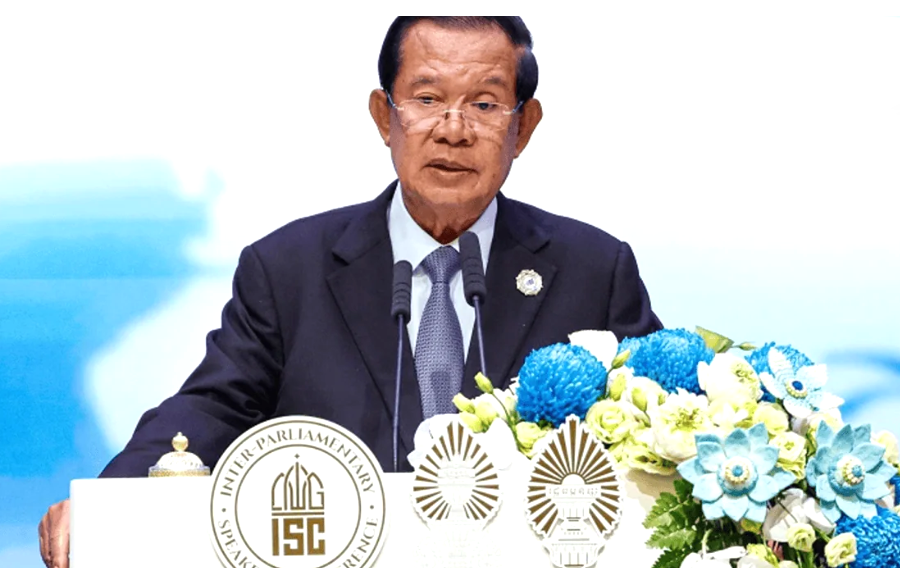
Cambodia's Senate president Hun Sen has launched a sharp rebuke against Thailand, alleging that Bangkok weaponised concerns over cross-border online scam operations to justify what he characterises as an illegal occupation of Cambodian territory. Speaking at the 2nd Inter-Parliamentary Speakers' Conference in Phnom Penh on Thursday, Hun Sen positioned his country's border dispute within a broader framework of destabilising global trends, arguing that Thailand has deliberately misused international enforcement mechanisms to pursue territorial ambitions under false pretences.
The conference drew parliamentary delegations from across the globe, including representatives from Pakistan, Malaysia, Myanmar, Australia and Russia, providing Hun Sen with a prominent international platform to articulate Cambodia's grievances. His comments underscore escalating tensions between the two Southeast Asian neighbours and reflect Phnom Penh's frustration with what it views as the selective application of international law to serve political interests. The Senate president did not specify which territorial areas remain under Thai control, though the Cambodia-Thailand border has been a chronic flashpoint, with disputes centring on demarcation and competing territorial claims.
Hun Sen framed Thailand's actions within a paradigm of contemporary military strategy that operates beneath formal declarations of war. He argued that modern conflicts increasingly adopt disguised forms—what he termed a new method of warfare where international pressure around cross-border criminal activity becomes weaponised to justify military occupation. This recharacterisation of Thailand's actions as part of a broader pattern of extra-territorial jurisdiction reflects Cambodia's attempt to internationalise the dispute and gain sympathy from fellow developing nations struggling with similar geopolitical pressures.
Beyond the bilateral dispute, Hun Sen presented a sweeping critique of how the international system has fractured under the weight of competing interests among powerful nations. He highlighted how modern conflicts have evolved far beyond traditional military engagement, now targeting the civilian infrastructure that underpins societies—roads, bridges, religious sites, schools and critical economic assets like oil refineries have become contested zones. This observation resonates strongly with Southeast Asian nations vulnerable to external pressures, as Cambodia's argument mirrors concerns across the region about how weaker states become collateral damage in great power competition.
The Senate president warned that a dangerous arms race has begun as vulnerable nations abandon faith in international treaties and seek independent security guarantees. His assertion that systemic insecurity driven by powerful actors exercising unilateral self-defence rights has undermined the collective security framework strikes at the core of post-World War II international architecture. For regional observers, Hun Sen's comments highlight how the UN-centred order that ostensibly protects smaller states has become increasingly ineffective when major powers prioritise their interests over institutional rules.
Hun Sen specifically condemned what he characterised as the weaponisation of trade and enforcement mechanisms, arguing that wealthier nations apply double standards when judging developing countries on issues ranging from human rights to environmental compliance to cross-border crime. He contended that accusations surrounding online scams and other transnational crimes often disregard the structural vulnerabilities and limited institutional capacity of developing nations that are still recovering from decades of conflict. This argument has particular resonance in Cambodia, which continues to rebuild after the devastation of the Khmer Rouge period and subsequent civil strife.
The Senate president's assertion that international treaties protecting non-proliferation could collapse under mounting security anxieties represents a sobering escalation in rhetoric. He suggested that as vulnerable nations lose confidence in multilateral frameworks, they may pursue independent nuclear or advanced weapons capabilities as deterrents, potentially triggering cascading proliferation across regions. Such a development would have profound implications for Southeast Asia, where most nations remain non-nuclear and depend on international guarantees of non-proliferation.
Hun Sen's critique of the rules-based international order carries weight precisely because it comes from a leader whose own government has frequently been criticised by Western powers for democratic shortcomings and human rights concerns. His arguments, however, reflect genuine frustrations shared across the developing world—that powerful nations establish international rules when such rules serve their interests, then abandon or reinterpret those same rules when circumstances change. This dynamic has eroded faith in institutions among many Global South governments.
The Senate president stopped short of naming specific nations responsible for destabilising the international order, though his implicit references to powerful actors exercising unilateral self-defence and employing double standards appeared directed at Western powers and regional rivals. His invocation of the UN Charter and ASEAN Charter as frameworks that should be restored suggests Cambodia seeks to anchor its arguments within collectively endorsed international instruments rather than rely on bilateral negotiations where it holds weaker leverage.
For Malaysia and other Southeast Asian nations, Hun Sen's warnings about trade weaponisation and the targeting of civilian infrastructure carry immediate relevance. Regional economies depend on predictable trade rules, stable supply chains and freedom of navigation through international waters and airspace. The argument that these fundamentals are increasingly subject to arbitrary enforcement by powerful actors speaks to anxieties animating ASEAN's push for greater centrality in regional affairs and its attempts to maintain hedging strategies between competing great powers.
Cambodia's use of an international parliamentary forum to air the border dispute and broader systemic concerns reflects its diplomatic strategy of mobilising regional and global opinion against Thailand. By framing the conflict as symptomatic of deeper fractures in the international system, Hun Sen attempts to elevate Cambodia's specific territorial grievance into a universal concern that should galvanise support from fellow developing nations. Whether this rhetorical strategy translates into concrete diplomatic or military advantages remains uncertain, but it signals Phnom Penh's determination to resist what it views as Thai opportunism.
The Senate president's warning about the collapse of the rules-based order, while hyperbolic in places, reflects genuine anxieties among smaller nations about their vulnerability in an increasingly multipolar world. His assertion that international law has become selectively enforced by those with military and economic power strikes a chord across the Global South. For Cambodia specifically, the challenge now lies in converting rhetorical arguments into diplomatic leverage capable of forcing a resolution to the border dispute on terms acceptable to Phnom Penh.

