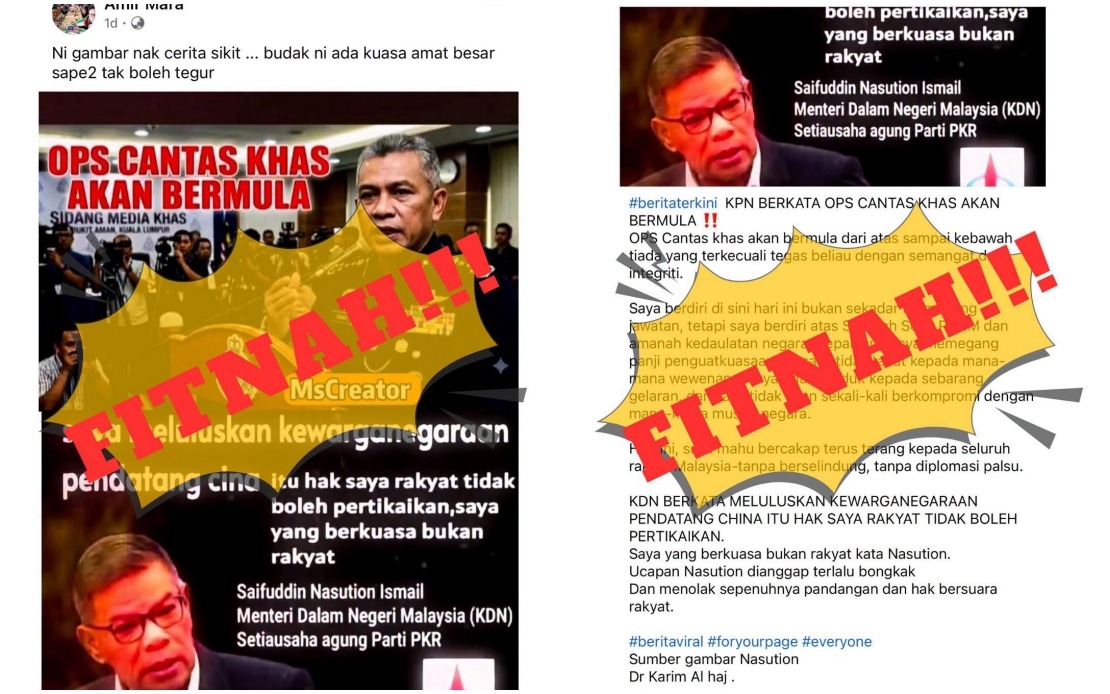
Datuk Seri Saifuddin Nasution Ismail, the Home Minister, has categorically rejected persistent allegations that the Home Ministry (KDN) has engaged in mass citizenship grants to foreign nationals, including unsubstantiated claims regarding the presence of 1.2 million Chinese nationals in Malaysia. Speaking from Putrajaya on August 19, Saifuddin expressed frustration with what he characterised as a deliberate campaign to recycle discredited narratives, emphasising that he has previously addressed these claims with documented evidence and official data.
The minister's statement underscores a broader concern within government circles about the weaponisation of citizenship and immigration-related narratives for political and social media purposes. Rather than engaging with the substantive arguments, Saifuddin adopted a more pointed critique of the tactics employed by those spreading the claims, highlighting the deliberate recycling of videos, posters, and narratives that officials have already publicly corrected. This suggests that despite repeated clarifications from the ministry, certain actors continue to propagate the allegations, apparently undeterred by official rebuttals.
Saifuddin's response carries particular significance in the Malaysian context, where citizenship and immigration issues touch upon sensitive communal identities and national identity debates. The deliberate circulation of unverified claims about mass naturalisation has the potential to inflame inter-ethnic relations, a concern that clearly weighs on the minister's mind. By framing the issue in terms of national security and public order, Saifuddin has elevated the discourse beyond simple policy disagreement into a matter of institutional integrity and social cohesion.
The spread of such allegations through social media platforms presents a distinctive challenge for government institutions seeking to maintain public confidence. Traditional media rebuttals, while important, often struggle to contain the viral nature of misinformation campaigns on digital platforms where reach and speed frequently outpace accuracy. Saifuddin's acknowledgment that these narratives continue to circulate despite official correction highlights the friction between institutional communication strategies and the decentralised dynamics of social media discourse.
The minister's call for citizens to verify information through official sources represents an attempt to establish alternative information hierarchies, positioning government data as authoritative counter-narrative. However, such appeals often presuppose a level of institutional trust that may already be compromised in segments of the population prone to believing the original allegations. In Malaysia's polarised media environment, where different demographic groups frequently consume divergent information sources, such requests for verification may have limited penetrative capacity.
The invocation of defamation law and concerns about undermining public confidence in state institutions reveals the government's sensitivity to the reputational damage these allegations inflict. When citizens harbour doubts about whether core institutional functions—such as determining citizenship eligibility—are being performed with integrity, the legitimacy of those institutions becomes compromised in more profound ways. This suggests that Saifuddin views the persistent circulation of these claims as posing risks beyond simple factual inaccuracy.
Saifuddin's explicit reference to the potential to stir racial hatred indicates that the claims gain traction precisely because they resonate with pre-existing anxieties about demographic change and foreign influence. The specificity of allegations targeting particular nationalities amplifies their capacity to trigger communal reflexes. By framing the response in terms of preventing racial discord, the minister acknowledges the deeply combustible nature of immigration and citizenship discourse within Malaysian society.
The call for responsible social media usage, while seemingly straightforward, points to a deeper tension between individual freedom of expression and institutional preservation. Saifuddin is essentially asking citizens to self-police their information-sharing behaviour in service of maintaining institutional trust, a request that can appear paternalistic to those sceptical of government motives or those who view such allegations as containing kernels of legitimate concern about immigration oversight.
Contextually, Malaysia has grappled with immigration-related challenges that have generated legitimate public concern, from human trafficking to irregular migration and employment. These real policy issues create receptive audiences for claims that administrative systems may be overwhelmed or compromised. The existence of genuine concerns about immigration governance means that blanket dismissals of all allegations as fabrication may ring hollow to portions of the public.
The minister's repeated emphasis on factual documentation and official data serves a defensive purpose, but also implicitly concedes that the narrative terrain has shifted. The fact that officials must repeatedly reassert the same denials suggests that simple contradiction has proven insufficient to close down these discourses. This dynamic reflects broader challenges facing institutions worldwide in combating coordinated or semi-coordinated misinformation campaigns that thrive on repetition and emotional resonance rather than logical consistency.
Moving forward, the Home Ministry faces the challenge of not merely denying these allegations but constructing affirmative narratives about citizenship administration that can command public confidence. This may require greater transparency in citizenship processes, public engagement with concerns about immigration, and recognition that some scepticism about government institutions reflects legitimate accountability demands rather than mere mischief. The recurring nature of these allegations suggests that institutional communication alone may prove insufficient without complementary steps to rebuild procedural legitimacy.

