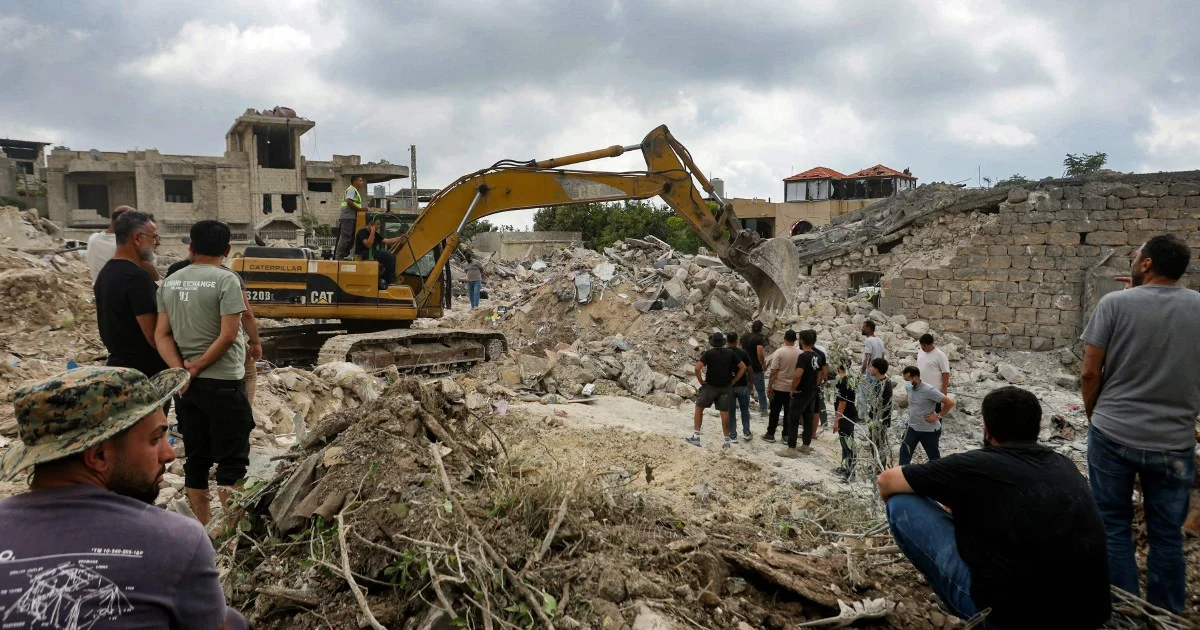
The escalating standoff between Israel and Hizbollah over Lebanon's southern territories has entered a critical phase, with the Lebanese militant group's leadership making an unequivocal statement against any form of Israeli military establishment on Lebanese soil. Naim Qassem, the prominent Hizbollah official, delivered the organization's formal rejection of what Israel terms a security zone in the country's south on Sunday, a move that underscores the deep mistrust and competing strategic visions between the two adversaries.
Prime Minister Benjamin Netanyahu's recent public assurance that Israeli forces would remain in southern Lebanon for an extended, open-ended period has provoked this sharp response from Hizbollah. Netanyahu's language—stating that troops would stay "as long as necessary"—suggests an operational posture unconstrained by specific timelines or predetermined withdrawal benchmarks. This rhetorical stance, coupled with visible military deployments, has galvanized resistance from Hizbollah, which views any prolonged Israeli military footprint as an infringement on Lebanese sovereignty and a strategic threat to the organization's influence across the border.
The dispute reflects deeper historical grievances between Israel and Hizbollah dating back decades. Israel has previously maintained buffer zones and military installations in Lebanese territory, most notably during its extended occupation from 1982 to 2000. For many Lebanese, including Hizbollah's constituency, the prospect of renewed Israeli military control over parts of southern Lebanon evokes memories of that earlier period. The mere invocation of a security zone therefore carries loaded symbolic weight, representing not merely a temporary military arrangement but potentially a step toward renewed territorial control by the Israeli state.
Hizbollah's categorical rejection of any Israeli security arrangement signals that the group intends to maintain its military and political influence in the southern region. The organization has been deeply embedded in Lebanese society, providing social services, running hospitals and schools, and maintaining armed capabilities that it justifies as essential for resistance against Israeli aggression. Any Israeli security zone would necessarily constrain Hizbollah's operational freedom and territorial claims, making compromise on this issue fundamentally incompatible with the group's core interests and ideological positioning.
The timing of these competing declarations reflects the volatile nature of Israeli-Lebanese relations and the broader regional security architecture. Recent years have witnessed periodic flare-ups along the Israel-Lebanon border, with cross-border artillery exchanges and aerial incursions creating cycles of escalation and tentative de-escalation. The current rhetoric from both Netanyahu and Hizbollah suggests that underlying tensions remain far from resolution, despite occasional periods of relative calm enforced by UN peacekeeping mechanisms and international diplomatic intervention.
From a regional perspective, this confrontation has implications extending well beyond the bilateral Israel-Hizbollah relationship. Lebanon itself, struggling with severe economic crisis, political dysfunction, and the burden of hosting approximately 800,000 Syrian refugees, has limited capacity to enforce territorial sovereignty or mediate between the two parties. The Lebanese government's weakness means that crucial national security decisions effectively devolve to powerful non-state actors like Hizbollah, which operates with significant autonomy from formal governmental structures.
International actors maintain varied interests in preventing escalation. The United States, which designates Hizbollah as a terrorist organization, typically supports Israeli security concerns while simultaneously encouraging restraint. France and other European nations have sought to preserve the UN Security Council Resolution 1701, which theoretically demarcates Lebanese-Israeli boundaries and calls for the presence of UN peacekeepers to maintain the buffer. These external actors recognize that a full-scale military conflict would destabilize the entire eastern Mediterranean region and potentially draw in broader geopolitical powers.
For Malaysian and Southeast Asian observers, this situation illuminates broader patterns of intractable regional conflicts where military occupation history, asymmetrical power dynamics, and competing national narratives create obstacles to peaceful resolution. The inability of formal international mechanisms—including UN peacekeeping operations and diplomatic frameworks—to forge lasting settlements offers cautionary lessons about conflict termination in zones of deep strategic competition.
Netanyahu's commitment to indefinite military presence amounts to a defiant assertion of Israeli strategic interests in Lebanese territory, a position unacceptable to Hizbollah's leadership. Qassem's formal rejection represents more than rhetorical posturing; it signals Hizbollah's determination to resist what it perceives as territorial encroachment and sovereign violation. The absence of compromise positions from either side suggests that this particular dimension of the Israeli-Lebanese dispute will remain a flashpoint for years to come, with the potential for periodic violent eruptions whenever one party perceives the other as consolidating territorial gains or military advantages.
%22%2F%3E%3C%2Fpattern%3E%3C%2Fdefs%3E%3Crect%20width%3D%22100%25%22%20height%3D%22100%25%22%20fill%3D%22url(%23ph168ptg)%22%2F%3E%3Crect%20width%3D%22100%25%22%20height%3D%22100%25%22%20fill%3D%22url(%23ph168ptp)%22%2F%3E%3Ctext%20x%3D%2250%25%22%20y%3D%2250%25%22%20text-anchor%3D%22middle%22%20dominant-baseline%3D%22central%22%20fill%3D%22rgba(255%2C255%2C255%2C0.95)%22%20font-family%3D%22Georgia%2C%20'Times%20New%20Roman'%2C%20serif%22%20font-weight%3D%22700%22%20font-size%3D%22320%22%20letter-spacing%3D%22-0.02em%22%3EMuda%3C%2Ftext%3E%3C%2Fsvg%3E)