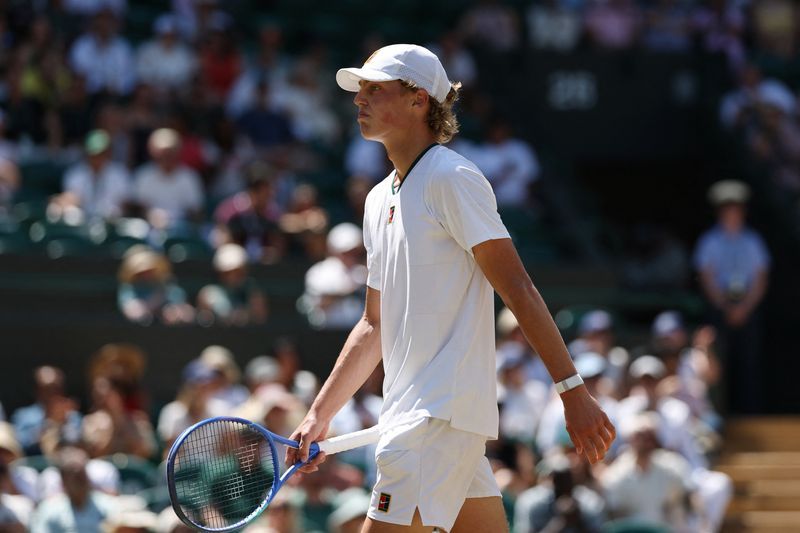
Cruz Hewitt, the teenage son of Australian tennis legend Lleyton Hewitt, has captured his maiden ATP Tour victory at the Washington Open, announcing himself on the professional circuit with a commanding 6-3 6-4 triumph over Marcos Giron in the opening round. The 17-year-old's success on Tuesday marks a watershed moment in his fledgling career and continues an extraordinary trajectory that has defined his competitive summer across the sport's most prestigious stages.
The younger Hewitt's breakthrough comes amid a season of remarkable achievements for the Australian prospect. Earlier this month, he finished as runner-up in the Wimbledon boys' singles final, falling short against American Jordan Lee in a match that carried profound symbolic weight given his father's legendary triumph on the same London lawns nearly a quarter century earlier. That near-victory at the sport's most storied tournament signalled that Cruz possessed the technical foundation and mental fortitude to compete against the world's finest junior talent. His conversion of that momentum into a professional-level win demonstrates a seamless transition upwards that few players achieve at such a young age.
Entering the Washington tournament as a qualifier ranked 612th globally, Cruz carried no expectations and minimal seeding advantage. Yet the ATP 500 event held special significance for the teenager, who had grown up watching his father compete in the American capital. Lleyton Hewitt captured the Washington title in 2004, leaving Cruz surrounded by paternal legacy and childhood memories as he navigated the tournament draw. Speaking after his opening victory, the youngster described the experience in almost dreamlike terms, acknowledging the emotional weight of following his father's footsteps in such proximity to where the former world number one had once succeeded.
Cruz's accomplishment carries particular historical weight within professional tennis. At 17 years and several months old, he became the youngest player to win a match at the Washington Open since Japan's Kei Nishikori achieved the feat in 2007. That distinction places him within an elite cohort of precocious talents who have proven capable of performing against mature professionals while still in their teenage years. The victory also marks him as the fourth man born in 2008 or later to claim an ATP-level win, joining Diego Dedura, Thijs Boogaard and Moise Kouame in a generation increasingly making its presence felt on the professional tour.
Navigating the pressure inherent in such high-stakes competition remains a critical developmental challenge for any emerging talent. Cruz's own reflections on his mental approach suggest a maturity beyond his years. He described the experience as encompassing both nerves and opportunity, emphasizing his determination to extract positive elements from the nervous energy rather than allow anxiety to compromise his performance. This psychological sophistication likely owes much to guidance from his father, who counselled his son to embrace the occasion, celebrate the crowd's energy, and break the contest into manageable increments rather than viewing the match as an insurmountable whole.
The influence of Lleyton Hewitt's counsel extends beyond general motivational philosophy. The former world number one's intimate familiarity with professional tennis mechanics and mental frameworks—accumulated across decades of elite competition—provides an invaluable resource for his son's development. Rather than relying on external coaching perspectives alone, Cruz has direct access to someone who has navigated identical challenges at the highest possible level. This paternal mentorship, combined with formal coaching support, creates a comprehensive development environment.
Cruz's next opponent will emerge from a clash between Greek star Stefanos Tsitsipas and fellow Australian Alex de Minaur, a pairing that carries fascinating implications for the teenager's trajectory. Should de Minaur prevail, Cruz would face a childhood friend and mentor figure with whom he has maintained a long-standing personal relationship. The younger Hewitt described de Minaur in almost familial terms, comparing their bond to that of brothers and referencing shared holidays and countless hours of accumulated advice. A professional matchup between the pair would blur the lines between personal affection and competitive necessity in compelling fashion.
The emergence of Cruz Hewitt carries broader significance for Australian tennis development. The country's pipeline of young talent has benefited from systematic grassroots development and domestic competition, yet producing players capable of immediate impact at professional level remains challenging. Cruz's early success suggests that the combination of genetic predisposition, elite coaching access, and deliberate practice can yield tangible results. His presence in Washington alongside de Minaur and other Australian professionals underscores the depth of emerging talent from the continent.
For regional observers in Southeast Asia and beyond, the Hewitt narrative embodies familiar themes of sporting inheritance and competitive excellence. While few young players enjoy such distinguished paternal legacies, the principles governing Cruz's development—emphasis on fundamentals, psychological resilience, mentor relationships with peers—offer instructive lessons for emerging competitors across the region. His relative maturity in handling pressure and his capacity to process complex emotions while competing suggest that elite performance requires emotional as much as technical sophistication.
Cruz's path forward inevitably invites comparisons to his father's journey, though the teenager himself appears sufficiently grounded to resist such expectations. His immediate focus centres on the Washington tournament's subsequent rounds and the accumulation of experience across professional environments. Each match at this level builds the competitive scar tissue and tactical vocabulary that distinguishes elite professionals from accomplished amateurs. The teenager's combination of pedigree, performance, and apparent psychological maturity suggests that Australian tennis has identified a talent genuinely capable of contributing meaningfully to the professional circuit.

