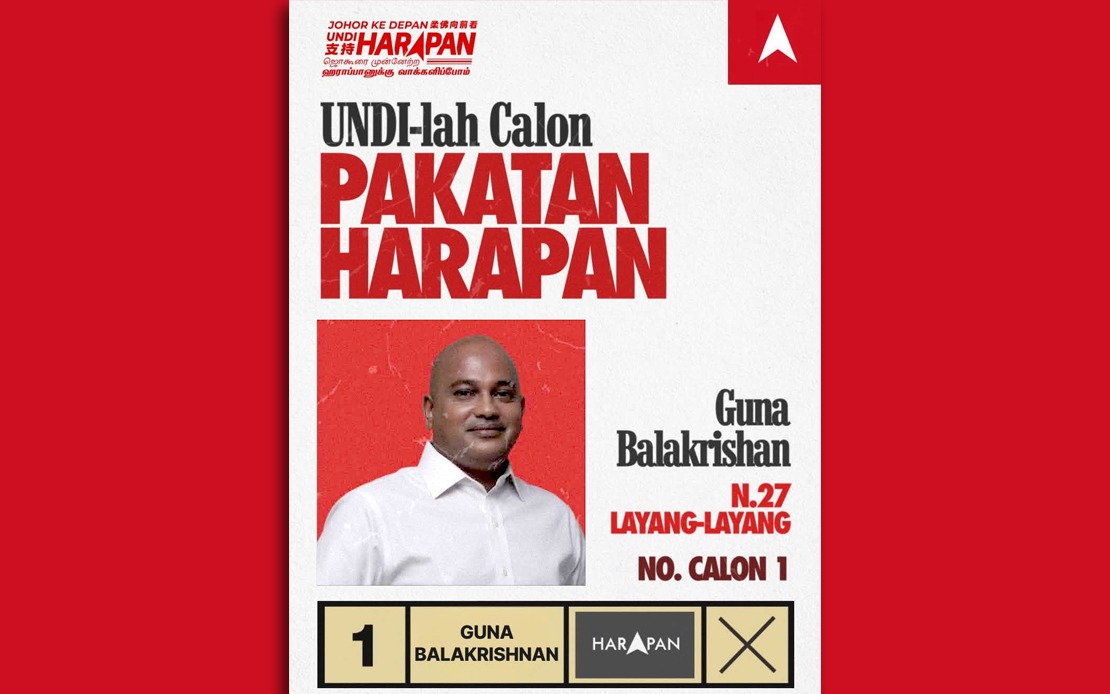
Pakatan Harapan candidate Guna Balakrishnan has unveiled a comprehensive six-point manifesto for the Layang-Layang state constituency, positioning himself as a representative committed to bridging community needs with government action. Addressing supporters in Kluang, Guna articulated his vision centred on inclusive development that extends benefits across all demographic groups within the constituency, reflecting an approach that acknowledges the diverse socioeconomic landscape of the Johor state seat.
Flood management emerges as a paramount concern within Guna's platform, responding to persistent inundation challenges that have plagued residential areas including Kampung Senda, Sungai Sayong, Kampung Tengah Renggam, Ulu Benut, Simpang Renggam, and Kampung Chokro. Rather than treating infrastructure as a singular issue, Guna frames flood mitigation within a broader development strategy encompassing drainage system upgrades and systematic road maintenance. This approach reflects growing recognition among opposition politicians that infrastructure resilience, particularly regarding climate-related risks, constitutes a fundamental governance responsibility. For Johor residents who have endured seasonal flooding disruptions, such commitments directly address tangible quality-of-life concerns that transcend typical electoral rhetoric.
Digital inclusion forms another pillar of the manifesto, with Guna advocating for expanded internet coverage in rural areas within Layang-Layang. This proposition carries particular relevance in Malaysia's context, where rural-urban digital divides continue limiting educational and entrepreneurial opportunities. By prioritising connectivity infrastructure alongside street lighting improvements, Guna signals understanding that public safety and digital access operate as interdependent factors shaping resident wellbeing and economic participation. The focus on rural digital infrastructure also aligns with broader Malaysian policy discussions around ensuring equitable access to the digital economy.
Economic empowerment constitutes a distinct component of the candidate's pitch, with specific attention to small-scale trading and Renggam's tourism development potential. Guna's proposal to leverage local tourism resources reflects pragmatic thinking about generating sustainable income streams beyond conventional employment channels. This economic dimension proves particularly pertinent for constituencies with significant informal sector activity, where state assemblymen can facilitate access to microfinance, skills training, and market linkages that directly impact household incomes.
Youth development receives dedicated attention through proposed expansion of Technical and Vocational Education and Training (TVET) programmes and establishment of an organised motorsports facility. The motorsports proposal, while appearing unconventional, addresses genuine concerns about youth engagement and talent channelling into structured environments. Within Malaysian political discourse, such concrete youth-focused initiatives distinguish candidate platforms by demonstrating engagement with demographic concerns beyond generic employment promises.
Women's entrepreneurship and senior citizen welfare also feature prominently in Guna's manifesto. Proposals to strengthen women business participation and establish a Senior Citizens Activity Centre (PAWE) reflect demographic realities within many Malaysian constituencies where female-headed households and ageing populations require specific policy attention. These pledges move beyond symbolic representation to propose institutional mechanisms—activity centres and entrepreneurship support frameworks—that translate commitments into tangible services.
Guna positions himself as an intermediary between constituents and government apparatus, emphasising the state assemblyman's role as a conduit for community concerns. This characterisation carries significance within Malaysia's federal system, where state legislators hold considerable capacity to influence local implementation of national policies and allocate state development funds. The candidate's explicit commitment to close government-community cooperation suggests recognition that effective representation requires sustained engagement rather than episodic election-period contact.
The Layang-Layang contest unfolds within a three-way contest featuring Guna against Barisan Nasional's Chua Jian Boon and Perikatan Nasional incumbent Abd Mutalip Abd Rahim. The 25,181 registered voters in this constituency represent a significant electoral pool by Johor state standards, making the seat genuinely competitive rather than predetermined. This three-cornered dynamic underscores the fragmented opposition landscape in contemporary Malaysian politics, where PH, Barisan Nasional, and Perikatan Nasional vie for urban and semi-rural constituencies simultaneously.
Guna's framing of manifesto pledges as realistic commitments rather than abstract promises addresses voter scepticism that has characterised Malaysian electoral discourse following multiple instances of unfulfilled campaign promises. By emphasising concrete mechanisms—flood mitigation project implementation timelines, specific facility establishment, measurable infrastructure upgrades—the candidate attempts to distinguish substantive policy proposals from rhetorical flourishes. This approach reflects evolving voter expectations that political candidates substantiate claims through detailed implementation frameworks.
The Johor state election scheduled for July 11, with early voting on July 7, occurs amid broader Malaysian political realignment. Johor's electoral dynamics carry particular significance given the state's economic weight and historical Barisan Nasional dominance. PH's efforts to capture constituencies like Layang-Layang represent strategic attempts to expand opposition presence within significant state governments, a priority given limitations on federal parliamentary gains. For Malaysian observers, Johor's electoral outcomes will illuminate current voter sentiment regarding governance performance, opposition credibility, and viability of electoral coalitions across peninsular Malaysia's largest economy.

